

Audio By Carbonatix
The National Commission for Civic Education (NCCE) has proposed the creation of a Democracy Fund to finance the internal activities of political parties, arguing that inadequate funding is one of the major factors driving vote buying in Ghana's electoral process.
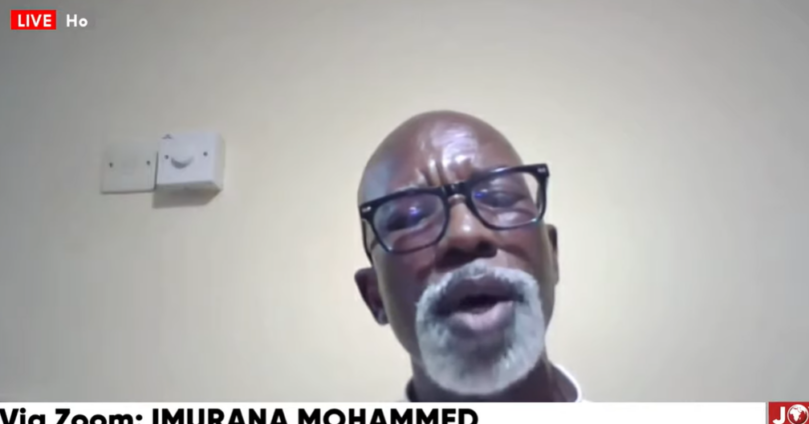
Speaking at JoyNews' "Democracy Is Not For Sale" forum, organised by the JoyNews Impact Makers Foundation, the NCCE's Programme Director, Dr Imurana Mohammed, said reforms aimed at tackling vote buying must address the financial challenges confronting political parties.
"For me, these are very critical issues that when we talk about vote buying and voter inducement, that we should be talking about," he said.
Dr Mohammed noted that the government had accepted several recommendations of the Constitutional Review Committee in its White Paper, including the proposal to establish a Democracy Fund.
According to him, while state institutions involved in governance receive public funding, political parties are expected to carry out their democratic functions without similar financial support.
"To speak for the political parties, you have an elaborate arrangement for our democracy. Every institution draws from the government. The executive draws from government. The legislature draws from government. The institutions that manage elections draw from government. But the political parties don't draw money from government to conduct their internal activities. And I think that is a big gap," he said.
He argued that the absence of state support forces political parties to depend on wealthy individuals and interest groups, creating an environment where money increasingly influences internal elections and candidate selection.
Dr Mohammed also called for stronger internal democracy within political parties, saying they must uphold democratic principles in the way they elect parliamentary and presidential candidates.
"The political parties believe in democracy. They thought that they believe in democracy. But when it comes to their entire arrangement for electing their candidates both for the presidential and parliamentary elections, they seem to compromise democratic tenets," he observed.
His remarks come days after the Supreme Court declared political parties' delegate-based electoral college systems unconstitutional, ruling that restricting voting in party primaries to a limited number of delegates violates Article 55(5) of the 1992 Constitution.
The court directed political parties to adopt a "one member, one vote" system within one year.
Dr Mohammed further questioned the fairness of requiring political parties to submit audited accounts to the Electoral Commission when they receive no direct state funding.
"If you say for example the political party should submit their audited accounts to the Electoral Commission. On what basis are you going to say that? Because the Electoral Commission doesn't give them money to conduct their affairs. The state doesn't give them money to conduct their affairs. So if you don't give them money to conduct their affairs, how then do you go and ask them for their audited accounts?" he asked.
He maintained that a Democracy Fund would not only improve the financing of political parties but also strengthen transparency, accountability and public confidence in Ghana's democratic process.
The proposal forms part of wider constitutional reform discussions, with governance institutions and civil society organisations continuing to advocate the implementation of key recommendations aimed at deepening Ghana's democracy and reducing the influence of money in politics.
Latest Stories
-
Nigeria set to launch National Digital Address System 9 years after Ghana showed the way
4 minutes -
Policy rate decision takes time to reflect in lower lending rates – BoG
14 minutes -
Western Regional Minister applauds Karpowership’s role in Ghana’s power sector
39 minutes -
Livestream: Road safety crises: Where are we getting it wrong?
41 minutes -
Enterprise Life celebrates 25 years of protecting families and building trust
49 minutes -
ICC London rules in favor of Ghana against Tullow over $400m tax charge
59 minutes -
We are disappointed in ICC’s ruling over our corporate income tax assessment in Ghana – Tullow Oil
1 hour -
Cost of building inflation for August 2026 increases to 4.6% – GSS
1 hour -
Today’s front pages: Wednesday, September 30, 2026
2 hours -
Bawumia highlights agricultural, compulsory insurance reforms in IBAG engagement
2 hours -
Ghana will secure Tullow tax revenues while protecting Jubilee, TEN investments – Ato Forson
2 hours -
Ghana wins $393m Tullow tax arbitration as tribunal upholds GRA assessment
2 hours -
Gender Minister assures women’s group of action on Affirmative Action, Development Bank
3 hours -
Over 2,000 teachers in Dormaa comply with strike – GNAT Secretary
3 hours -
Food Buffer Stock seeks stronger liquidity buffer despite record profit
3 hours