

Audio By Carbonatix
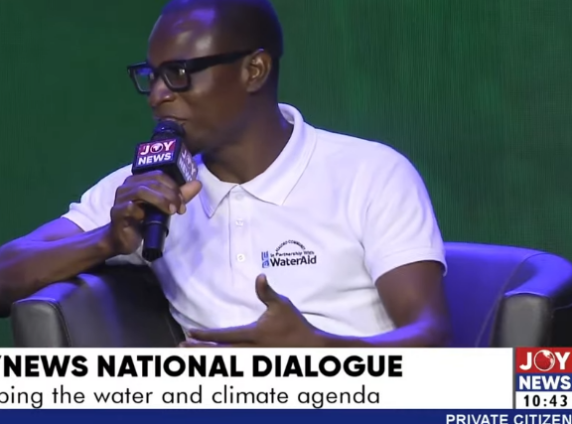
Youth Climate Advocate Jerry Anaba Nyaaba has said climate change is worsening water scarcity in northern Ghana, with communities in the Upper East and Upper West regions increasingly struggling to access water for domestic use, schools and healthcare facilities.
Speaking at the WaterAid and JoyNews National Dialogue on Wednesday, August 12, Mr Nyaaba said the impact of climate change was becoming increasingly evident in the northern parts of the country, where declining groundwater availability was making it difficult for communities to rely on traditional sources such as wells.
He noted that in some areas of the Upper East Region, wells that previously provided water were now failing to yield water even after being dug.
“Sometimes when you dig a well this time, you don't get water. That is telling you something,” he said.
According to him, the situation could become more severe in the coming years if urgent measures are not taken to improve water security and build communities' resilience to climate change.
He warned that without intervention, communities could be forced to depend on water transported from other areas to replenish depleted water sources.
“This is a very terrible thing. Water scarcity for schools, for health centres, and even for households has become a major problem for the northern communities,” Mr Nyaaba said.
He said residents in some communities had to walk several kilometres to access potable water, sometimes spending hours fetching water for basic domestic needs.
The situation, he noted, was also affecting education, particularly during the dry season.
Mr Nyaaba said students in some senior high schools spend considerable time searching for water instead of preparing for classes.
“When you go to most of the senior high schools, from January to somewhere June, students spend much time searching for what to grab before going to class than the time they spend learning,” he said.
He added that water shortages were equally affecting health facilities and placing a disproportionate burden on women, who often bear responsibility for fetching water for households and institutions.
“Women suffer the most,” he stressed, describing the situation as a current reality rather than a distant threat.
Mr Nyaaba is therefore calling for urgent investments in climate-resilient water systems and infrastructure in northern Ghana.
He said the country must increase the number of dams and other water storage facilities in the north to help communities cope with prolonged dry periods.
“We need climate-resilient water. We need more dams in the north,” he said.
He also urged authorities to take advantage of the rainy season to harvest and store water for use during periods of scarcity.
“This is the time we have enough water. Can we start harvesting rainwater and be using it in the garden?” he asked.
Mr Nyaaba said the situation required coordinated action from government, development partners, communities and other duty bearers to prevent water scarcity from worsening.
He warned that failure to address the problem could have serious consequences for the future development and wellbeing of people in northern Ghana.
Latest Stories
-
Ablakwa: Ghana’s Embassies, High Commissions to support World Assemblies of God Congress
4 minutes -
Joyce Bawah Mogtari cites infrastructure, healthcare reforms as evidence of Mahama’s development agenda
6 minutes -
Ghana had no single gadget to detect narcotics when we took office – Muntaka
12 minutes -
GES to consult stakeholders on academic calendar adjustments
19 minutes -
Mahama reaffirms commitment to equitable development across Ghana
20 minutes -
Youth employment must remain central to Ghana’s economic reset – Joyce Bawah Mogtari
22 minutes -
Ethnic conflicts, land disputes and illicit drugs remain major security concerns – Muntaka
27 minutes -
Mahama Ayariga visits Kumasi Central Market fire scene to assess damage
31 minutes -
Ghana has 48 legitimate entry points but over 300 illegal crossing points – Interior Minister
45 minutes -
Ghana is much safer now than in 2025 – Muntaka
1 hour -
Bawku has gone 150 days without gunfire – Interior Minister
1 hour -
It still surprises me GAUA is on strike after signing MoU – Fair Wages CEO
1 hour -
Kumasi Hospital removes 880-gram bladder stone in rare surgical case
2 hours -
Ghana lacks sufficient power generation redundancy – Energy Minister
2 hours -
CPA assures consumers of safety of registered sanitary towels on the Ghanaian market after complaints
2 hours