

Audio By Carbonatix
As misinformation spreads rapidly across digital platforms and public trust in the media faces growing challenges, journalism students are being urged to develop the skills, courage and ethical standards needed to hold power to account.
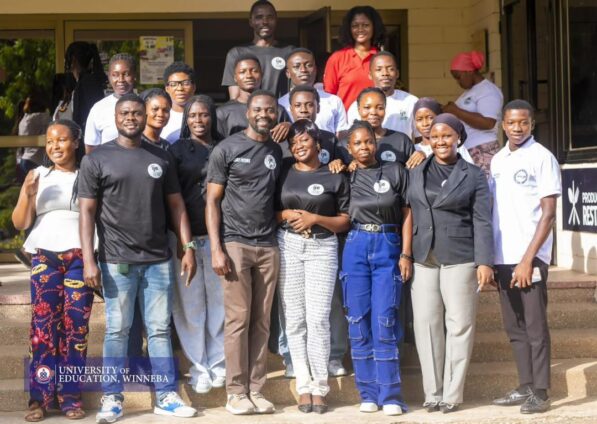
This was the focus of a workshop organised by the Investigative Journalism Club, University of Education, Winneba (UEW) Chapter, on June 16, 2026, under the theme “Practical Investigative Techniques and Strategies to Resist Media Capture.”
The workshop, sponsored by Betty Dufie Owusu of the Africa Centre for Energy Policy (ACEP), brought together aspiring journalists and experienced media professionals to discuss investigative reporting, misinformation, media ethics and the responsibilities of journalists in protecting the public interest.
Among the key speakers was award-winning investigative journalist Manasseh Azure Awuni, whose work has influenced a generation of young journalists in Ghana.
Building the next generation of investigative journalists
According to Awuni, the investigative journalism club initiative was established in 2023 with support from ACEP to help groom the next generation of investigative journalists.
He described the UEW chapter as one of the outstanding clubs under the initiative, pointing to its organisation, regular meetings, branding and continued engagement as signs of its commitment to developing investigative skills.
He also acknowledged the contribution of Prof. Gifty Appiah-Adjei to keeping the club active and sustaining its activities.
For students, the recognition demonstrated the importance of creating platforms where aspiring journalists can develop practical skills before entering the professional newsroom.
Understanding investigative journalism
Awuni told participants that investigative journalism goes beyond breaking news or reporting scandals. He described it as a systematic process of uncovering information that is hidden from the public and is in the public interest.
He encouraged students to develop curiosity, read widely and ask questions rather than simply reporting information that is readily available.
He also cautioned against entrapment and other shortcuts that could undermine the credibility and ethical standards of an investigation.
According to him, journalists must be transparent in their methods, verify information and cross-check facts before publication.
Courage, competence and character
Awuni identified courage, competence and character as essential qualities for investigative journalists.
He explained that courage enables journalists to pursue difficult stories, including those involving powerful individuals and institutions. Competence allows journalists to research, analyse information and present accurate stories, while character helps them remain ethical and principled when faced with pressure.
He further stressed that credibility is among a journalist's most valuable assets and should not be sacrificed for speed or sensationalism.
Tackling misinformation
Misinformation in the digital age was another major focus of the workshop.
Evans Aziamor Mensah urged journalists not to reproduce information simply because it is trending on social media. He stressed the need for journalists to investigate, verify and provide context before publishing information.
Awuni also introduced participants to different forms of misinformation, including false connection, misleading content, satire and parody, imposter content and fabricated content.
The discussion reinforced the importance of fact-checking and source verification, particularly at a time when unverified information can reach thousands of people within minutes.
Awuni also addressed defamation and encouraged students to understand the legal principles surrounding their work. He reminded them that claims made against individuals or institutions must be supported by credible evidence.
Bridging the classroom and the newsroom
Beyond the technical lessons, the workshop provided students with an opportunity to interact directly with a journalist whose investigative work they had followed.
Students asked questions, shared experiences and gained insight into the realities of professional journalism. The interaction helped bridge the gap between classroom learning and the demands of the newsroom.
The workshop also encouraged participants to view investigative journalism not merely as a career but as a public service that can expose corruption, institutional failures and abuses of power.
At the end of the programme, students received books and learning materials, including The Voice of Conscience, A Letter to My Future Wife and an investigative journalism manual.
The materials are expected to provide students with additional resources to strengthen their understanding of investigative journalism and professional practice.
Preparing journalists to defend the truth
The executives of the UEW Investigative Journalism Club expressed appreciation to their patron, Dr. Rainbow Sackey, for his guidance and support towards the club's activities and the organisation of the workshop.
For the club, the programme was more than an academic exercise. It provided professional exposure, mentorship and an opportunity for students to learn directly from experienced practitioners.
As the club continues its activities, the lessons from the workshop are expected to strengthen its efforts to develop journalists who are courageous, competent and committed to ethical reporting.
In an environment where misinformation can travel faster than verified information, the need for journalists who can question, investigate and verify facts remains critical.
The training of watchdog journalists, therefore, does not end when a workshop closes. It continues every time a journalist asks a difficult question, verifies a claim, challenges an abuse of power and chooses truth over convenience.
Source: University of Education, Winneba website (photographs).
Latest Stories
-
Challenging Heights welcomes Ghana’s Tier 1 ranking, calls for more anti-trafficking funding
7 minutes -
Cedi extends depreciation against dollar; going for GH¢12.10 at forex bureaus
9 minutes -
ECG cannot keep lending electricity for free
11 minutes -
No trader will be evicted from Aboabo Market after redevelopment – Mahama Ayariga assures traders
19 minutes -
GAUA to communicate decision on strike suspension after Tuesday
23 minutes -
Moody’s upgrades Ghana’s credit ratings to B3, but changes outlook to stable
29 minutes -
‘I want to raise well-rounded individuals, not just men’ – Kate Addo on parenting boys
33 minutes -
Yaa Konadu Agyeman’s ‘Exceptionally Yours’ is the perfect romance read for the holiday season
42 minutes -
‘You have to man up’ – Kobby Kyei on the hidden cost of silence for Ghana’s boys
46 minutes -
DVLA extends regional office hours to 10pm under 24-Hour Economy
50 minutes -
‘Ghanaians are becoming like Kweku Ananse’ – Agyinasare warns against culture of lies
51 minutes -
‘The nation failed us’ – Okada Riders’ PRO defends young riders caught between survival and the law
52 minutes -
DVLA plans demerit point system, real-time monitoring of testing stations
53 minutes -
Health Committee Chair lauds NHIA’s swift disbursement of insurance claims
53 minutes -
Okada Association says it’s preparing training centre as gov’t works on new regulations
54 minutes