

Audio By Carbonatix
Vice President and Chair of the Public Accountability Committee of the Ghana Institution of Engineering (GhIE), Ing Dr Patrick Amoah Bekoe, has urged the government to pay greater attention to health infrastructure at the lower tier of the healthcare system to improve access to quality healthcare.
He said the country’s health infrastructure remains poor, with weaknesses at the primary level leaving many people, particularly those in rural communities, without reliable access to essential healthcare services.
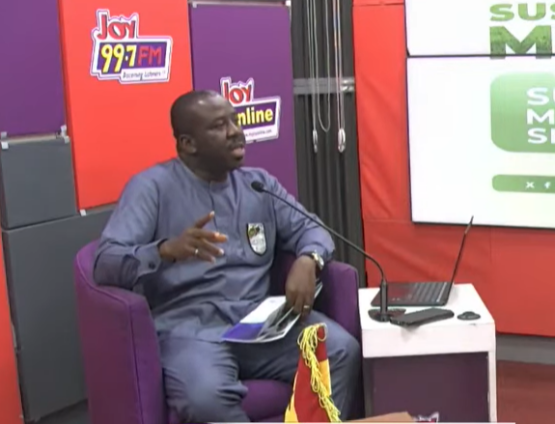
Speaking on the Joy FM Super Morning Show on Thursday, August 13, as part of Joy Sustainability Month, Ing Dr Amoah Bekoe said the situation was reflected in Ghana’s ambulance-to-population ratio.
He said the Ghana Infrastructure Scorecard research conducted by the GhIE showed that one ambulance was serving about 84,000 people.
“So what our research showed was that our ambulance-to-population ratio, we're talking about 1 to 84,000, which basically one ambulance is serving 84,000,” he said.
According to him, the country must rethink its approach to ambulance infrastructure, particularly amid concerns over the condition and functionality of some of the ambulances procured by the state.
“There has been so much noise about ambulances, and I believe recently you heard the fact that even those that we procured are not functioning very well. So we need to rethink in terms of the ambulance infrastructure. We need to rethink and do things differently,” he said.
Ing Dr Amoah Bekoe also raised concerns about Ghana’s doctor-to-patient ratio, saying it remained below the World Health Organisation (WHO) standard.
“Our doctor-to-patient ratio is far below the WHO standard, and so we also need to look at even the personnel. For us, we also see that as part of the infrastructure in a way in the health sector,” he said.
However, he said that the government’s immediate focus should be on strengthening health facilities at the lower tier because these facilities serve as the first point of care for a large proportion of the population.
“But what for us we believe is that the government should pay significant attention to the health infrastructure within the lower tier,” he said.
He explained that many people, especially those living in rural communities, might never have the opportunity to access major referral hospitals such as Korle Bu Teaching Hospital or Ridge Hospital in Accra.
“Those are the primary assets to help most people. There are a lot of people in your village, in my village, who may not ever come to Korle Bu or Ridge,” he said.
He added that even some facilities at the higher levels of the health system faced infrastructure challenges.
“For us, we are asking the government to look at the health infrastructure because it came in as E1. That's poor. But it also has the ability to at least go to fair, if we do the right things,” he said.
The engineer said the poor state of health infrastructure had direct consequences for ordinary Ghanaians, particularly people who become sick or are involved in accidents in areas where quality medical care is not readily available.
“It means that, to the simple person, when you are sick, when you get an accident, depending on where you find yourself, you may not get good health care. Basically that's what it is,” he said.
He said the consequences went beyond the visible costs of running the healthcare system, saying that inefficiencies could result in deaths, long-term disabilities and other social and economic losses.
“That's why I talk about the hidden costs, that there are a lot of people dying or incapacitated because of the inefficiencies within the system,” he said.
When asked whether Ghana’s infrastructure challenges were mainly caused by a lack of funding or poor management of available resources, Ing Dr Amoah Bekoe said both factors played a role.
However, he said the more pressing issue was how the available funds were prioritised and managed.
“Well, I will say both, but if you push me, I will end up saying how money is managed,” he said.
He acknowledged that successive governments had faced financial constraints and that there was unlikely to be a time when the Finance Ministry could say the country had enough money to fund every infrastructure project it needed.
“Since I was born, even from Kwesi Botchwey's time, we always say that there's not enough money, so I don't believe the Minister of Finance will ever say that we have enough money to fund all our projects,” he said.
“But the little that we have, how are we managing that? And so that's why I'm saying, with the little that we have, are we prudently using the money? Well, the results tell us no.”
Ing Dr Amoah Bekoe said that Ghana’s infrastructure challenges were also linked to a culture of allowing existing public assets to deteriorate before replacing them with new ones.
He agreed with the observation that the country often appeared more interested in constructing new roads than maintaining those already in place.
He said the same approach could be seen in other sectors, including sports infrastructure.
“And not only roads. We're going to expand this to sports infrastructure; we're going to go to other places, and you see that even on our stadiums, in most of our stadiums, we have left them to deteriorate, waiting that in maybe 10 years' time, they will be unusable, and then we'll construct new ones. That's our character,” he said.
He called for a deliberate shift towards preserving existing public assets, saying maintenance offered a more sustainable way of managing limited public resources.
“But if efficiently, we can apportion the little we have, and prioritise asset preservation, and I use asset preservation, very key for the country's development,” he said.
According to him, the GhIE has recommended the establishment of a council that would help ensure ministries, departments and agencies consistently prioritise maintenance when planning and implementing infrastructure projects.
“And that's why in our recommendation, we said that we need a council that will keep all the ministries and agencies in line, so that in everything that we do, we prioritise maintenance,” he said.
He said that such an approach would be critical to ensuring that public infrastructure remains useful for future generations.
“That is more sustainable. Sustainable for the future,” he said.
“We should leave our assets for your children's children, not built within two or three years, then they collapse.”
Joy Sustainability Month is proudly sponsored by MTN and MoMo.
Latest Stories
-
GoldBod must be more accountable to Ghanaians – Haruna Iddrisu
9 seconds -
Affi Agbenyo’s EC appointment is constitutionally appropriate, but politically, people have the right to remind us – Haruna Iddrisu
12 minutes -
Education is critical to Ghana’s future and development – Haruna Iddrisu
30 minutes -
Who’s Emelia Affi Agbenyo, the 43-year-old newly sworn-in Deputy EC Chair?
1 hour -
Haruna Iddrisu calls for limits on annual university accommodation fee increases
2 hours -
Today’s front pages: Tuesday, October 13, 2026
2 hours -
Wealth Over Water: How Galamsey Is Threatening Ghana’s Water Security
3 hours -
LA 2028: Black Queens pumped up for second leg of Mauritius tie
3 hours -
LA 2028: Black Queens hold final training session ahead of second leg against Mauritius
4 hours -
Standards are not Seasonal: What the EC appointments teach both sides
4 hours -
King Mohammed VI urges private sector to create youth jobs and spread benefits of growth
4 hours -
KGL U17 Colts 2026: Greater Accra win title after penalties win over Western Region
4 hours -
UK Investment Roadshow opens in London to advance UK-Ghana growth partnership
4 hours -
Assemblies of God requires pastors to resign before entering partisan politics – Rev. Wengam
4 hours -
Ghana targets 20% annual reduction in maternal deaths – Health Minister
4 hours