

Audio By Carbonatix
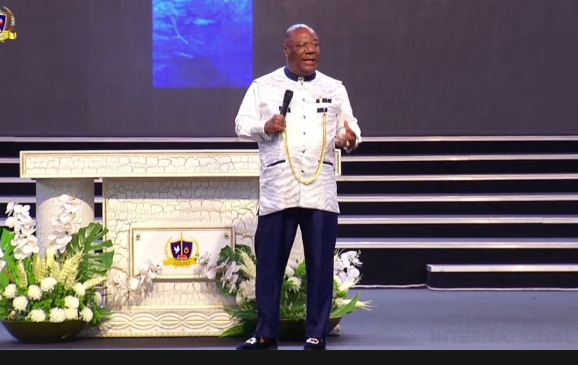
The General Overseer of Action Chapel International, Archbishop Nicholas Duncan-Williams, has raised alarm over what he described as attempts by powerful interests to find new channels into Ghana’s gold trade.
According to him, political interference and the continued destruction caused by illegal mining could jeopardise the future of the country.
Addressing congregants on Sunday, Archbishop Duncan-Williams called for prayers for the Ghana Gold Board (GoldBod), saying information he had received from a sheikh, as well as conversations he had held, had left him deeply concerned about the pressures facing the institution.
“I feel very strongly that we need to pray for the Gold Board,” the Archbishop said.
He claimed that some individuals who could no longer obtain gold illegally as easily as they had in the past were now seeking ways to access the formal gold-trading system.
“With what I was told by this sheikh and the calls I had, they can't get the gold like before illegally, so they want some channels to the Gold Board so they can purchase the gold now from the Gold Board,” he said.
The Archbishop said he believed GoldBod was confronting a highly organised and influential network.
“It's clear to me that the Gold Board is dealing with a very powerful movement,” he said.
He described those behind the alleged interests as “very, very established” people who understand the gold business and know how to operate within the sector.
According to him, the concern was not simply about gold trading but about whether powerful actors were prepared to allow Ghana's efforts to regulate its mineral resources to succeed.
“People very, very established who know and understand the field and how to do this and don't want the right thing to be done,” he said.
“And in the name of politics, we are destroying the future of our children and our grandchildren,” he warned.
He said he was sufficiently concerned about developments in the country that he intended to devote considerable time to prayer and intercession.
“I am not speaking as a prophet,” he said. “As much as some may be prophetic, I am speaking as a student of prophecy and a student of history.”
The Archbishop expressed particular concern about the state of Ghana's water bodies and agricultural land, arguing that the environmental consequences of illegal mining could eventually threaten the country's ability to feed itself.
“I take time to study history a lot, and some things are bothering me,” he said.
“One of them is how we are managing the future of our children and our grandchildren when it comes to our water bodies, when it comes to the land that produces crops and the food we eat.”
“We are poisoning the land,” he added.
Despite such measures, Archbishop Duncan-Williams questioned whether Ghana's laws were being enforced effectively.
“For whatever reason it looks like the rules and the laws are not working because if anybody tries to make it work and enforce the law, we turn everything to politics,” he said.
He suggested that elected officials could be reluctant to enforce unpopular measures because of concerns about electoral consequences.
“And if you don't do what I want, next time I won't vote for you,” he said.
According to the Archbishop, such political pressures could ultimately encourage politicians to prioritise their electoral interests over the enforcement of laws.
“And so, because people don't want to lose their seat in Parliament, or they don't want their party to lose, they give in and allow lawlessness to continue,” he said.
He repeatedly framed the issue as one of intergenerational responsibility, warning that the country's current approach to natural resources could leave future generations with polluted water, degraded farmland and fewer economic opportunities.
“If you look at the way we are running our society as a country, a nation, the future is in trouble,” he said.
The Archbishop subsequently urged his congregation to spend time praying for Ghana, describing the issue as sufficiently serious to warrant national intercession.
For him, the fight against illegal mining is also a fight over the country's future — its rivers, farmland, food supply, institutions and the ability of future generations to inherit a healthy and prosperous nation.
He urged his congregation to intercede for Ghana and to look beyond immediate political interests.
“We are destroying the future of our children and our grandchildren,” he said.
Latest Stories
-
Duncan-Williams warns of powerful interests targeting GoldBod
11 minutes -
We need to pray for GoldBod – Duncan-Williams
31 minutes -
Strong favourites or tougher task – will Arsenal defend their title?
1 hour -
Passengers escape death as VIP travelling from Kumasi to Sunyani catches fire
1 hour -
Ariana Grande leaves problems at home as her tour hits the UK
1 hour -
Multiple suspects at large after five shot at Virginia State University, police say
1 hour -
Three killed as Russia launches fresh aerial attacks across Ukraine
2 hours -
Boxing: John Laryea disqualified in WBA Featherweight title eliminator
2 hours -
Hawaii battles strong winds and rain as Hurricane Lala threat looms
2 hours -
Twelve killed as Polish bus veers off Hungarian motorway
3 hours -
Building Ghana better: Why architects must be at the heart of national development
5 hours -
GMet warns of severe rainstorm across northern Ghana
6 hours -
Semenyo eyes bigger targets after breaking Yeboah’s Ghanaian Premier League record
6 hours -
Health Ministry reviews NDC manifesto commitments
7 hours -
Mfantsipim School @ 150 and Creech’s Mfantsipim Diaries: My First Shock
8 hours