

Audio By Carbonatix
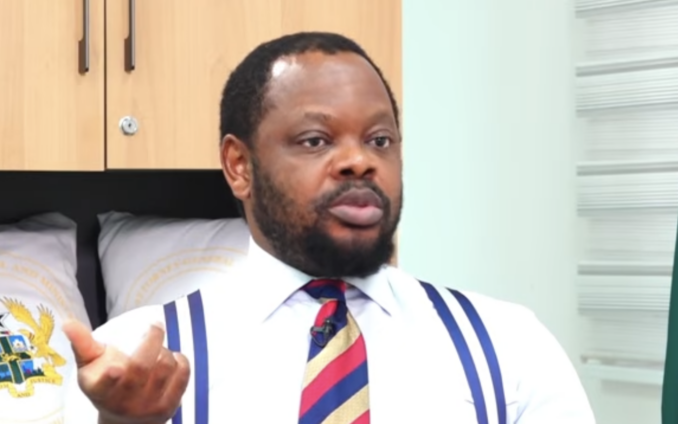
Deputy Attorney General Dr Justice Srem-Sai has defended the government’s push for speedy trials, insisting that the governing NDC's position is consistent with the constitutional requirement that accused persons have their cases determined without undue delay.
He said there was nothing wrong with the NDC's political interests coinciding with a constitutional obligation to ensure speedy trials.
Speaking on Joy News’ PM Express, Justice Srem-Sai rejected claims that the government was seeking to manipulate the legal vacation to secure favourable outcomes in cases involving former government officials.
“There are two answers to that. Two things can coincide. Okay. So, the interest of my political party, the NDC, can be equal to the interest of the constitution, and in this case, I’ve demonstrated that the constitution mandates that we have a speedy trial. So, the NDC’s interest in this case seems to align with the constitutional demand, so there’s nothing wrong about that,” he said.
His comments come amid a controversy over the conduct of trials during the legal vacation, with concerns raised about whether superior courts should conduct substantive trials during the period.
Justice Srem-Sai said the interpretation that vacation judges cannot conduct trials was impractical because a judge assigned to a vacation court also has cases in his or her substantive court.
He explained that the Chief Justice may attach cases from other courts to a vacation court, particularly urgent matters. However, the judge can continue hearing the merits of cases in their own court.
“If you apply the GBA interpretation, what it means is that this judge will not be able to hear any case until January next year, because when the others come, he goes on vacation, and another judge cannot hear his cases. So, it’s bizarre,” he said.
He also disputed claims that trials during the legal vacation are unprecedented.
“There is ample evidence even from the media. Journalists have been able to pull out several cases, instances where courts have conducted trials, superior courts have conducted trials during the legal vacation,” he said.
He cited the Takoradi Girls case as one example, saying it was conducted during the legal vacation despite protests from defence counsel.
Justice Srem-Sai further rejected the argument that lawyers must agree before a trial can proceed during the vacation.
“What it means is that now lawyers are deciding how cases should be conducted, which is never the essence of establishing a judiciary,” he said.
He argued that lawyers could have competing interests over the pace of proceedings, making judicial oversight necessary.
“For every case, one party wants it fast, while the other wants it slow, because the interests of lawyers never merge. That is why we need a judge to balance the interests and give us where justice will be,” he said.
Justice Srem-Sai acknowledged that defence lawyers could have legitimate reasons for wanting proceedings to move slowly, particularly because evidence and witness memories can deteriorate with time.
But he insisted the Constitution requires speedy trials.
“I want it fast, and I want it fast because the law, the Constitution, demands that we conduct trials fast, quickly, speedily. It’s a constitutional provision,” he said.
He pointed specifically to Article 19(1), which he said guarantees every accused person a fair and speedy trial.
He also rejected the allegation that speeding up proceedings amounts to perverting the course of justice.
“That is exactly where we need the evidence. Because if you say by being fast, being fast alone doesn’t mean that you are perverting the course of justice,” he said.
He maintained that the practice of assigning vacation judges was not a new development.
“Whatever the Chief Justice has done, at least the evidence shows that it is the standard practice for decades, for so many years, in this country that during vacation judges sit, vacation courts are appointed,” he said.
Justice Srem-Sai also challenged suggestions that only politically sensitive cases were being pursued during the legal vacation.
“There are cases, oral cases before some judges who are not vacation judges; those cases are not moving because the judges in those cases are on vacation,” he said.
He added that if the process was being manipulated, other cases, including SSNIT-related cases, would not also be proceeding during the vacation.
Latest Stories
-
Namibia, Ghana eye strategic bilateral cooperation in Volta Region
11 minutes -
Jasikan midwives deliver baby at roadside
20 minutes -
Police arrest 14 suspected narcotic plant farmers at Daliga
30 minutes -
Call off strike, give us one month to resolve payment issues – Education Minister appeals to GAUA
2 hours -
Cagliari’s Trepy in intensive care after pool incident
2 hours -
Chelsea co-owners Boehly & Walter explore selling stakes
2 hours -
GAUA to consult members after talks with Haruna Iddrisu as strike continues
2 hours -
Man Utd will reject any bid for Fernandes
3 hours -
Guardiola-Walker fallout revealed in new documentary
3 hours -
NDC’s interest aligns with the Constitution – Srem-Sai defends push for speedy trials
3 hours -
Man City move for £85m Bouaddi and still want Fernandez
3 hours -
Rodri lands in Barcelona to complete ‘dream’ move
3 hours -
Being fast doesn’t mean perverting justice – Srem-Sai challenges critics to prove manipulation
3 hours -
Lawyers can’t decide how cases run – Srem-Sai fires back in vacation court row
4 hours -
Aksa case should ordinarily be handled by OSP, not EOCO – Manhyia South MP
4 hours