

Audio By Carbonatix
The government has outlined a five-pillar economic strategy aimed at protecting Ghana’s recent economic gains and building a stronger, more productive and resilient economy capable of withstanding future shocks.
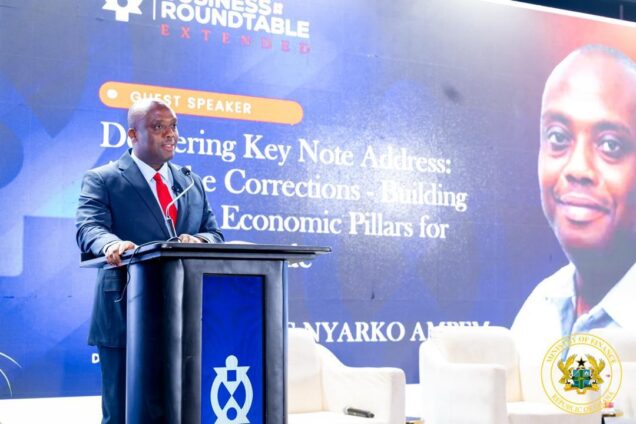
The Deputy Minister for Finance, Thomas Nyarko Ampem announced the strategy on Wednesday, September 2, 2026, when he delivered the keynote address on behalf of Finance Minister, Dr Cassiel Ato Forson at the Business Roundtable Extended 2026 Executive Dialogue in Accra.
The dialogue was held on the theme: “After the Corrections: Building Resilient Economic Pillars for the Next Decade.”
The five pillars identified by the Deputy Minister are stronger economic buffers, a productive economy, a private sector that can invest, institutions stronger than the political cycle, and growth that Ghanaians can feel.
Mr. Ampem said the strategy was necessary because while Ghana had made significant progress in restoring macroeconomic stability, the country must now ensure that those gains were sustained.
He cited real GDP growth of 6.0 per cent in 2025 and 6.4 per cent year-on-year in the first quarter of 2026, while inflation had declined from 23.8 per cent in December 2024 to 4.6 per cent in July 2026.
He also said gross international reserves had reached about US$12.9 billion at the end of June, providing five months of import cover, while Ghana’s risk of external and overall debt distress had moved from high to moderate.
However, Mr. Ampem cautioned that macroeconomic stability must not become an end in itself.
“We must not become prisoners of our own good numbers,” he said, stressing that stability must reach factories, farms, markets, small businesses and households through value addition, productivity and job creation.
Under the first pillar, government intends to strengthen economic buffers through higher reserves, sustainable debt, fiscal buffers, energy security and food security.
Mr. Ampem said the next economic shock was certain to come, although its timing and nature remained unknown.
“The next shock will certainly come. We simply do not know when and its name yet,” he said.
He said Ghana was targeting 15 months of import cover by the end of 2028 under the Ghana Accelerated National Reserves Accumulation Programme, while debt-to-GDP had declined from 61.8 per cent in 2024 to 45 per cent as of June 2026.
The second pillar focuses on transforming the productive structure of the economy.
Mr Ampem said Ghana must reduce its vulnerability to commodity price fluctuations by producing more of what it consumes and adding value to what it produces.
“A resilient economy must produce more of what it consumes and add value to more of what it produces,” he said.
He said government’s New Economy Programme, expected to begin from 2027, would focus on productivity, diversification, value addition and job creation, with attention to agriculture, energy, critical minerals, textiles, tourism and pharmaceutical manufacturing.
The third pillar seeks to create better conditions for private-sector investment. Mr Ampem pointed to declining Treasury bill yields and lending rates as signs of improving financing conditions, but said cheaper credit must ultimately support productive activity.
“But cheaper credit must become productive credit. We need finance for production, innovation, exports and long-term investment,” he said.
The fourth pillar centres on strengthening institutions and ensuring that fiscal discipline is maintained regardless of changes in government.
“We cannot build a ten-year economy with four-year thinking,” Mr Ampem said, calling for effective enforcement of fiscal rules, commitment controls, procurement rules and debt limits.
The final pillar focuses on ensuring that economic growth delivers tangible benefits to citizens through infrastructure, enterprise development, skills, jobs and export expansion.
Mr. Ampem also called for a new compact between Government and the private sector, with Government providing stability, predictability, infrastructure, efficient regulation and fiscal discipline, while businesses respond with investment, innovation, productivity, exports and jobs.
He urged Ghana to use the current economic breathing space to break from the cycle of borrowing, spending, accumulating arrears, losing stability and restructuring.
“What we do with that space will define the next decade,” he said, adding that the country must now invest in productive capacity, strengthen institutions, expand exports and build competitive Ghanaian firms.
Mr. Ampem concluded that Ghana had stabilised the present and must now focus on securing its economic future.
“We have stabilised the present. Now we must secure the future,” he said.
Latest Stories
-
CDD-Ghana calls on Chief Justice to avoid partisan political commentary
4 minutes -
Ghana could save $500m a year by switching from liquid fuels to gas – Energy Advisor
7 minutes -
Daily Insight for CEOs: Accelerating performance before year-end
9 minutes -
Apples versus Pears: Which fruit is better for blood sugar?
11 minutes -
‘Ghana believes in you’ – Sports Minister sends goodwill message to Black Princesses ahead of World Cup
13 minutes -
Improper EV home charging can overload circuits and cause fires – Ing. Ato Roberts
19 minutes -
Why dieting alone may not be enough for weight loss – experts explain obesity complexities
28 minutes -
‘Layer upon layer of miracles’: How Nepal flood survivors were rescued from tunnel
30 minutes -
Roads Minister praises Astee and P&W Ghanem for quality work on Upper West Big Push road projects
33 minutes -
Chief Justice spoke the truth at the wrong place -Dr Jabir Mohammed
36 minutes -
51-year-old drug ‘pusher’ in Accra and his 42-year-old wife arrested by NACOC
38 minutes -
NADMO intensifies monitoring in Daboya as Bagre Dam spillage raises flood fears
38 minutes -
8 Foods that can help you sleep better at night, according to nutrition experts
41 minutes -
JoyNews Republic Bank Habitat Fair clinic set for September 11–13 at Marina Mall
43 minutes -
Parents troop to Joy FM Back-to-School Fair for school deals and discounts
45 minutes