

Audio By Carbonatix
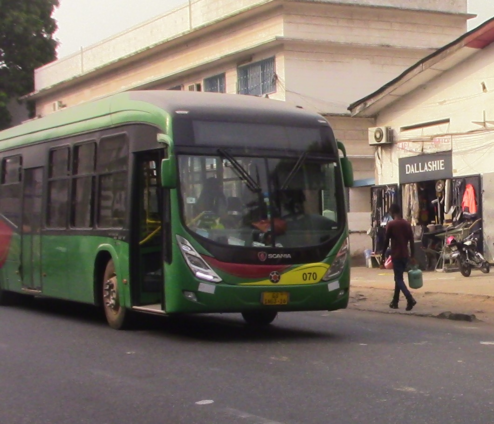
The Managing Director of the Greater Accra Passenger Transport Executive, Awudu Dawud, has assured commuters that Aayalolo buses operating on the newly introduced contra-flow lanes are not speeding to beat traffic, insisting that drivers have received special training to ensure passenger safety.
His assurance comes as the system enters its second day of implementation, with commuters reporting shorter journey times but raising concerns about the safety of buses travelling against the normal direction of traffic.
Mr Dawud said safety had been a major consideration in the planning and implementation of the system, adding that relevant transport, security and road safety agencies were involved in efforts to protect passengers and other road users.
Speaking on the operation of the contra-flow lanes, he said the buses were not expected to take advantage of the relatively free lanes to travel at excessive speeds.
“Safety is critical when it comes to contra-flow, and it's something that we have worked on,” he said.
He explained that the Greater Accra Passenger Transport Executive had worked with the Motor Traffic and Transport Department (MTTD), the Ministry of Transport, the Ministry of the Interior, the National Road Safety Authority and the Department of Urban Roads, among other stakeholders, to ensure the safe operation of the buses.
“We have MTTD on board. We have the Ministry for Transport. We have Interior. We have Road Safety and all Urban Roads and all other stakeholders on board to making sure that everybody is safe,” he said.
Mr Dawud added that the safety measures were intended to protect not only passengers on the Aayalolo buses but also motorists using the roads.
Mr Dawud said the buses were being escorted by motorcades while using the contra-flow lanes to alert other road users to their approach and discourage motorists from entering the designated lanes.
He explained that the escorts served as a temporary measure to keep the lanes clear and reduce the risk of collisions.
“You could appreciate that most of these buses when they are on their contra-flow lane are led by a motorcade just to ward off the motorists from the particular lane and to give a signal that these buses are coming,” he said.
He acknowledged that the arrangement could give the impression that the buses were travelling at high speeds because they faced less congestion than other vehicles.
However, he rejected suggestions that the operators were using the system to race through traffic.
“Most people think that once it is contra-flow and you have a free-flow lane, the buses are going to go on top speed. No. We are not going on any top speed,” he said.
The Managing Director said drivers had been trained specifically to operate under the contra-flow arrangement, with the aim of preventing accidents and ensuring that passengers reached their destinations safely.
“We have trained all these drivers to making sure that we wouldn't be caught in any accident or something like that,” he added.
Despite the concerns about safety, passengers who used the Aayalolo service expressed satisfaction with the time saved during their journeys.
Some said trips that would normally take several hours because of heavy traffic had been completed in a fraction of the usual time.
One passenger said the service had made a considerable difference to the morning commute and expressed hope that the arrangement would continue.
“It will help us if they continue to give us their service,” the passenger said.
The commuter added that the journey had been a positive experience, given the amount of time normally spent in traffic.
“We hope that it will go well for us because, looking at the time that we spent on the way, we think it's one of the best experiences that we have this morning,” the passenger said.
Another commuter said the difference in travel time was particularly noticeable on a route that could take between three and four hours under heavy traffic conditions.
“Because of the traffic, maybe you can take three hours, four hours, but today we take only 15 minutes to get here,” the passenger said.
The commuter added that the reduced journey time could allow passengers to complete their daily activities more efficiently.
“So, I think if you want to go like three or four trips, we will go and come early,” the passenger said.
A third passenger also praised the service, saying the journey had taken less than an hour and had helped several commuters reach their destinations more quickly.
“It took about less than one hour before we came here, and it helped us. It helped most of us,” the passenger said.
Latest Stories
-
5% progress on Suame Interchange Phase One inadequate – Roads Minister tasks contractor to speed up work
11 seconds -
Photos: Vice President joins GAAS Awards to celebrate outstanding women leaders
1 minute -
OSP vs Ken Ofori-Atta, SML and others: Court gives OSP four more weeks to serve Ofori-Atta with summons
3 minutes -
High Commission sends caution to Ghanaians in South Africa ahead of planned protests
6 minutes -
Okai Mintah outlines vision for NDC Youth Wing as he engages MMDCEs
11 minutes -
Mahama Ayariga leads renewed push for stronger local governance through partnerships
15 minutes -
NDC youth organiser aspirant Okai Mintah consults MMDCEs ahead of elections
16 minutes -
PHOTOS: Ayikuma Methodist Basic School wins National Juniors Challenge
18 minutes -
Silence has entered our homes : Salomey Awiti Bafoh and the chilling effect of free expression in Ghana
19 minutes -
UG Pro-VC calls for stronger research funding to curb brain drain
21 minutes -
Woman in critical condition after shooting at funeral grounds in Yeji
23 minutes -
Breast Cancer awareness must lead to action – Deputy Health Minister
26 minutes -
UK identified as leading destination for Ghana’s illicit cannabis exports – Report
28 minutes -
Drug money allegedly finances Ghana’s political parties and real estate – Global Organised Crime Index
33 minutes -
NSA outlines seven steps for successful posting and validation of national service personnel
34 minutes