

Audio By Carbonatix
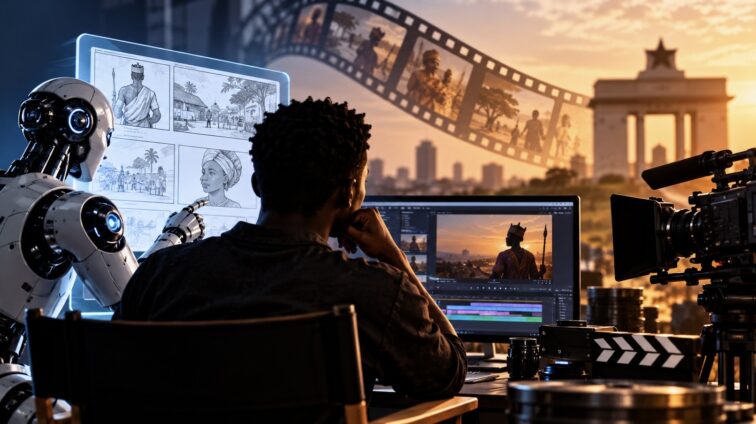
The film industry is entering one of the most significant technological transitions since the introduction of digital cameras, non-linear editing and computer-generated imagery. Artificial Intelligence (AI) is no longer a futuristic concept waiting to enter filmmaking. It is already becoming part of the filmmaking process.
For Ghana, this development presents both a challenge and an opportunity. The question should therefore not be whether AI will affect Ghanaian filmmaking. It will. The more important question is: Will Ghanaian filmmakers learn to use AI to strengthen our storytelling, or will we watch other film industries use the technology to move further ahead of us?
This is why Ghana’s film-training institutions, film schools, lecturers, trainers and students need to begin treating AI literacy as an important part of modern film education.
UNESCO has already called for education systems to develop human capacity around generative AI while keeping human agency, ethics, safety and equity at the centre. Its 2026 guidance for technical and vocational education similarly argues that institutions need to prepare students for changing occupational tasks and skills created by AI.
AI Is Not the Death of Filmmaking
There is understandable anxiety surrounding AI. Some filmmakers fear that AI will replace writers, actors, cinematographers, editors, designers and other professionals. Some worry that students will stop learning the fundamentals because they can simply ask an AI system to produce something for them.
These concerns are legitimate, but the solution is not to reject AI but to educate filmmakers on how to use it responsibly.
Cameras did not eliminate cinematographers. Digital editing did not eliminate editors. Computer-generated imagery did not eliminate visual-effects artists. Instead, technology changed the tools available to creative professionals. AI should be viewed in the same way: as a powerful creative and production tool, not as a substitute for human creativity, judgement, experience and cultural understanding.
UNESCO’s recent work on AI in education specifically stresses that AI should support pedagogy and human learning rather than simply become a shortcut to completing assignments. The same principle should apply to filmmaking.
Where AI Can Transform Ghanaian Filmmaking
AI can potentially contribute to almost every stage of film production.
1. Story Development and Screenwriting
During the development stage, AI can be used to:
- Brainstorm story concepts
- Develop characters
- Explore alternative story structures
- Identify weaknesses in a screenplay
- Generate scene possibilities
- Research historical or cultural contexts
- Develop treatments
- Create beat sheets
- Translate material
- Develop dialogue alternatives
- Analyse pacing and structure
In all these, the filmmaker remains the storyteller. For example, an AI system might help a Ghanaian writer explore a story about a traditional chief confronting modern political and economic pressures. The AI can help organise ideas, but it does not possess the filmmaker’s lived understanding of the cultures and traditions of Ghanaian societies. The technology can only assist the writer, but not replace the writer’s voice.
2. Pre-production
This may be one of the areas where Ghana can gain enormously. AI can assist filmmakers with:
- Concept development
- Mood boards
- Visual references
- Production design ideas
- Costume concepts
- Location concepts
- Shot planning
- Storyboarding
- Scheduling
- Call-sheet preparation
- Production breakdowns
- Budget planning
- Pitch-deck development
For an independent Ghanaian filmmaker working with limited resources, this can be extremely valuable.
A director who cannot afford to create elaborate visual previsualisation can use AI-assisted tools to communicate the intended visual language to the cinematographer, production designer, departments and other production crew. The director can use it to create visual references that help the entire crew understand the intended direction.
For film students, this can be particularly useful. A directing student could develop several visual interpretations of the same scene before shooting it physically. This would encourage students to think more deeply about visual storytelling, rather than simply pointing a camera at actors.
However, film students must still learn the fundamentals of cinematography: exposure, lighting, lenses, composition, camera movement, blocking and visual continuity. AI should only enhance those skills, not replace them.
3. Production
Filmmakers can use AI-assisted systems to organise information and analyse scripts to improve production management by helping to identify:
- Characters appearing in each scene
- Locations
- Props
- Costumes
- Special requirements
- Shooting days
- Production requirements
- Potential logistical problems
For low-budget Ghanaian productions, where producers often have to do several jobs simultaneously, intelligent production tools could save considerable time. This matters because time is money in filmmaking.
4. Editing and Post-production
Post-production is another area where AI is rapidly becoming important. AI-assisted editing technologies can help with:
- Transcription
- Subtitles
- Dialogue identification
- Footage organisation
- Scene detection
- Noise reduction
- Audio enhancement
- Colour correction
- Visual effects
- Translation
- Sound design
- Music workflows, etc.
This could be particularly important for Ghanaian films seeking audiences outside Ghana.
Imagine a Ghanaian film originally produced in Twi, Ga, Ewe or another Ghanaian language being efficiently prepared with subtitles and multiple language versions for international distribution. That creates opportunities for our stories to travel.
5. Creating Better Visual Effects on Small-Budget Productions
AI could help reduce the high-cost barrier involved in producing sophisticated visual effects, which is a persistent challenge in Ghanaian cinema. It may also allow independent filmmakers to experiment with environments, visual effects, clean-up, compositing and other techniques that previously required expensive equipment and large post-production teams.
This does not mean Ghana should attempt to imitate or replicate Hollywood. The opportunity is to use technology to make Ghanaian stories look more ambitious without losing their Ghanaian identity. Technology should help us tell our stories better, not make our stories look foreign.
6. Marketing and Distribution
AI can also assist filmmakers after the film has been completed to develop:
- Trailers
- Teaser concepts
- Posters
- Social-media campaigns
- Audience profiles
- Promotional copy
- Press releases
- Subtitles
- Multiple versions of promotional material
- Festival submission materials, etc.
For independent Ghanaian producers who do not have large marketing departments, this could be extremely useful. AI can help filmmakers become more sophisticated marketers. A good film that is not seen remains a hidden treasure.
The Biggest Opportunity May Be Film Education
This is where Ghana needs to think seriously.
If film schools continue teaching filmmaking exactly as they did before AI became part of the creative industry, they risk producing graduates who understand yesterday’s production environment but are unprepared for tomorrow’s.
Interestingly, this transition has already begun in other places.
Ghana should not wait until AI becomes completely embedded in international production before introducing it into film education. The technology gap is part of the current state of the Ghanaian film industry. The time is now. We should start now.
Latest Stories
-
Global fashion coalition launches in the heart of Kantamanto Market
4 minutes -
‘No concrete commitments from government’ – Brong Ahafo teacher unions maintain strike
8 minutes -
Finance Minister demands greater returns from NLA after GH¢10 million dividend presentation
17 minutes -
National Customers’ Choice Awards set to celebrate Ghana’s best customer-centred brands
21 minutes -
ICEE Conference: Ghana must get governance right to solve transport problems – Ing. Ludwig Hesse
21 minutes -
Luv Fm journalists Clinton Yeboah, Nana Boakye Dankwah Yiadom selected for UK MEET emerging technology fellowship
25 minutes -
VRA warns payment delays, inter-utility debt threaten liquidity despite GH¢8.9bn revenue in 2025
27 minutes -
NPP congress: 7,163 delegates to elect national officers in Kumasi tomorrow
30 minutes -
BoG Governor, all MPC members voted to keep policy rate at 14%
36 minutes -
‘Real poll will be Saturday’s vote’ – Ahiagbah dismisses Global InfoAnalytics survey
45 minutes -
Importers petition GRA over alleged unauthorised removal of 28 containers from Tema Port
54 minutes -
Creative Arts Agency Board seeks Lands Ministry’s support for welfare project
1 hour -
Mahama and Kyrgyzstan Foreign Minister discuss AU-UN cooperation – Ablakwa
1 hour -
Ghana, Kyrgyzstan explore cooperation in gold mining and trading
1 hour -
Bono Region teacher unions back strike, demand action on outstanding grievances
1 hour