

Audio By Carbonatix
By Jimmy Aglah
Once upon a time in the Republic of Uncommon Sense, the government decided that passengers travelling in commercial vehicles deserved some peace and quiet. It dusted off a regulation that had been on the statute books since 2012, strengthened the penalties and announced that preaching and hawking in moving vehicles were prohibited.
Some pastors protested. Prophet Nigel Gaisie threatened to board buses and preach until somebody arrested him. Reverend Kwadwo Boateng Bempah declared that wherever human beings gathered, the Gospel must be preached. Even Reverend John Ntim Fordjour, a Member of Parliament, appealed to the President to abandon the restriction.
Then, on Friday, 9th October 2026, news broke that the government had suspended its implementation.
Hallelujah!
The Republic had performed another administrative miracle. A regulation that had survived fourteen years on the statute books apparently could not survive a few days of renewed public controversy.
The situation reminds me of a hypothetical meeting between a Ghanaian headmaster and a troublesome student. The headmaster announces that nobody should make noise during examinations. The student protests that singing is his God-given talent. After a heated argument, the headmaster suspends enforcement of the noise regulation and returns to his office, leaving the other students to negotiate with the singer.
But the latest development raises a fascinating question that nobody appears eager to answer.
If the Christian preacher is entitled to turn a commercial vehicle into a travelling chapel, what happens when other religions demand the same privilege?
Imagine a trotro leaving Kejetia for Ejisu tomorrow morning.
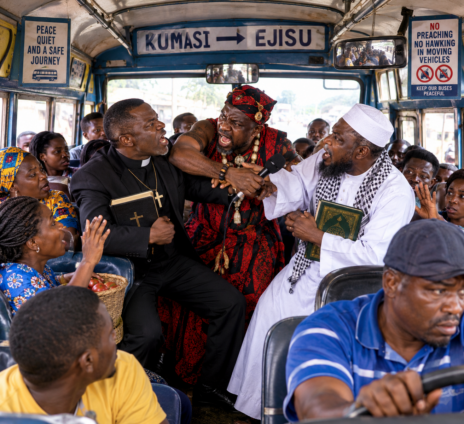
A Christian evangelist rises and begins preaching salvation through Jesus Christ. Halfway through his sermon, an ɔkomfo, a traditional priest, boards the vehicle, having obtained permission from the driver. He begins chanting traditional invocations, explaining that his ancestors have also instructed him to bring spiritual enlightenment to the travelling public.
The evangelist objects.
The traditional priest reminds him that Ghana's Constitution recognises freedom of religion, not merely freedom of Christianity.
Before the disagreement is resolved, a Muslim cleric joins the discussion. He too wishes to proclaim his faith. He begins reciting verses from the Qur'an and declaring, "Allahu Akbar", the familiar Islamic expression meaning "God is greatest".
The Christian preacher wants to continue his sermon. The traditional priest insists that his religious heritage deserves equal recognition. The Muslim cleric maintains that his faith cannot be treated as an inferior passenger.
Meanwhile, the driver is negotiating a pothole, the mate is demanding fares, and a woman carrying a basket of tomatoes is begging everybody to lower their voices.
Who will determine which religion gets the microphone?
Will the driver draw up a timetable allocating fifteen minutes to Christianity, fifteen to Islam and fifteen to traditional worship? What happens when another religious group boards halfway through the journey and demands its constitutional share of the remaining distance?
Perhaps we shall soon require an Interfaith Trotro Worship Committee, with the driver as chairman and the mate as secretary.
The absurdity is not that people practise different religions. Ghana has accommodated religious diversity for generations. The absurdity is the suggestion that a person's freedom to manifest religious belief automatically includes the right to impose its audible expression upon an unwilling audience.
And this is where the current controversy becomes particularly revealing.
Some of those defending unrestricted bus preaching insist that the driver's permission is sufficient. But a driver does not own the religious convictions of his passengers. He has been engaged to transport people to their destinations, not to determine which spiritual messages they must endure along the way.
If we accept that principle for Christian evangelists, fairness requires us to consider its application to every other faith.
Article 21 of Ghana's Constitution protects religious freedom. Article 17 guarantees equality before the law, while Article 12 requires respect for the rights of others and the public interest.
These protections belong to Christians, Muslims, traditional worshippers and citizens who profess no religion whatsoever.
Of course, none of these rights automatically grants anyone unrestricted permission to disrupt a moving vehicle. That is precisely why reasonable rules governing conduct in shared public spaces are necessary.
It is also why the government's reported suspension requires a proper explanation.
Was Regulation 141 unconstitutional? Was its maximum custodial sentence of eight months considered excessive? Did officials discover some unforeseen problem with enforcement? Or has the government simply decided that the controversy is too hot to handle?
These are questions, not accusations. But citizens deserve answers.
After all, the Ministry of Transport launched a public education campaign on the new traffic regulations only weeks ago. Now that one provision has generated strong religious objections, reports say its implementation has been suspended. Yet the public has not been told precisely what this administrative suspension means for a regulation that remains on the statute books.
Meanwhile, transport operators have expressed opposition to the reported decision, insisting that passengers' safety and comfort must be protected.
And let us not forget the hawkers.
Regulation 141 covers hawking as well as preaching. If implementation of the entire provision is suspended, what becomes of the prohibition on selling goods inside moving commercial vehicles? Are passengers now to expect sermons, mobile pharmacies, toothbrush demonstrations and advertisements for miraculous herbal preparations between Kejetia and Ejisu?
Imagine a preacher promising eternal salvation while a hawker standing beside him guarantees instant relief from waist pain, stubborn coughs and thirty-seven other ailments.
Both insist that their products can change your life.
The passenger merely wants to arrive alive.
There is nothing objectionable about preaching the Gospel, reciting the Qur'an or observing traditional religious practices. The difficulty arises when personal conviction is mistaken for an unrestricted entitlement to command public space.
Neither should a minor public nuisance automatically attract a punishment as severe as eight months in prison. There is room for reasonable regulation, proportionate sanctions and respect for religious liberty without turning every disagreement into a battle between Heaven and the state.
Perhaps the government will eventually explain its decision and provide a sensible way forward.
Until then, the Republic finds itself in a curious position. We have a regulation that has reportedly been suspended but not repealed, preachers celebrating a reprieve, transport operators objecting, and passengers wondering whether anybody remembered to consult them.
I have one modest suggestion.
Before we convert every trotro into a mobile religious conference centre, let us conduct a simple experiment. Invite a Christian preacher, a Muslim cleric and a traditional priest to share one vehicle. Give each person the same opportunity to express their faith, subject to the same rules.
Then ask the passengers whether they wish to participate.
Their answers might teach us something about religious freedom that fourteen years of legislation and several days of controversy have failed to establish.
The freedom to preach is sacred. The freedom not to listen deserves respect too.
And until we understand that distinction, we may soon require a new road sign at every lorry station:
WELCOME ABOARD. YOUR DESTINATION IS EJISU. YOUR RELIGIOUS DESTINATION WILL BE DETERMINED BY THE DRIVER.
Latest Stories
-
GH¢800,000 goods destroyed as fire engulfs Kia Rhino truck on Apedwa-Kibi Road
24 minutes -
Chief Justice calls for supportive workplaces to address mental health stigma
25 minutes -
NVI CEO defends GH¢13m spending on training, workshops and conferences
26 minutes -
Ghana targets first locally manufactured vaccine by 2027
29 minutes -
Teachers suspend strike after reaching agreement with government
40 minutes -
Council of State describes talks with striking teachers as fruitful
58 minutes -
Adjaye Associates opens new Accra studio with public space for cultural exchange
1 hour -
BoG to issue new Credit Risk Directive as NPL ratio in the Savings and Loans sector deteriorates
1 hour -
You can preach in a stationary vehicle, but not when it’s moving – Mahama clarifies
1 hour -
Alhaji Iddrisu Mustapha: The educated professional seeking to bring experience to NDC Western Region leadership
1 hour -
Former Deputy Trade and Industry Minister Nana Ama Dokua called to Ghana Bar
2 hours -
Old Edubiase Methodist Basic School pupils turn traders, farmers as teachers’ strike bites harder
2 hours -
Prudential Bank secures GH¢1.13bn investment from Bloom Africa
2 hours -
Ernest Kwasi Okoh
2 hours -
The Trotro has become a House of Worship!
2 hours