

Audio By Carbonatix
By Jimmy Aglah
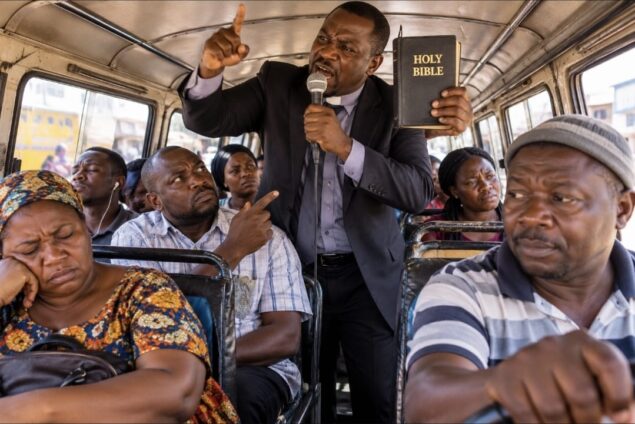
Once upon a time in the Republic of Uncommon Sense, a man boarded a trotro at Kejetia with a Bible, a powerful voice and an urgent assignment from Heaven. His mission was to save souls before the vehicle reached Ejisu. Unfortunately, the passengers had boarded with entirely different expectations. Some wanted to sleep, others wanted to make telephone calls, and one exhausted woman simply wanted to reach home without being reminded that the wages of sin are death.
The preacher, however, was not interested in their travel arrangements. Having obtained the driver's permission, he considered the entire vehicle spiritually available for immediate redemption. He rose from his seat, cleared his throat and announced that everybody should prepare to meet the Lord.
A gentleman seated behind the driver politely explained that he was only preparing to meet his wife, who had been waiting for him since morning.
That was when the trouble began.
The preacher reminded him that Jesus commanded His followers to go into the world and preach the Gospel. The gentleman agreed but wondered whether the instruction included compelling thirty unwilling passengers to attend an unscheduled church service. After all, he had paid for transportation, not theological instruction.
This imaginary encounter captures the controversy currently exercising the Republic.
Under Ghana's Road Traffic Regulations, 2026 (L.I. 2519), preaching and hawking in moving public or commercial vehicles are prohibited. Offenders risk fines ranging from GH¢120 to GH¢600, imprisonment for up to eight months, or both.
Interestingly, the prohibition is not new. It existed under L.I. 2180 in 2012. For 14 years, the law appears to have been travelling quietly in the boot while preachers occupied the passenger compartment. Now that enforcement has attracted renewed attention, some people are behaving as though Parliament has just deleted the Great Commission from the Bible.
Prophet Nigel Gaisie has entered the controversy with considerable enthusiasm. He has announced his intention to preach aboard buses and lorries, daring the authorities to arrest him. He wonders what injury anyone suffers when the Gospel is preached and argues that preachers ordinarily obtain permission from drivers.
The prophet raises an interesting question, but his answer creates an even more interesting problem.
Since when did the driver become the constitutional representative of everybody's conscience?
A driver's permission may authorise someone to enter his vehicle, but does it automatically authorise that person to convert every passenger into a member of an involuntary congregation?
If that principle were universally accepted, a traditional priest could obtain the driver's permission to perform rituals throughout the journey. A Muslim cleric could lead prayers over the same captive audience. A political activist could deliver a two-hour lecture on why his party deserves another opportunity to govern.
And everybody would be expected to listen because the driver said yes.
The Constitution guarantees freedom of religion under Article 21. But Article 12 also requires respect for the rights of others and the public interest. Religious freedom is precious, yet its exercise cannot be considered in isolation from the freedoms of fellow citizens.
Surely, the right to preach deserves protection. So does the right to decline an invitation to be preached to.
Meanwhile, Reverend Kwadwo Boateng Bempah has also condemned the restriction, insisting that the Church must continue proclaiming its message wherever people gather.
It is a position rooted in religious conviction. Yet even within Christianity, opinion is divided. Reverend Enoch Paul Hayes of the International Central Gospel Church has reportedly urged fellow pastors to respect the law and explore alternative platforms for evangelism.
Which introduces another fascinating question: If the Gospel can reach millions through radio, television, social media and organised outdoor evangelism, must salvation necessarily travel in a moving trotro?
To be fair, not every bus preacher is a nuisance. Some deliver thoughtful messages, offer encouragement to distressed travellers and conclude their sermons respectfully. Others have apparently mastered the remarkable art of turning a twenty-minute journey into a three-hour crusade, complete with testimonies, altar calls and financial appeals.
The passenger who boarded at Kejetia hoping to reach Ejisu may consequently arrive spiritually exhausted before becoming physically exhausted.
Nevertheless, the punishment deserves serious examination.
Eight months in prison is a substantial maximum sentence for preaching in a moving vehicle. Public order matters, but proportionality matters too. Is imprisonment of that duration an appropriate possible response to conduct that may range from persistent harassment to an otherwise peaceful sermon delivered in the wrong setting?
Surely, a civilised society can debate reasonable restrictions without automatically treating every offending preacher as a dangerous criminal.
Consistency also matters. If excessive noise and passenger discomfort are the concerns, authorities must address other disruptive activities fairly. A passenger subjected to deafening music deserves consideration just as much as one trapped inside an unsolicited sermon.
The central issue is neither Christianity nor hostility towards religion. It is the delicate business of sharing public space in a society where everybody has rights, convictions and destinations.
We must avoid creating a country where every regulation becomes religious persecution and every expression of faith becomes a public nuisance.
Perhaps the solution is remarkably simple: preach with consideration, listen by choice, enforce the law reasonably and remember that even the most righteous journey requires respect for fellow travellers.
After all, Jesus invited people to follow Him.
He did not appoint the trotro driver to accept the invitation on their behalf.
And if the Lord Himself stands at the door and knocks, surely His earthly messengers can learn the courtesy of waiting for someone to open it.
Latest Stories
-
Health investment beginning to improve access to care – Akandoh
2 minutes -
“It is meaningless” – Parent laments as teachers’ strike leaves boarding school students idle
4 minutes -
Austin Gamey predicts possible end to teachers’ strike, urges better negotiation
6 minutes -
Mahama, Trade Minister champions local manufacturing during Ghato Foods visit
7 minutes -
Labour Minister, ILO Country Director strengthen partnership on decent work and jobs
8 minutes -
Approved vaccine to be rolled out in Upper West next week-GHS
11 minutes -
Fear, institutional bias, and lack of support keep domestic abuse victims from reporting – Lawyer
14 minutes -
Yellow fever outbreak is under control – Health Minister
15 minutes -
Communication Minister Sam George called to the Bar
21 minutes -
Kenteman’s Kentemusic weaves ‘Kente Love’
23 minutes -
Former JoyNews journalist Richard Kwadwo Nyarko called to the Bar
42 minutes -
Chopmoney Bookkeeping seeks to simplify bookkeeping for Ghana’s small businesses
44 minutes -
Beyond word of mouth: Bizella’s bid to build trust in Ghana’s services market
51 minutes -
Former JoyNews journalist Ayisha Ibrahim called to the Bar
57 minutes -
Counting performances of the Black Stars – at the doom stage?
1 hour