

Audio By Carbonatix
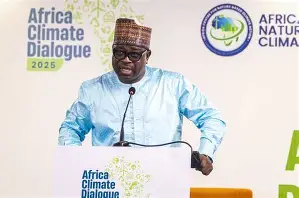
Minister of State in Charge of Climate Change and Sustainability, Issifu Seidu, has called for climate-vulnerable countries undergoing debt restructuring to retain access to climate finance, insisting that exclusion could undermine development gains and efforts to achieve debt sustainability.
The country said timely financing was essential to help vulnerable economies respond to climate shocks without diverting scarce domestic resources from development priorities or resorting to emergency borrowing.
He made the call in an interview with Ghanaian journalists after a ministerial dialogue on the margins of the International Monetary Fund (IMF) and World Bank Group (WBG) annual meetings in Bangkok.
The dialogue formally initiated the process to establish a US$500 million Lifeline Fund by the V20 group of climate-vulnerable economies.
The proposed facility is intended to provide rapid financial support to countries facing climate shocks.
Mr Seidu credited Barbados with leading advocacy for reforms to the international climate finance architecture to better address the needs of climate-vulnerable countries.
He said climate shocks repeatedly reversed development progress, compelling governments to redirect limited domestic resources towards emergency response and recovery.
“We realise that anytime these countries go through debt restructuring, they are excluded from the financing arrangement. So, if they are taking difficult decisions, these difficult decisions should not exclude them from these opportunities of climate fund,” he said.
Mr Seidu said the exclusion created competing fiscal demands for governments, which had to meet debt-servicing obligations, finance development programmes and respond to floods, droughts and other climate-related disasters.
He said the proposed Lifeline Fund would help address the financing gap by providing quicker access to resources for climate interventions, avoiding the lengthy bureaucratic processes associated with traditional climate funds.
The Minister said the exclusion of countries undergoing debt restructuring was counterproductive, particularly when they had taken difficult but necessary measures to restore debt sustainability in line with international expectations.
“If they are taking difficult decisions, those decisions should not exclude them from opportunities for climate finance,” he said.
Mr Seidu reaffirmed Ghana’s commitment to sustained advocacy to address structural inequalities at the intersection of climate justice and debt sustainability.
He said responding promptly to climate shocks could also support debt sustainability by preventing costly reversals in development and reducing the need for emergency borrowing after disasters.
The Minister called on strategic partners to complement government efforts to support vulnerable countries and communities.
He also urged investors to collaborate in developing sustainable solutions and share resilience-building successes across the Global South.
Latest Stories
-
Over 38,000 commercial, 150,000 residential customers unbilled – Ghana Water MD
16 minutes -
Several injured as Sprinter bus collides with ‘trotro’ at Odorkor
16 minutes -
Ghana records progress on reparatory justice agenda – Ablakwa
33 minutes -
Mahama commissions Christian Tetteh Yohuno Ward Complex at Police Hospital
48 minutes -
Vice President calls for wider access to Ghana’s political party histories
48 minutes -
Republic Bank JoyNews Habitat Fair to connect prospective homeowners with exhibitors in Ho from October 16 to 18
58 minutes -
Obaasima Summit: ‘AI is not a spiritual attack’ — Rev. Dr. Ofori-Boateng urges young women to embrace technology
1 hour -
GHS to distribute 80,000 pairs of locally-made protective footwear to health workers
1 hour -
GoldBod boosts local jobs as 90% of gold undergoes refining in Ghana – Sammy Gyamfi
1 hour -
The search for the politically unblemished: Are we asking the impossible of public appointees?
1 hour -
Ghana seeks climate finance access for debt-restructuring countries
1 hour -
Afenyo-Markin urges stronger media scrutiny of public institutions
1 hour -
GoldBod recovers GH¢38.7m in legacy PMMC debts, targets remaining arrears
2 hours -
62 out of every 100 commercial meters inspected missing from Ghana Water database – MD
2 hours -
GoldBod gets BoG authorisation to sell forex, Sammy Gyamfi tells PAC
2 hours