


Audio By Carbonatix
How much rest do we think we need, who is getting the most, and what are the most restful activities? The results of the world's largest survey on rest indicate that to feel truly rested, a lot of us want to be alone.
Last November an online survey called The Rest Test was launched to investigate what rest means to different people, how they like to rest and whether there is a link between rest and well-being. The results are now in and the analysis has begun.
Rest sounds easy to define, but turns out to be far from straightforward. Does it refer to a rested mind or a rested body? Actually, it depends. For some, the mind can't rest unless the body is at rest. For others it is the opposite. It is the tiring out of the body through vigorous exercise that allows the mind to rest - 16% of people said they find exercise restful.
Altogether, 18,000 people from 134 countries made time to take part in what was quite a lengthy survey devised by Hubbub - an international group of academics, artists, poets, and mental health experts - showing perhaps what a pressing issue rest is in the modern world.
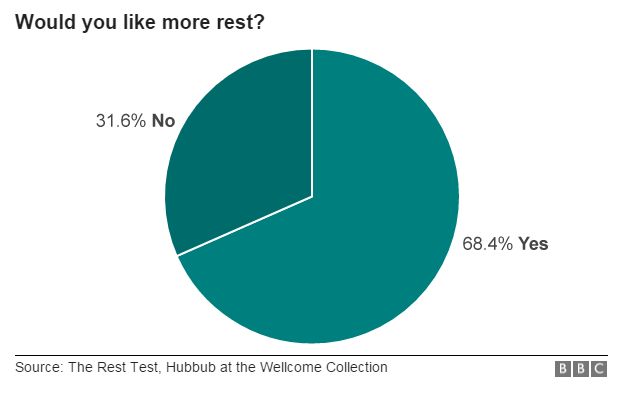
Just over two-thirds of respondents said they would like more rest. Almost a third thought they needed more rest than the average person, while 10% thought they needed less than average.
One question asked people how much they had rested the previous day, leaving them free to define rest in any way they wanted to. The average was three hours and six minutes.
Another gave people a long list of activities, asking them to rank the three most restful - and the results were unexpected.
Reading came out as the clear winner, followed by being in the natural environment, being on your own, listening to music and doing nothing in particular.
What is striking is that all these are activities often done alone.
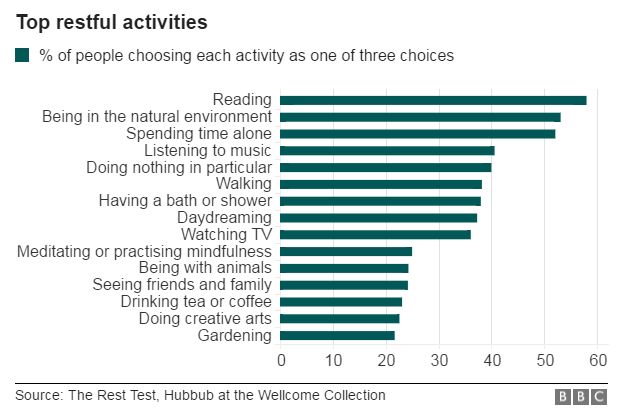
Could it be that what we really want, in order to rest, is respite from other people?
Seeing friends and family, chatting or drinking socially all come much lower down the list. This doesn't mean that the respondents don't like socialising, but that they don't consider it to be particularly restful.
Interestingly, this applies both in the case of extroverts - sometimes defined as people who gain energy from being around others - and introverts, who find other people draining. Extroverts do place chatting and socialising a little higher up the chart, but still they are beaten by solitary activities.
We need to remember, of course, that choosing to be alone is very different from enforced loneliness.
The Rest Test
 Image copyrightTHINKSTOCK
- The Rest Test is a collaboration between BBC Radio 4 and the Wellcome Collection's researchers in residence, Hubbub
- Hubbub is an international collective led by Durham University, comprising scientists, artists, poets, humanities researchers, mental health experts and social scientists - among them the BBC's Claudia Hammond, presenter of All in the Mind
- Some 18,000 people from 134 countries took the survey - they were self-selecting, not randomly chosen
- The biggest survey of rest before this was a fraction of the size, based on data from little more than 1,000 people.
The reason people want to be alone might be explained by the answers people gave when they were asked what is going on in their minds while they do different activities.
"People said that when they were on their own mostly they were focused on how they were feeling, so on their body or their emotions," says Ben Alderson-Day, a psychologist from the University of Durham, who co-wrote the survey.
The idea that when people are alone they are mentally talking to themselves is only partly true, it seems.
"People said they were only talking to themselves in their head 30% of the time," says Alderson-Day.
"There is a hint that when you're on your own, as well as switching off from other people, you get the chance to switch off from your own inner monologue as well."
But just because we're on our own doing nothing, that doesn't mean the brain is resting. Neuroscientists used to think that the brain was less active whenever we stopped concentrating on a task, but late in the 20th Century studies using brain scanners threw up some curious findings and they realised they had got it wrong.
When we are at rest, supposedly doing nothing, our minds have a tendency to wander and our brains are in fact busier when we're not concentrating on a task, than when we are.
These days it's common to hear the complaint that rest is hard to find. So what if we don't have enough time to do these restful activities? Does it matter?
Possibly.
Latest Stories
-
IMF identifies political appointments as major weakness in GPHA, VRA, COCOBOD and other SOEs
9 minutes -
Government reform efforts yet to translate into improved SOEs financial performance – IMF
41 minutes -
Teacher unions demand apology from Muntaka over WASSCE forgery comments
58 minutes -
NSMQ 2026: From 9 points to ADO9 – PRESEC Legon survive thriller to claim 9th trophy
1 hour -
Photos: Inside the thrilling NSMQ 2026 Grand Finale as PRESEC, AUGUSCO and Accra Academy battle for glory
2 hours -
Achimota, five other SHSs pilot waste segregation, clean-air initiative
2 hours -
More women attempt suicide, but men die by suicide more often – National Suicide Analysis Report
2 hours -
Three Ghanaian students launch e-commerce platform, Panta, to support small businesses
2 hours -
KMA passes by-law requiring Metropolitan Chief Executives to occupy official residence
2 hours -
Zoomlion rolls out disinfection, disinfestation exercise across Volta Region
2 hours -
Photos: Mahama swears in three new Supreme Court justices
2 hours -
$260 e-Visa fee could make Ghana less competitive – GHATOF
2 hours -
New Supreme Court justices pledge fairness, impartiality and fidelity to Constitution
3 hours -
Mahama urges Supreme Court to communicate decisions with ‘extreme clarity’
3 hours -
Techiman MCE residence abandoned since 2017; Regional Minister sets December deadline
3 hours