

Audio By Carbonatix
The absence of decentralized state institutions is hindering access to essential services and justice by vulnerable communities in the Upper East Region, a study conducted by the Widows and Orphans Movement (WOM), a gender-focused organization has revealed.
The study showed that only the Department of Social Welfare was the most decentralized state institution and had offices in almost all the 15 Municipalities and Districts in the region while the rest did not.
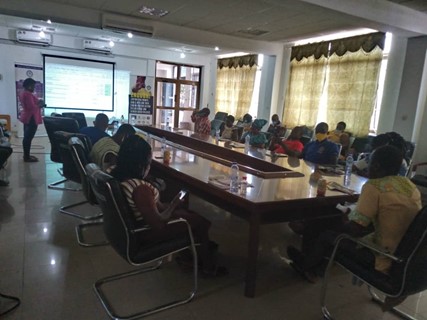
The Executive Director of WOM, Fati Abigail Abdulai who made the findings known to stakeholders in Bolgatanga, noted that the study was part of a four-year project on the theme: “ENOUGH!” being implemented in partnership with Oxfam Ghana and Women in Law and Development (WiLDAF) with funding support from the European Union (EU).
The project aims to empower women, girls, boys, and men to take positive action in ending sexual and gender-based violence in Ghana, Liberia, and Mali.
The Executive Director explained that as part of the implementation of the project, a research was commissioned to ascertain the state of implementation of the Domestic Violence Act of 2007, Act 732, and the Domestic Violence Legislative Instrument of 2016, LI 2237 in the region.
“We employed the participatory process through scorecards to find out the performance level, availability of office space, collaboration among others so that community members will rate the performance of state institutions and the state institutions equally did same. The study covered six communities in the Bongo and Nabdam Districts,” she said.
The findings revealed that due to lack of state institutions at the district and community levels such as the Domestic Violence and Victims Support Unit (DOVVSU), the Commission on Human Rights and Administrative Justice (CHRAJ) and Legal Aid among others, many people were often denied services especially justice.
Also because of poverty in the rural communities, women, especially did not have the resources to travel from their various communities to Bolgatanga, the regional capital to seek justice for being abused.
That, Ms Abduali noted, coupled with high medical fees had denied abused persons access to essential services and justice, increasing the incidence of sexual and gender based violence in the rural communities.
The study revealed that there was no single shelter in the region designated for abused persons.
It, therefore, recommended that the government take urgent steps to create office space and decentralize state institutions to help deliver justice to abused persons especially women and girls who are the most vulnerable.
It further urged the government to operationalize the Domestic Violence Support Fund to enable abused persons to have access to financial support for medical bills and seek justice.
It further called on stakeholders to join synergy to advocate the construction of a shelter for abused persons.
Latest Stories
-
Power restoration fault suspected in Kumasi Central Market fire
2 hours -
The 7-foot giant of Ngleshie Amanfro: Seven-foot Ghanaian Ephraim Saawa dreams of joining the national basketball team
3 hours -
Government promises support for Kumasi Central Market fire victims
3 hours -
Vibes The Movie: Big Ghun’s Ghanaian film earns five nominations at 2026 REFFA
3 hours -
MamaCare CEO warns unresolved conflicts among health workers could undermine maternal and neonatal care
4 hours -
Health professionals urged to translate medical knowledge into practice to save mothers
4 hours -
Conflicts among care providers linked to maternal, neonatal deaths – Expert
5 hours -
GIS marks 10th TIME conference, champions improved teaching practices
6 hours -
BRICS Or Balance? What Ghana’s bid really means
6 hours -
GPRTU wants full TRAFFITECH-GH implementation to start in 2027
6 hours -
Mahama announces plans to import electric wheelchairs for PWDs
6 hours -
KGL U17 Colts 2026: Western beat Prempeh Elite Academy to set up final final with Greater Accra Region
7 hours -
Late Solanke strike salvages 10-man Spurs draw at Man United
7 hours -
Gender Ministry to monitor welfare of Nana Akua Addo’s children amid domestic violence case
7 hours -
Benedict Okyere Yeboah: Ghana’s football problem goes beyond sacking a coach
7 hours