

Audio By Carbonatix
African scholars and policymakers have been urged to ensure that research conducted on the continent is grounded in African values and context to make it relevant for policymaking and development.
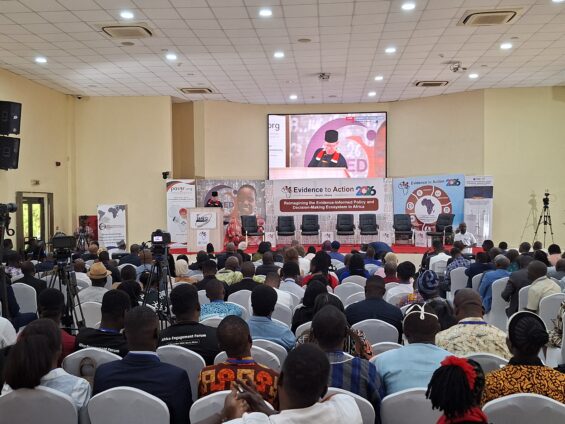
The Government Spokesperson of Kenya, Dr Isaac Mwaura, made the call at the final plenary and closing session of the 2026 Evidence to Action (E2A) Conference held at the ISSER Conference Facility, University of Ghana, Legon.
The three-day conference, organised by the Institute of Statistical, Social and Economic Research (ISSER), in collaboration with the International Centre for Evaluation and Development (ICED), focused on strengthening evidence-informed policymaking across Africa.
Dr Mwuara said African countries must rely on locally generated knowledge systems and data in shaping policies.
That, he said, must be the convention rather than depending heavily on external research models.
He noted that for research to effectively influence decision‑making, it must reflect the realities, values and lived experiences of African societies.
“We cannot use evidence that outsiders are producing alone. We must rely on evidence produced within our own context and environment,” he said.
Dr Mwaura explained that research disconnected from African values often failed to address local development needs, limiting its usefulness in policy formulation and implementation.
He stressed the need for African institutions and researchers to take ownership of data generation and analysis to ensure that policies were not only evidence based but also culturally relevant.
Earlier, Professor Peter Anyang’ Nyong’o, Governor of Kisumu County in Kenya, emphasised the importance of linking research to action.
He stated that academic work must translate into practical solutions for development challenges.
“We are not going to change Africa without action. What matters is what we do from here,” he said.
Prof. Nyong’o urged researchers to focus on issues directly affecting citizens, including poverty, education, healthcare, and economic productivity, noting that those areas required solutions that were rooted in local contexts.
He said much of the research used in African policymaking was derived from external sources, which may not fully capture the continent’s social and cultural dynamics.
Prof. Nyong’o underscored the importance of integrating African values into emerging technologies, including artificial intelligence and data systems, to ensure that innovation aligns with local needs.
He called for stronger collaboration between researchers, governments and institutions to build robust, Africa‑centred evidence systems that inform policy and practice.
Latest Stories
-
Prime Insight: Making room for meaningful national conversations on Joy Prime
8 minutes -
FABAG commends Ato Forson’s over removal of 20% excise duty on locally manufactured fruit juices
15 minutes -
HIV stigma discourages testing, prevention and treatment in Ghana – Ghana AIDS Commission
17 minutes -
Blocking cocaine probe lends weight to claims of political protection for traffickers – Assin South MP
21 minutes -
NPP Vice Chair race: I may be the youngest, but most experienced – Nana B
23 minutes -
Last UK and US troops leave Iraq as anti-Islamic State mission ends
23 minutes -
Don’t stay home idle, embrace entrepreneurship while awaiting posting – Unemployed nurses urged
35 minutes -
Aayalolo buses not speeding on contra-flow lanes – GAPTE assures commuters
37 minutes -
Effia MP calls for Kurt Okraku’s removal, overhaul of Ghana football structure
38 minutes -
CAS hearing on AFCON final appeal by Senegalese Football Federation set for October 8
39 minutes -
STC fares to go up by up to 8% this week – Deputy MD
40 minutes -
Photos: Accra-Kumasi bypasses get new lease of life as contractors return to site
40 minutes -
Man allegedly swallows five SIM cards to conceal evidence after arrest
41 minutes -
After three finals, Ayikuma Methodist Basic School finally lifts National Juniors Challenge trophy
41 minutes -
Black Stars management ignored players’ health conditions ahead of Gambia game – Ernest Thompson alleges
42 minutes