

Audio By Carbonatix
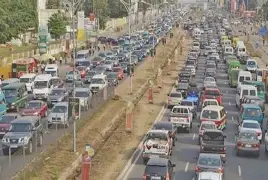
The Ghana Private Road Transport Union (GPRTU) has attributed the public transport crisis in Accra largely to heavy traffic congestion in the capital during peak morning and evening hours.
The Union said the persistent gridlock was preventing commercial drivers from completing multiple journeys and returning to transport terminals on time, contributing to long queues and delays experienced by commuters at the major terminals.
In an interview with the Ghana News Agency, Nana Nimako Asiamah, the National Chairman of the GPRTU, rejected suggestions that commercial drivers had created “artificial” shortages to justify fare increases.
“As far as the GPRTU is concerned, we are not creating any artificial scarcity. The problem is that the traffic in Accra is affecting the transport business,” he said.
“The situation is worse in the mornings and evenings because drivers are not able to return to the stations on time to pick up more passengers.”
Nana Asiamah’s comments come amid recent government concerns that unlawful practices by some private transport operators had worsened transportation challenges in Accra.
The Minister of Government Communications, Felix Kwakye Ofosu, had noted that some drivers were deliberately creating artificial shortages, especially during peak periods.
That was to compel commuters to pay higher fares despite reductions in fuel prices and an agreed 15 percent cut in approved transport fares, he said.
Mr Ofosu cited examples of drivers avoiding designated terminals and instead roaming urban centres in search of passengers willing to pay more, describing the behaviour as unlawful and pledging the government’s resolve to take action against those involved.
In response, Nana Asiamah corroborated the government’s concerns, saying the GPRTU had been notified of such acts and assured that the Union would sanction any member found culpable.
He, however, indicated that because of the lack of proper identification on some vehicles, it was difficult to determine which of the offending drivers were members of the Union, especially when some of them belonged to other transport bodies.
He urged the Government to work with the Union to develop a system to facilitate the identification of each bus to aid enforcement.
“We are ready to meet the Government and work together with other transport unions to find a solution to the challenges,” Nana Asiamah said.
Latest Stories
-
Iran urges Iraq to lift flight ban amid US sanctions
18 seconds -
GIBA calls for constitutional protection of media freedom in ongoing review
7 minutes -
Reviewed: Queiroz resigned and wasn’t sacked
9 minutes -
10 years, 2 cars and a motorbike: Studio 7 Clinic & Med Spa rewards loyal staff
17 minutes -
Schandorf Writes: Is galamsey fight lost? An open letter to Oliver Barker-Vormawor
25 minutes -
Fr Andrew Campbell honoured among 100 Africa Most Influential Persons in Rwanda
45 minutes -
Ghana to mark World Cleanup Day with National Sanitation Day on October 3
51 minutes -
Ignite Social Enterprise to partner Ghanaian watch manufacturer to boost global sales
1 hour -
Ignite Social Enterprise does not condone fraud – Bola Ray
1 hour -
Mr Eazi returns with new single ‘Comfort’ featuring Moliy
2 hours -
‘I don’t hire coaches, and I don’t fire coaches’ – Kofi Adams
2 hours -
NPP sets up 31 voting centres to speed up national executive elections
3 hours -
Demolition begins at La Pleasure Beach amid heavy security presence
3 hours -
Senyocue: Highlife will dominate global music in the next 20 years
3 hours -
Innovare Limited congratulates Ahantaman Community Bank PLC on ISO/IEC 27001:2022 certification urges others to follow suit
4 hours