

Audio By Carbonatix
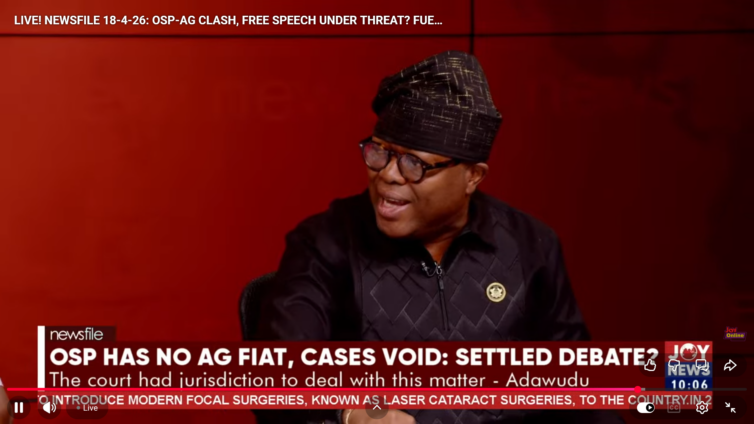
Managing Partner at Lord & Lords Legal Practice and a member of the NDC Legal and Communication Committee, Victor Kwadjoga Adawudu, has described the government’s recent move to reduce fuel prices as a “creative” short-term intervention, while cautioning that Ghana must prioritise domestic refining capacity to reduce long-term vulnerability.
Speaking on Newsfile on Saturday, April 18, Mr Adawudu weighed in on the latest pricing window, which saw diesel prices drop by GH₵2.00 per litre and petrol fall by about 36 pesewas per litre.
The reductions come despite rising global crude oil prices, driven largely by geopolitical tensions in the Middle East.
Ghana, as a net importer of refined petroleum products, remains exposed to such external shocks. In response, the government moved to cushion consumers by adjusting or suspending selected taxes, levies and margins within the fuel pricing structure—effectively absorbing part of the global price increases.
Mr Adawudu characterised the move as a pragmatic, if temporary, solution.
“It’s this has been a short term and I think that was a very innovative and creative ways of doing it.”
He explained that the approach carefully avoids creating fiscal imbalances elsewhere in the economy, drawing parallels with previous debates around energy sector financing.
“It’s just like, you know, the price build-up. We’re not taking money from somewhere to create another problem. Just like the energy sector levy that we all agreed at a point that once it should be added. The people were saying that taxes should be taken off. However, if we take that off, the purpose that we wanted that money to be useful to keep the electricity, we may have created a problem.”
According to him, while tax relief at the pump is often politically attractive, it can undermine critical funding streams if not handled carefully.
He therefore welcomed the government’s balancing act, noting that it offers immediate relief without significantly destabilising other sectors.
“For now, I think it’s good and we’re watching.”
Mr Adawudu also linked the domestic pricing dynamics to developments on the global stage, particularly disruptions in key shipping routes.
“I was a little bit happy when I realised that the Strait of Hormuz has been officially open, so I was like it was going on a line with what we thought that we take some short-term… And now I’ve just been told it’s been closed again, so we are hoping that things will do.”
Despite his support for the current intervention, Mr Adawudu stressed that Ghana must move beyond reactive measures and adopt a more self-sufficient energy strategy.
“As Kofi has suggested, we have refineries here. Let’s look at our own. I think let’s think out of the box… I will leverage all this by the end of the day.”
He called for structural reform aimed at reducing reliance on imported refined products.
“It’s not the same that we are always depending on them,” he said.
Latest Stories
-
Mahama calls for structural repair after UN slavery resolution
2 minutes -
Mahama condemns Gaza carnage, backs Palestine and two-state solution
5 minutes -
Fund Accra-Kumasi Expressway with private capital, not state funds — Alan Kyerematen urges gov’t
9 minutes -
TUC calls for stronger funding and labour representation in TVET system
11 minutes -
GES threatens removal of SHS heads over illegal fees
15 minutes -
Youth power to explode at 2026 Global Changemakers Summit in Accra
22 minutes -
SIU community remembers Kofi Akamani at vigil as memorial fund is announced
24 minutes -
Shot and killed in the US: Who was Dr Kofi Akamani?
32 minutes -
Sosu challenges EOCO’s basis for attempted arrest of Manhyia South MP
39 minutes -
KMA plans to convert Adum railway enclave into cargo truck terminal
40 minutes -
2026/27 cocoa season: COCOBOD engages international trading partners in London
58 minutes -
Fire contained at Dansoman’s Dayspring School, no casualties reported
1 hour -
Nyankyerenease gets furnished CHPS compound to improve healthcare access
1 hour -
Sky Train trial moves to defence as Asamoah, Ameyaw-Akumfi file witness statements
1 hour -
AFCON 2027Q: Ghana will face Ivory Coast, Gambia unscathed – Sports Minister
1 hour