


Audio By Carbonatix
The town of Adidome in the Central Tongu District has taken a bold step in the fight against Non-Communicable Diseases (NCDs) with the commissioning of a Health Kiosk Project—a community-driven initiative aimed at saving lives through early detection, health education, and lifestyle changes.
The launch, held at the Fiagbenu Triangle on Saturday, August 9, 2025, drew traditional rulers, government officials, health experts, civil society partners, and community members, all united by a shared determination to combat the rising tide of preventable illnesses, including hypertension, diabetes, and stroke.
A VISION BORN FROM LOSS AND GLOBAL LEARNING
Speaking at the event, Executive Director of ProHealth Ghana Initiative and Chief of Adidome, Torgbe, Togbe Kwasinyi Kakaklolo Agyeman V, described the Health Kiosk as “a candle of hope” for people who may be unknowingly living with life-threatening conditions.
Citing alarming global and national statistics, he noted that hypertension alone affects over 1.28 billion people worldwide, with nearly half unaware of their condition, and is a leading cause of premature death. In Ghana, hypertension tops adult hospital admissions and is linked to significant mortality rates.
“In Central Tongu alone, newly confirmed hypertension cases have more than doubled in just two years,” he revealed. “We cannot wait until people collapse before acting. Prevention must come first.” The Chief of Adidome, Togbe Kwasinyi Kakaklolo Agyeman V, said
The idea for the project, he explained, was inspired by personal loss, the premature death of his father, and developed further during a Cambridge Summer School in Nutrition, where it won a first-prize essay award.
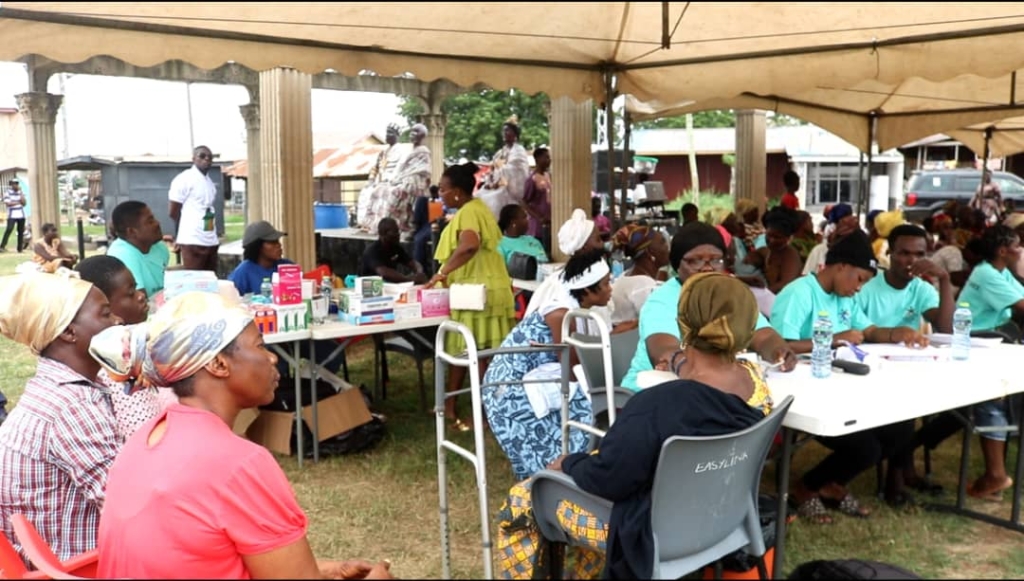
The kiosk model, according to Togbe Kwasinyi Kakaklolo Agyeman V, anchored on four pillars under the acronym AKNE - Awareness, Checking to know your status, Nutrition, and Exercise, will provide free vital checks, nutrition literacy, and age-friendly fitness activities. The pilot, he noted, begins in Adidome before expanding to all five sub-districts of Central Tongu.
ALIGNING COMMUNITY ACTION WITH NATIONAL POLICY
Chairman for the occasion and Volta Region’s representative to the National Development Planning Commission (NDPC), Dr. Elikplim Kwabla Apetorgbor, hailed the project as a perfect example of how traditional leadership can drive sustainable change.

“This health kiosk aligns deeply with President John Dramani Mahama’s people-centred health policy, which emphasises community-based health delivery, early detection, and preventive care,” Dr. Apetorgbor said. “Health and development are inseparable. Healthy people form the bedrock of a productive economy.”
He called on development partners, philanthropists, and other traditional authorities across the Volta Region to “light similar fires in their communities,” saying such grassroots initiatives could transform the region’s health landscape.
A RESPONSE TO AN URGENT HEALTH CRISIS
District Director of Health Services, Baba Awumi, described the kiosk as “a symbol of hope, equity, and a vital tool in our fight against NCDs,” warning that the district is facing an escalating public health crisis.
He disclosed that in the past year alone, the district recorded: A 24% increase in new hypertension cases.
Severe hypertension is the second leading cause of emergency cases at Adidome Government Hospital in 2024. Hypertension complications are the leading cause of institutional mortality.
An 81.6% increase in diabetes cases in the first half of 2025 compared to the same period in 2024.
“Most of our adults are unaware of their blood pressure or sugar levels,” Mr. Awumi said. “By the time many are diagnosed, complications have already set in. This kiosk will take health directly to the people — market women, drivers, Okada riders, hawkers, and pedestrians — right where they are.”
He urged chiefs, assembly members, and the youth to champion early detection and healthy lifestyles, warning against excessive alcohol intake, smoking, and poor diets.
A CALL FOR PARTNERSHIP AND SUSTAINABILITY
All three speakers stressed that while the kiosk is a game-changer, its long-term success will require continuous funding, volunteerism, and active community engagement.
The ProHealth Ghana Initiative is appealing to international donors, corporate bodies, government agencies, and individual philanthropists to invest in scaling the project nationwide.
“Let us shift our mindset from cure to prevention, from silence to awareness, from inaction to empowerment,” the Executive Director urged. “Health should not be a privilege — it is a right.”
The commissioning ended with words of gratitude to the Ghana Health Service, the Adidome Development Advisory Board, project supervisor Gideon Agordome, the Wellness Bridge Initiative team, and all who contributed to the launch.
Latest Stories
-
Power restoration fault suspected in Kumasi Central Market fire
4 hours -
The 7-foot giant of Ngleshie Amanfro: Seven-foot Ghanaian Ephraim Saawa dreams of joining the national basketball team
5 hours -
Government promises support for Kumasi Central Market fire victims
5 hours -
Vibes The Movie: Big Ghun’s Ghanaian film earns five nominations at 2026 REFFA
5 hours -
MamaCare CEO warns unresolved conflicts among health workers could undermine maternal and neonatal care
6 hours -
Health professionals urged to translate medical knowledge into practice to save mothers
6 hours -
Conflicts among care providers linked to maternal, neonatal deaths – Expert
7 hours -
GIS marks 10th TIME conference, champions improved teaching practices
7 hours -
BRICS Or Balance? What Ghana’s bid really means
8 hours -
GPRTU wants full TRAFFITECH-GH implementation to start in 2027
8 hours -
How 10-mile walks for basic education birthed a 50-year legal career for Justice Korbieh
8 hours -
Mahama announces plans to import electric wheelchairs for PWDs
8 hours -
KGL U17 Colts 2026: Western beat Prempeh Elite Academy to set up final final with Greater Accra Region
9 hours -
Late Solanke strike salvages 10-man Spurs draw at Man United
9 hours -
Gender Ministry to monitor welfare of Nana Akua Addo’s children amid domestic violence case
9 hours