

Audio By Carbonatix
Ghanaian business leader Sir Sam Jonah has warned that the African Continental Free Trade Area (AfCFTA) is in “grave danger” of failing if African countries do not demonstrate stronger commitment to its implementation.
He said the continent’s most ambitious economic integration project since independence was not being threatened by a lack of vision, but by protectionist policies, xenophobia and the treatment of African investors and workers in other African countries.
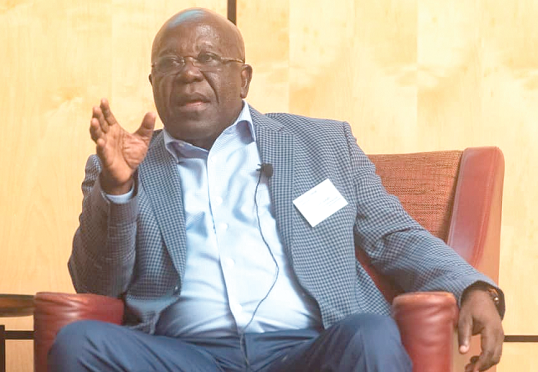
Delivering the keynote address at the Global Business Forum – Ghana Edition on Friday, August 28, Sir Sam Jonah said African countries must move beyond declarations and ensure that the principles of free trade are reflected in how businesses and investors are treated.
“Let us also disabuse ourselves of one comfortable illusion: nobody will buy African out of a sense of duty to the cause. Sentiment is not a supply chain,” he said.
‘AfCFTA will die by our own hand’
Sir Sam Jonah, who began his career underground at Obuasi and later led Ashanti Goldfields to become the first operating African company listed on the New York Stock Exchange, said the fate of AfCFTA ultimately rested with its member states.
He warned that the agreement would not necessarily be undermined by external forces but could instead collapse because of actions taken by African countries themselves.
“If it dies, it will die by our own hand — border by border, permit by permit, prejudice by prejudice,” he declared.
He identified recent xenophobic attacks in South Africa as particularly damaging to the vision of a unified African market.
Describing the attacks as “a dagger aimed at the heart of continental integration,” Sir Sam Jonah warned that such incidents could trigger retaliatory actions in other African countries.
“A free trade area cannot survive among citizens who are not free to trade, to work, and to live among one another in safety,” he said.
Sir Sam Jonah also drew on his own experience as an African investor to illustrate the challenges facing businesses operating across the continent.
He disclosed that a significant real estate investment he made in Nigeria had faced what he described as “sustained harassment by state agencies”.
“Ghanaian workers on the site have endured treatment not dissimilar to the scenes we deplore in South Africa,” he said.
He said he was raising the issue not to embarrass any country but to highlight the broader implications for African investors.
“I say this not to embarrass anyone, but because silence would be the greater disservice,” he said.
He questioned what such experiences meant for younger African entrepreneurs who lacked the financial resources, networks and influence available to established investors.
“If this is the experience of an investor with my resources, my networks and my grey hairs, what hope has the young entrepreneur with none of these?” he asked.
He warned that continued harassment of African businesses on the continent could encourage capital to move outside Africa.
“When African capital is harassed in Africa, we should not wonder why it flees to London and Dubai,” he said.
Sir Sam Jonah called on African governments to focus on implementing existing commitments under AfCFTA rather than creating additional protocols.
He said the success of the agreement would depend on whether member states could create conditions that make intra-African trade easier, faster and more competitive.
“Implementation is the new innovation,” he told governments participating in the forum.
“We do not need another protocol; we need the last one to work.”
He urged African economies to improve their competitiveness while removing unnecessary barriers that make it difficult for businesses to operate across borders.
“Make it cheaper and faster for a Ghanaian firm to sell in Lagos, Abidjan and Nairobi than in Rotterdam,” he said.
Sir Sam Jonah said the AfCFTA could be sustained by countries that honour their commitments, economies that produce goods and services that other African markets want to buy, and governments that protect African investors and workers as strongly as they court foreign investment.
Latest Stories
-
Asos hackers took more personal details than first revealed, BBC finds
1 hour -
Fort Hood shooter’s execution by firing squad will be livestreamed, Pentagon says
1 hour -
Chrysler Building to get its crown restored after being sold
1 hour -
Infantino re-election boost as Concacaf chief will not stand
2 hours -
Everton’s Sherif fined for breaching betting rules
2 hours -
Suspended fine for Xhaka over Covid-19 certificate
2 hours -
Businessman dragged to court over GH¢480,000 fraud
2 hours -
Pregnant woman and husband found dead in a room at Anloga-Kportorgboe
2 hours -
Man, 87, jailed 20 years for defiling nine-year-old girl at Ofankor
2 hours -
Maresca says ‘feeling is fantastic’ among Man City squad
3 hours -
Sam George warns FBI Director against taking sole credit for Ghana cybercrime operation
3 hours -
Foreign capital no passport to Ghana’s informal retail market – GIPA CEO
3 hours -
E&P model should be seen as a blueprint for building local mining giants – GIPA Boss
3 hours -
Govt’s decision to reduce nurse training long overdue – GRNMA
3 hours -
Ghana needs emergency health fund to respond swiftly to outbreaks – SEND Ghana
3 hours