

Audio By Carbonatix
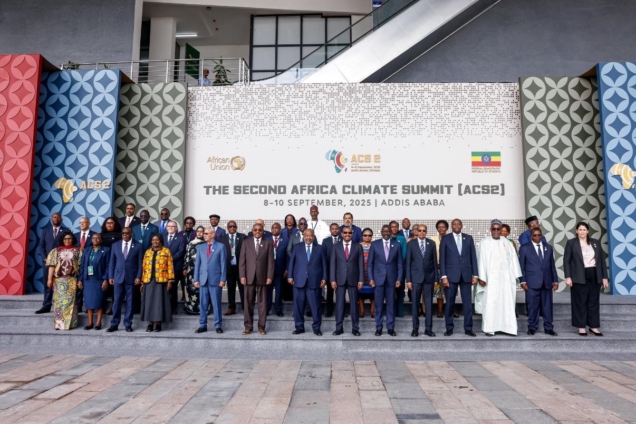
The Second Africa Climate Summit (ACS2) concluded with a clear call to position Africa, not as a mere victim of climate change, but as a driver of solutions and the next global climate economy.
The ‘African Leaders Addis Ababa Declaration on Climate Change and Call To Action’ was officially adopted, heralding a historic moment that puts Africa at the forefront of global climate action.
The Leaders Declaration called for "strengthened and sustained support to scale up the implementation of African-led climate initiatives such as the African Union Great Green Wall Initiative, the African Forest Landscape Restoration Initiative, and the Ethiopian Green Legacy Initiative.
The Summit was hosted by the government of Ethiopia, in collaboration with the African Union, under the theme: “Accelerating Global Climate Solutions: Financing for Africa's Resilient and Green Development”.
Over 25,000 delegates, including heads of state and government, ministers, representatives of civil society, development partners, private sectors, local community and indigenous peoples, farmers, youth, and academia, converged to deliberate and chart a way forward for their future and for posterity.
Financial and innovative Commitments
African leaders and partners of Africa pledged financial and innovative commitments to the continent for the implementation of African-led solutions, including:
The Africa Climate Innovation Compact (ACIC) and the African Climate Facility (ACF) were established under the initiative of the Prime Minister of Ethiopia, Abiy Ahmed, committing to mobilise $50 billion annually in catalytic finance to champion climate solutions that accelerate innovation and scale local climate solutions across the continent. The Compact aims to deliver 1,000 African solutions to tackle climate challenges in energy, agriculture, water, transport, and resilience by 2030.
Leaders were clear that adaptation finance is the legal obligation of the developed world, not charity. Africa stressed that adaptation finance must be delivered in the form of grants, not loans that worsen already fragile debt burdens. To correct the imbalance of the climate finance in Africa, a landmark deal was struck to operationalise the long-awaited African Climate Change Fund, supported by the African Development Bank, which will channel green bonds and innovative financing instruments built for Africa’s realities.
The Heads of State and Government spoke with one voice in demanding urgent reform of multilateral development banks to lower borrowing costs and expand African representation in global financial governance.
The Government of Denmark announced $79 million for supporting agricultural transformation.
African financial institutions such as AfDB, Afreximbank, Africa50, and AFC signed a landmark Cooperation Framework to operationalise the Africa Green Industrialisation Initiative (AGII), backed by $100 billion mobilised for green growth and aiming at transforming Africa’s renewable energy, resources, and industries into a climate-smart growth engine.
The Government of Italy reaffirmed its commitment to its pledge of $4.2 billion to the Italian Climate Fund, devoting about 70% of this to Africa. It signed an MoU with Ethiopia to benefit from this initiative.
The second phase of the Africa Adaptation Acceleration Program (AAAP) called on partners to collaborate actively in AAAP 2.0, which aims to climate-prepare Africa’s food systems, future-proof infrastructure and urban zones, seeking $50 billion investment and unlocking resilient finance at scale by 2030.
The EIB Global has signed technical assistance agreements with Zemen Bank SC, Dashen Bank SC and Hibret Bank in Ethiopia with facilitation through the “Readiness support for greening central banks” of the NDC Partnership as part of EIB Global's devotion to supporting €100 billion of investment by the end of 2027.
The Mission 300 Agenda and the Clean Cooking Initiative were advanced to ensure that 300 million Africans gain access to modern energy and 900 million to clean cooking solutions within the decade.
Leaders further called for Africa’s share of global renewable energy investments to rise from a meagre 2% today to at least 20% by 2030, a shift that would finally reflect the continent’s potential as a renewable energy powerhouse.
The Summit pushed for the Green Minerals Strategy, a blueprint to ensure that cobalt, lithium, copper, and rare earths fuel not only global clean energy supply chains but also local beneficiation, job creation, and industrialisation.
Leaders pledged to establish dedicated financial mechanisms for addressing climate-related health threats, from deadly heatwaves to the spread of vector-borne diseases.
ACS2 also marked the official launch of the newly developed Africa Just Resilience Framework (JRF), which will work alongside the Climate Justice Impact Fund for Africa (CJIFA) to provide a framework and funding for local climate initiatives. CJIFA has already dispersed 64 grants in 17 African countries.
Road to Belem for COP30
At a time when many global summits have been reduced to finger-pointing and stalemates, ACS2 was notable for its spirit of cooperation.
The presence of leaders from across the African Union Member States, alongside global partners, reinforced the message that climate is the ultimate test of multilateralism.
The summit’s success is proof that Africa can convene, lead, and deliver outcomes that reverberate globally, that will directly carry into COP30 and beyond.
Latest Stories
-
Young girls demand climate action, stronger protection against child marriage
3 minutes -
Ex-gang boss sentenced to 40 years for orchestrating Tupac Shakur’s murder
3 minutes -
From near-deferral to three awards: UMaT graduate’s academic journey
5 minutes -
Atta Akyea denies seeking presidential pardon for Wontumi in galamsey case
43 minutes -
Photos: Mahama commissions 85-bed Police Hospital ward, donates two ambulances
51 minutes -
GTEC directs Ghana’s public universities to reopen by October 16 and begin lectures on October 19
53 minutes -
Star Oil donates GH¢1million towards construction of new CID facility
57 minutes -
Court hands Adjetey Sowah, two others lifetime bans after Amputee Football legal dispute
1 hour -
NDC appoints Julius Kwame Anthony as a Deputy Communications Director
1 hour -
Ghana repatriates 120 Nigerians rescued from suspected cybercrime centres
1 hour -
NPP rejects Emelia Agbenyo’s appointment as Deputy EC Chair, demands withdrawal
1 hour -
EOCO grants Suame MP John Darko enquiry bail in GH¢27m SIC investigation
1 hour -
NPP cannot question EC appointment after appointing own people to Commission – Kwakye Ofosu
1 hour -
BoG deepens public trust with regional stakeholder forum in Techiman
2 hours -
‘We have turned the tide’ – Ato Forson says Ghana is ready to take off
2 hours