

Audio By Carbonatix
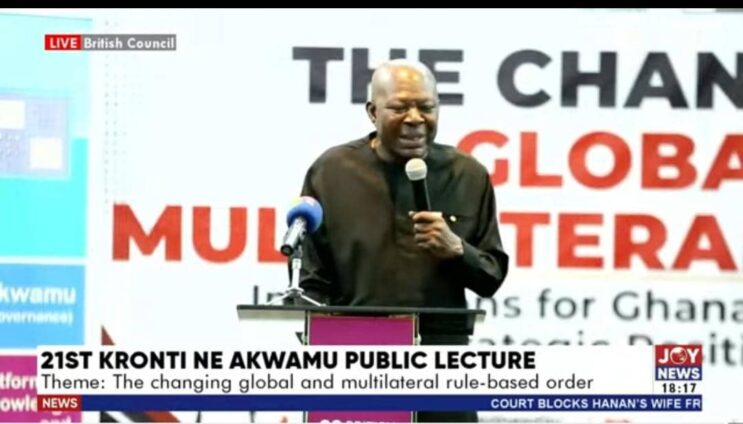
President of the Ghana Council on Foreign Relations, Ambassador D.K. Osei, has called for bold and visionary leadership across Africa.
He warned that "the continent risks losing its influence in an evolving global order unless leaders take decisive steps to deepen integration and speak with one voice on international issues."
Addressing participants at the 21st Kronti ne Akwamu Public Lecture on the theme, "The Changing Global and Multilateral Rule-Based Order," Ambassador Osei said the world is undergoing profound geopolitical shifts that demand a stronger and more coordinated African response.
According to him, while Africa has outlined ambitious development aspirations under Agenda 2063, achieving those goals will require difficult decisions and sacrifices from member states.
"There are sacrifices the continent will have to make," he said, explaining that some of the reforms envisioned under Agenda 2063 may require countries to cede aspects of their sovereignty, particularly in areas such as security and foreign policy.
He also questioned whether African states are prepared to elevate continental integration by strengthening the African Continental Free Trade Area (AfCFTA) and pursuing more ambitious initiatives such as a common African currency.
"Are we ready to do that? Are we willing, for instance, to consider a continental currency? I'm not sure the record of Africa internationally indicates that we are willing to be doing that," he stated.
Ambassador Osei argued that Africa's response to recent global developments has exposed weaknesses in the continent's collective leadership and commitment to multilateralism.
Using the Economic Community of West African States (ECOWAS) as an example, he noted that although "the regional bloc has acknowledged the instability in the global order, some of its decisions have failed to demonstrate the bold leadership required to navigate current political and security challenges."
He further criticised what he described as Africa's fragmented approach to the race for the next United Nations Secretary-General, saying the continent's decision to support more than one candidate weakens its chances of securing the position.
Referring to Ghana's former President and UN Secretary-General Kofi Annan, Ambassador Osei said Africa had previously benefited from presenting a united front, allowing Annan to serve two successful terms.
"So why are we throwing in two candidates when we know that we are not going to get the position of UN Secretary-General?" he questioned.
He warned that such divisions undermine Africa's credibility and cast doubt on whether the continent is genuinely prepared to embrace a new economic and political paradigm capable of addressing today's global challenges.
Despite the concerns, Ambassador Osei expressed optimism that Africa can still chart a different course if it embraces courageous and visionary leadership.
He recalled a period when leaders such as Ethiopia's late Prime Minister Meles Zenawi, former South African President Thabo Mbeki and former Senegalese President Abdoulaye Wade worked together to champion transformative continental initiatives, including the New Partnership for Africa's Development (NEPAD) and the African Peer Review Mechanism (APRM).
According to him, those leaders were willing to challenge prevailing views and persuade their colleagues to pursue reforms that strengthened African institutions and cooperation.
Latest Stories
-
Interest payments to average a high 20% of government revenue over next 4 years
2 hours -
Strategy of accumulating foreign reserves, gold carries high fiscal cost – S&P Global
2 hours -
Weak institutional arrangements, high debt servicing constrain Ghana’s rating – S&P
2 hours -
Bond market: Turnover declined by 28% to GH¢1.56bn
3 hours -
Volta Region National Public Speaking contest advances drug prevention conversation
3 hours -
New health training facility at Ampoma-Jema to address admission shortfalls, but Minister flags missing amenities
3 hours -
Black Challenge unveiled with sights set on Amputee World Cup glory
3 hours -
Pay striking teachers before expressway spending, Dr Kingsley Agyemang tells government
4 hours -
Customs intercepts assault rifle, two pistols and 610 rounds of ammunition at Tema Port
4 hours -
PKO boxers secure wins at Odwira Festival
5 hours -
South Tongu Records Rise in Teenage Pregnancy
5 hours -
Cabinet threw out US health compact faster than anything I’ve seen – Mahama
5 hours -
MoFA urges Finance Ministry to reverse World Bank food programme withdrawal over GH¢643m commitments
5 hours -
NAGRAT demands signed timelines before calling off strike
5 hours -
National Investment Quiz: West Africa SHS, St. Louis SHS advance to semi-finals
6 hours