

Audio By Carbonatix
Six months have passed since the Akosombo Dam disaster, yet victims lament that they have not regained normalcy, as the government remains silent on the path forward.
On September 15th, 2023, the lives of many Ghanaians in the lower Volta basin changed drastically. The Volta River Authority (VRA) opened the floodgates of the country's largest hydro dam, the Akosombo Dam, citing excessive water levels threatening the dam's sustainability.
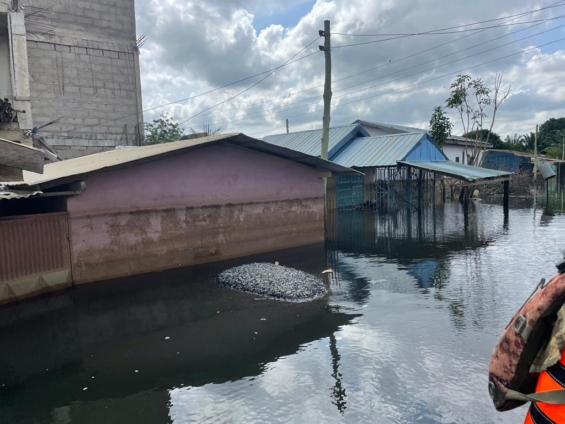
Subsequently, hundreds of downstream communities were inundated, leading to the destruction of thousands of livelihoods and homes, rendering many homeless and disrupting education for months.

According to the National Disaster Management Organization (NADMO), approximately 39,000 Ghanaian lives were affected. In North Tongu alone, over 1,540 homes were destroyed.
Six months after this unprecedented disaster, Joy News revisited the affected areas to assess how victims were faring in its documentary 'AFTER THE FLOODS.' From Mepe, the epicentre of the flood disaster, the Joy News team surveyed over 112 villages in the North, Central, and South Tongu in the Volta Region, and interviewed numerous victims across communities.

In Mepe, victims like Patrick Worlanyo, a father of two, expressed their ongoing struggle to rebuild their lives. Worlanyo, who used to rely on his corn mill and domestic poultry for his family's livelihood, now finds himself jobless and homeless. He recounted, "On that fateful day, my corn mill and entire compound were flooded within minutes. My corn mill is now unusable, and since the flood, I have been unemployed." He added, "Even my domestic poultry, on which I relied, perished due to the flooding."
In addition to losing his source of income, Worlanyo's house suffered extensive flood damage, rendering it uninhabitable. He lamented, "I am now staying with a Christian sister in another community. I couldn't salvage anything from my room, and the structure itself is on the verge of collapse."
Thirteen kilometres away in the Sikor community, where over 100 houses were destroyed, the Joy News team met 54-year-old Agboklayi Amevor. His six-bedroom house was razed by the flood, and his nine fishponds, each stocked with 3,000 catfish fingerlings, were completely swept away along with his water pumping machines. Amevor stated, "I had invested a total of GHC 100,000 in this fish farming business. But now, everything is gone. I am homeless and jobless."

In Agave Ziwoenu, South Tongu district, 14 out of approximately 30 homes in the island community were flattened by floodwaters. Pregnant women were observed sleeping in makeshift structures made of palm branches and polythene as roofs.
A 42-year-old father of two recounted how reptiles entered their dwellings almost every night due to the absence of doors.
These stories resonate across the 112 villages visited by the Joy News team, with livelihoods destroyed and victims enduring severe post-disaster conditions.

The government announced a 220 Ghana cedis package for flood victims in its 2024 budget. Later, during the president's address at the 67th Independence Day celebration on March 6th, 2024, it was captured in the speech, "As set out in the 2024 budget, the government has set aside two hundred and twenty million cedis (GH¢220 million), of which eighty million cedis (GH¢80 million) has already been released by the Ministry of Finance, to support the ongoing rehabilitation efforts for the affected communities. Government will stop at nothing to restore normalcy to the lives and livelihoods of all affected persons."
However, the Mankralo of Mepe, Togbe Korsi Nego VI, expressed dissatisfaction with the lack of clarity regarding government plans six months after the disaster. Togbe Nego asserted, "We have not seen any tangible action on the ground. The inter-ministerial committee has not even visited us to hear our grievances. How can they address our concerns if they do not engage with us?"
He revealed that relief items from corporate Ghana and charitable organizations had also depleted, exacerbating the situation.
Questions linger regarding the fate of flood victims: Why has the government not fully intervened after six months? Why hasn't a national inquiry into the disaster been launched? What is the government's strategy for compensation and resettlement, and who should be held accountable for this unprecedented disaster?
With the victims’ losing patience, they are determined to compel the government to restore them to their previous lives. Until then, their future remains uncertain, as the government's intentions remain unclear.
Latest Stories
-
EOCO is only carrying out its mandate, not violating Baffour Awuah’s rights – Dzimegah
14 seconds -
Heavy security at Baba Yara Stadium as NPP elects national officers today
6 minutes -
Horticulturists call for dedicated authority, irrigation and tomato factory revival
25 minutes -
Nakpayili E-Block opens, admits first batch of 650 students after nearly a decade of neglect
26 minutes -
Ethel Cofie writes: You need board experience to get board experience
30 minutes -
Baffour Awuah expected in court as EOCO moves to meet bail deadline
40 minutes -
Happy 76th Birthday to the Daily Graphic!
44 minutes -
Weija Children’s Hospital now operational with 120-bed capacity – Health Minister
55 minutes -
Health Minister orders deployment of 40 additional health workers to Weija Children’s Specialist Hospital
1 hour -
Greater Accra teacher unions back nationwide strike over three key demands
1 hour -
Bawumia promises leases and redevelopment for businesses affected by La Beach demolition
1 hour -
Bawumia condemns La Pleasure Beach demolition, questions destruction of movable assets
1 hour -
Livestream: Newsfile discusses EOCO arrest of Manhyia South MP, drug trafficking, teachers’ strike and Ghana’s sports crisis
1 hour -
Chief of Staff urges effective implementation of laws to strengthen public confidence
2 hours -
La Dadekotopon NDC, MP demand answers over demolition of La Pleasure Beach
2 hours