

Audio By Carbonatix
The agriculture sector in Ghana is confronted with multiple challenges, including the need to ensure profitability, adapt to climate change, and promote sustainable practices.
Due to these challenges, farmers are being urged to adopt methods that are environmentally conscious to maximize returns.
Traditional agricultural practices such as bush burning, monocropping, excessive chemical usage, and lack of product value addition are notable hindrances to agricultural and environmental sustainability.
The situation is worsened due to a lack of knowledge when it comes to proper farming models.
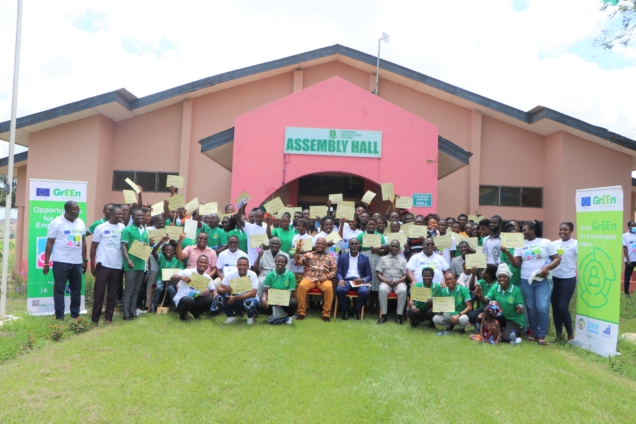
In view of this, some 83 farmers and prospective farmers have received training from the SNV Boosting Green Employment and Enterprise Opportunities in Ghana (GrEEn) Project. This is in partnership with the Kwadaso Agricultural College
This number adds to 114 trained and certified agricultural entrepreneurs in the agriculture value chain from the Ashanti and Western Regions of Ghana who graduated from the program in February, this year.

The SNV’s Basic and Advanced Skills training under its Opportunities for Youth Employment (OYE) Programme seeks to equip beneficiaries with Climate Smart Agricultural practices.
Beneficiaries will increase their entrepreneurship and employability skills after going through courses in agro-processing, basic concepts in the value chain, crop production, financial literacy and management.
SNV Senior Skills Advisor, Awudu Darmani Musa, indicated that the key to maximum profits is to incorporate innovative methods into farming.
“Most of them are farmers or entrepreneurs who needed some theoretical background in what they are doing and also seek innovative ways of doing things. We are looking at climate change models and experiences to be put into their activities. Farmers don't know the scientific backgrounds of their practices and their effects.
"Like burning the bushes. They don't know the effects of it. So with this program, they had gone through this training and experience. Through the program, they have learned how to turn their farm produce into a useful product for them to maximize their profit,” he said.
Ejisu Municipal Director of Agriculture, Dr. David Anambam, implored agricultural practitioners and experts to take up the task of educating farmers.
“Farmers have to do their work, but the extension officer is there to assist them to improve and employ modern farming practices. Some places have one officer to 2,500 farmers. Farmers can be helped to apply experience to the theory they learn here. And that will improve their work and income. Programs like this can solve such issues.
“We should demarcate, our farmer population into the various districts. Opinion leaders who are like an extension of extension officers can teach farmers new methods. And programs where we have practitioners who teach them about their work is also better,” he said.
Principal of Kwadaso Agriculture College, Albert Appiah Amoako, revealed the school is going digital.
"…such that we now monitor produce right from production to harvesting through technology. We entreat organic farming without the use of chemicals. The sector has attracted many people. The population in Kwadaso has moved from 500 to about 921. It tells us that what we are doing here is increasing the numbers, and we need to expand our facilities now. The good news is, a lot of them are female.”

Beneficiaries of the training and financial grants of the SNV GrEEN expressed their appreciation and enlightenment.
“As a rice farmer, I only cultivate rice but, the training has enlightened me that I could start a pig farm and feed them with my rice husks. And this will generate extra income,” a beneficiary said.
Another continued that, “SNV came to our community and realized my need as a rice farmer and gave me a grant. Firstly I was working on 2 acres of land, but now working on 7 acres of and with about 10 casual workers. And I came here to gain additional knowledge to top up to expand my business,” Ahiamadzor Selasi said.
“I have been on poultry for some time now, but the animals keep dying. Today's training has taken me through practices that can maintain them and prevent losses. I have been taught how to cultivate a side business like mushroom irrespective of land size. I am very grateful that I took this opportunity,” said Hannah Akuttei
Latest Stories
-
Gov’t to establish Prison Industrial Hub to equip inmates with income-generating skills – Prison Service boss
15 minutes -
Alhassan Tampuli donates cement, roofing sheets to support storm victims in Gushegu
15 minutes -
Alhassan Tampuli appeals for urgent support for storm victims in Gushegu
18 minutes -
The hypocrisy must stop; pass Anti-LGBTQ+ Bill now – Alhassan Tampuli to Mahama
22 minutes -
Imprisonment should be rehabilitative, not punitive – Ghana Prisons boss at UNGA
44 minutes -
Ga Adangbe traditional priests petition Mahama over McDan aviation licence revocation
55 minutes -
Anti-LGBTQ Bill: NDC’s arrogance is worrying – Hassan Tampuli
1 hour -
Let’s give OSP time to mature, not to scrap it – Hassan Tampuli
1 hour -
Nigeria convicts 386 Islamist militants in mass trials
1 hour -
Djibouti president wins election with 97.8% of vote, state media says
1 hour -
We don’t have mandate to deduct tax from rent allowance of security services personnel – Interior Ministry clarifies
2 hours -
Ablakwa receives Presidential Special Envoy on Reparations to advance global agenda
2 hours -
Christina Koch becomes first woman to travel around the moon on Artemis II
2 hours -
Epstein survivors’ calls to meet King Charles and Queen harder to ignore as US visit approaches
2 hours -
UN Secretary-General names Ghana’s Anita Kiki Gbeho as South Sudan envoy
2 hours