

Audio By Carbonatix
The Ghana Association of Agricultural Economists (GAAE) has outlined ten key recommendations aimed at transforming the country’s agriculture and food systems through sustainable agribusiness development.
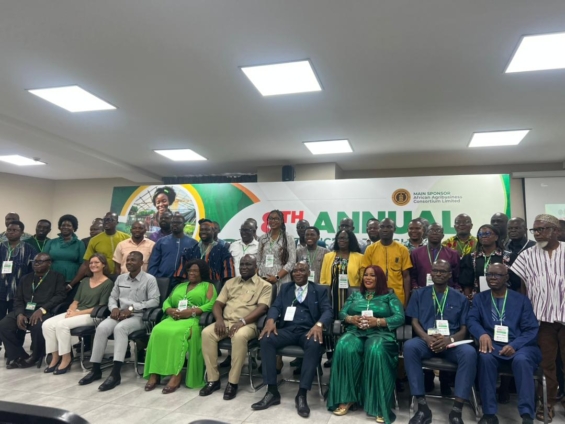
The proposals were presented at the close of the Association’s 8th Annual Conference, held from 6th to 7th November 2025 at the Kwame Nkrumah University of Science and Technology (KNUST) under the theme “Transforming Agri-Food Systems in Developing Economies through Sustainable Agribusiness Development.”
The two-day event brought together agricultural economists, agribusiness experts, agronomists, policymakers, young agripreneurs, and industry players to discuss practical solutions for advancing Ghana’s agricultural sector. Over 70 research papers were presented, covering areas such as agricultural policy, value chain development, food security, and postharvest management.
Speaking at the conference, members of the Association stressed that sustainable agribusiness and increased investment in agriculture are essential for achieving food security and inclusive growth.
“In addition to providing an enabling policy environment, we call on government to increase budgetary allocation — at least 10% — for the agricultural sector. Adequate investment in agribusiness is critical to transforming Ghana’s agri-food systems,” the Association urged in a communiqué.
Among the top recommendations was a call for sustainable cocoa production practices to help Ghana maintain access to premium international markets and comply with the European Union’s Deforestation Regulation (EUDR). The economists emphasized the need for empirical data on carbon sequestration in cocoa farming systems to inform both national policies and farm-level practices.
On agribusiness development, industry leaders at the conference encouraged young entrepreneurs to “dream big, start small, and start now.” They urged agribusiness start-ups to seek creative partnerships and leverage available resources to sustain their ventures.
The experts also underscored the importance of climate-smart agriculture in addressing the growing challenges of food insecurity and water scarcity. They recommended scaling up technologies such as the Alternate Wetting and Drying (AWD) system for rice farmers to improve productivity and profitability.
The GAAE called for stronger collaboration between researchers, the private sector, and government institutions to accelerate innovation in the agri-food sector. They further appealed to private agribusiness operators to partner with the Association to conduct research that offers “practical, evidence-based solutions” to sector challenges.
The conference concluded with a renewed commitment from GAAE and its partners to foster public–private partnerships, evidence-based policymaking, and capacity building for the next generation of agribusiness leaders.
Participants affirmed that transforming agri-food systems through sustainable agribusiness is vital for achieving inclusive economic growth, food security, and environmental sustainability in Ghana and across Africa.
Latest Stories
-
MTN Ghana trains civil society organisations on artificial intelligence
32 minutes -
GoldBod FX framework aims to make dollar supply predictable – Acheampong
1 hour -
How does a Ghanaian team make it to the BAL?
1 hour -
Ghana’s investment climate presents opportunities for industrial growth and job creation.
1 hour -
‘I paid thousands to a company for jobs that never came’
1 hour -
SSNIT intensifies informal sector enrolment drive with Techiman float
2 hours -
Ghana seeks long-term mining investments that benefit local communities – Armah-Kofi Buah
2 hours -
GHATOF demands compensation for 85 businesses affected by La Pleasure Beach demolition
2 hours -
Bono Regional Minister calls for investor education to drive economic growth
2 hours -
Ghana’s Ambassador to China, Kojo Bonsu, presents credentials to Nepalese President
2 hours -
Fairtrade Africa’s Cocoa Hubs Project strengthens rural service centres in cocoa-growing communities
2 hours -
MPs are not development officers – Edem Kpotosu
2 hours -
SEC cautions investors against fraudulent investment schemes
2 hours -
Land Ministry urges rCOMSDEP operators to reserve earnings for land reclamation
2 hours -
Commercial drivers give authorities one week to clear traders from lorry terminals, bus stops
2 hours