


Audio By Carbonatix
On the opening day of "Get Up, Stand Up Now -- Generations of Black Creative Pioneers," lines of visitors snaked around the courtyard of London's Somerset House.
The landmark exhibition celebrates the last half-century of African diasporan artists, who have often been denied the recognition they deserve. And if the crowds are anything to go by, the acknowledgment is long overdue.
Among the more than 100 participating artists -- from across multiple disciplines and generations -- is Nigerian-American painter Victor Ekpuk.
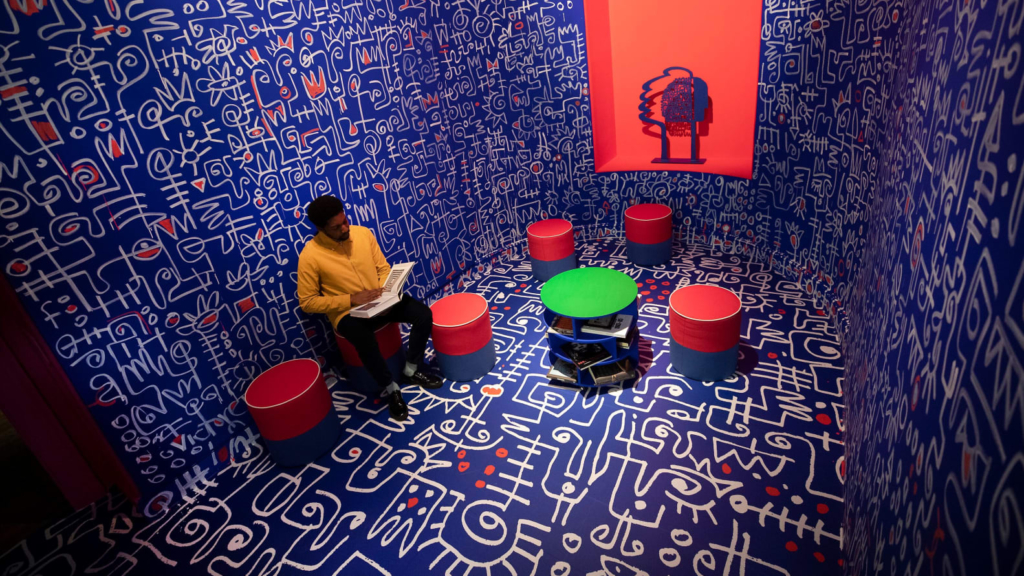
His room-sized installation, "Shrine to Wisdom," invites visitors to sit and learn, while immersed in one of his signature murals, which is based on an ancient writing system.
CNN caught up with Ekpuk to discuss whether his afro-futuristic art pre-empted "Black Panther," and why we need more platforms to champion black creativity.
Let's talk about your new installation at Somerset House, "Shrine to Wisdom." Why did you create this mural?
Victor Ekpuk: I was contacted by Zak Ové, the curator, to contribute to the exhibition because of the nature of my work -- my large murals look at futuristic ideas of learning and knowledge.
I write these glyphs inspired by ancient writing systems in (what is now) Nigeria. They are actually knowledge-based art forms called "Nsibidi."People come into the room and feel like they are in a sacred space where they should learn something.
They're always eager to know what the symbols mean. The idea was to have an interactive space were people would walk in and be engulfed, (and) feel like they are in the womb of this knowledge. You are engulfed in entirety in writing.
What originally drew you to Nsibidi symbols?
Way back when I was in art school, there was a push for students to look closer to Nigerian traditions.
I came to Nsibidi because it's my direct tradition: I'm from Nigeria. Also its one of the earliest forms of writing or knowledge.
Do your individual glyphs all have meanings?
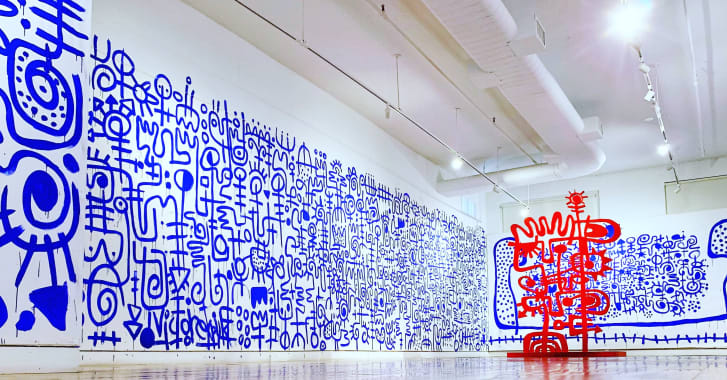
I'm not necessarily using the traditional symbols in my work. I've crafted my own "language," in making my own abstract marks.
There's also the sense of reducing ideas to their essence, because that's what the art form is about -- to reduce ideas or concepts to graphic symbols.
It's not like the Roman alphabet, where graphic symbols represent sounds, and when they are put together they make a word which explains a concept. In this form of writing, the graphic symbols represent ideas.
This work has been described as afro-futuristic -- would you say this is a fitting description?
Yes, it is definitely afro-futuristic. In a sense, Nsibidi themselves are afro-futuristic signs and technology.
You see it in "Black Panther' -- (in) the symbols they used in the palace and on the clothes the actors were wearing. Even bracelets had beads with inscriptions of Nsibidi and other African graphic systems.
And each of those beads were power systems that could be used as a weapon, or as a seed to create more.
"Black Panther' plays into the rethinking of the presentation of African knowledge. I was doing it before the movie. Since I left college I've been making work in that style.
With films like "Blank Panther" and exhibitions celebrating black creativity -- do you think there is a movement to rethink how African knowledge is presented?
I think so. It makes it easier for me to talk about my work. If I reference a blockbuster movie like "Black Panther," people have already seen an example of how ancient African graphic systems are used as power symbols.
It gives me an angle to talk to someone who has never experienced my culture.
It's mesmerizing to watch you drawing all over the walls in such an all-encompassing space. What's going through your mind as you create the symbols?
I'm trying to let my hands catch up with what's going on in my head at that time. It takes a lot out of me, mentally and physically.
There's only so much the physical body can do! But I do not plan ... the next mark, it just flows. I do pre-plan the concept, but when I actually arrive at the space, I don't make sketches.
What does it mean to you to be part of the "Get Up, Stand Up Now" exhibition?
It's very significant for me. I believe as an African, as somebody who grew up in non-Western society, it always seems like our voices are not being heard.
We've experienced a lot of appropriation of the ideas of African creativity, but haven't had the creators at the center.
Until now, when you talk about British art, for instance, very rarely do you see black names associated with it.
As an African in the diaspora, I share in this history of artists not being appreciated -- not because their work is not good, but because of the color of their skin.
So maybe this exhibit gives an opportunity for a dialog to begin to change. It's a conversation that's going on throughout the world. The United States is having that conversation too.
Museums in the United States are becoming more inclusive, and they're having large exhibitions of African American artists, and Africa diaspora artists, that before now have not been represented.
"Get Up, Stand Up Now -- Generations of Black Creative Pioneers" is on until Sept. 15, 2019, at London's Somerset House.
This interview has been edited for length and clarity.
Latest Stories
-
Hawa Koomson pledges experienced and mature leadership of NPP women’s wing
31 minutes -
Young woman found dead at Kasoa Peace Town
1 hour -
Playback: The Law examined lawful arrest in Ghana
1 hour -
Mahama urges African governments to treat healthcare as an investment, not budget cost
2 hours -
Bawumia congratulates John Boadu and new NPP executives, pledges support ahead of 2028
2 hours -
‘No talent should be left out’ – Bawumia pledges inclusive NPP campaign for 2028
2 hours -
Prof. Mike Oquaye recounts how he blocked the Special Prosecutor’s attempt to arrest Bawku Central MP
2 hours -
Make health sovereignty a priority for Africa – Mahama
3 hours -
Dorimon Naa, Wa West DCE lead massive clean-up exercise; threaten sanctions against recalcitrant residents
3 hours -
Photos from Adom FM Y2K Jam
3 hours -
Praye Tiatia steals the show at Adom FM Y2K Jam [Watch]
3 hours -
Boakye Agyarko congratulates John Boadu, pledges support for NPP leadership
3 hours -
Antwi HiMight thrills fans with Antwi ne Antwi hits at Adom FM’s Y2K Jam [Video]
4 hours -
Amb. Edward Boateng congratulates Boadu, Kodua on election wins
4 hours -
John Boadu pledges to rebuild NPP from grassroots and restore ‘winning machinery’
4 hours