

Audio By Carbonatix
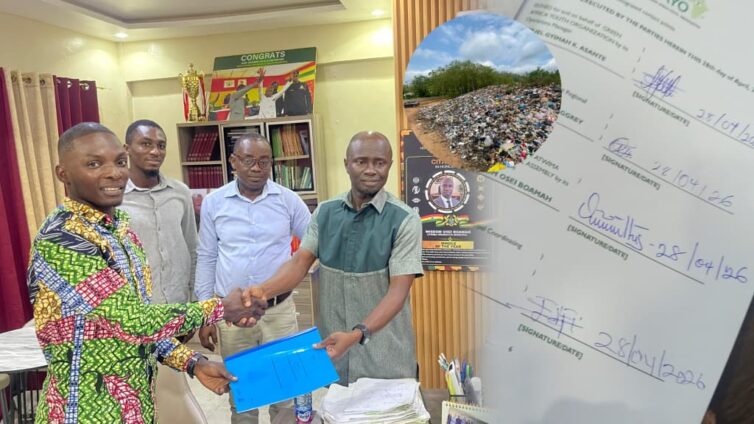
The Atwima Nwabiagya Municipal Assembly has signed a Memorandum of Understanding (MoU) with the Green Africa Youth Organisation (GAYO) to develop alternative waste management solutions, as pressure mounts over possible restrictions on the use of the Oti Landfill.
The agreement is aimed at reducing the municipality’s dependence on the landfill, which is currently under strain and may soon be restricted by the Kumasi Metropolitan Assembly (KMA).
Speaking after the signing, GAYO’s Zero Waste Ashanti Regional Coordinator, Sampson Osei Tutu Aggrey, said the partnership is a timely intervention to avert a looming sanitation crisis.
“We came to sign an MoU with the municipality in order to partner on managing the sanitation crisis at hand… We cannot stand by while the municipality faces this challenge when we have a viable solution,” he said.
The Oti Landfill, managed by the KMA, serves Kumasi and about 13 surrounding districts, including Atwima Nwabiagya. However, it currently receives between 2,000 and 3,000 tonnes of waste daily — far exceeding its design capacity — raising concerns about operational sustainability and possible closure.
In response, the Assembly and GAYO are rolling out the Zero Waste for Sustainable Cityscape Project, which seeks to reduce landfill dependency by promoting recycling, composting and waste segregation.
Under the MoU, the Assembly will provide land for key infrastructure, including a material recovery facility and an urban demonstration garden, as well as facilitate regulatory approvals. GAYO will, in turn, provide technical expertise and resources to implement the project.
Mr Osei Tutu Aggrey explained that the initiative is designed to divert waste from landfills and the environment, while creating value through a circular economy approach.
“This project will help us reduce waste going to landfill sites, prevent pollution, and create a sustainable system that benefits the community,” he noted.
Municipal Coordinating Director for Atwima Nwabiagya South, Eric Anarfi, welcomed the initiative, describing it as a forward-looking solution to the municipality’s growing waste management challenges.
“GAYO’s intervention comes at the right time… By helping us manage waste properly, it will also generate employment for our community people, particularly the youth,” he said.
He added that the project will also support efforts to introduce waste segregation at source and reduce the cost burden of waste management on the Assembly.
The partnership comes at a time when urban authorities across Ghana are grappling with rising waste volumes and limited landfill capacity, making sustainable waste management solutions increasingly critical.
Latest Stories
-
US immigration officials defend ICE agents who shot man in same car as child
2 minutes -
Commentator Katie Zacharia picked as new White House press secretary
5 minutes -
Drone strike by Sudan paramilitary kills 41 near Ethiopian border, rights group says
12 minutes -
King warns malicious online actors are evolving tactics
19 minutes -
Several injured as Saudi capital airport reportedly hit again
21 minutes -
Christa Pike discharged from hospital and returned to prison, her lawyers say
24 minutes -
Ghana’s BRICS move requires clear strategy to manage risks – Godfred Bokpin
2 hours -
Pay teachers realistic income – Duncan Amoah to gov’t
2 hours -
Bechem to become chicken capital of Ghana – Mahama projects
2 hours -
Gov’t targets recruitment of 16,500 health professionals in 2026
3 hours -
Two-week strike will not derail academic calendar – GNAT President
3 hours -
Headmaster detained after BBC investigation into alleged sexual abuse of students
3 hours -
GNAT pushes for clear implementation procedures of teachers’ conditions of service
3 hours -
Recurrent strikes threaten quality of education and academic calendars – Prof Bokpin
4 hours -
‘Cockroach’ group leaders among hundreds detained in Delhi protest
4 hours