

Audio By Carbonatix
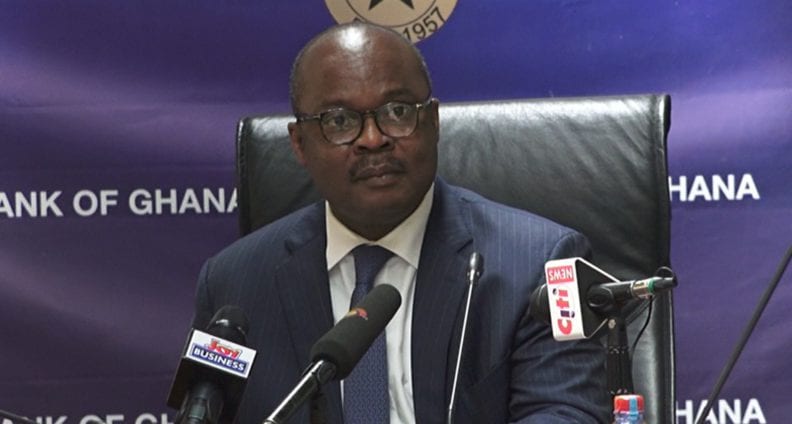
The Monetary Policy Committee of the Bank of Ghana (BoG) has lowered the policy rate by 150 basis points from 16 percent to 14.5 percent.
This is the first time since 2019 that the central bank has lowered the policy rate.
Before this reduction, The Bank of Ghana has since January last year kept the policy rate unchanged six times.
According to the BoG the Coronavirus pandemic has “significantly heightened uncertainty in global financial markets, causing a sharp downturn of global stock prices and a steep rise in emerging markets’ sovereign bond spreads. These unfolding developments have further worsened the pre-existing weaknesses in global growth and caused major disruptions to global supply chains with adverse implications for the global economy.”
In a statement on Wednesday, the BoG said “An initial assessment by the Organisation of Economic Co-operation and Development suggests that global growth could slow by about 0.5 percent this year, given the scale of disruptions to current economic activity.
“The slowdown could be deeper in a worst-case scenario, especially if the pandemic is not effectively contained in the near-term. The potential adverse effects of COVID-19 on growth, along with the sharp fall in commodity prices, will weigh heavily on economic activity in emerging market and frontier economies.”
On the domestic economy, the Bank’s internal assessment shows that the pandemic could impact Ghana through a number of channels.
First, the dampened global demand could significantly impact Ghana’s crude oil export earnings with major implications for foreign inflows and tax revenues.
There is also a likelihood of export restrictions from advanced economies and other emerging market economies which could create supply chain shortages for Ghanaian businesses, with significant impact on imports of intermediate and capital goods, as well as consumption goods.
This is expected to negatively affect inputs in the domestic production channels with severe consequences for growth and tax revenues which could become more pronounced by the second or third quarter.
In addition, crude oil prices have declined sharply to historically low levels, and already creating negative shocks on exports, albeit with some offsetting effects from rising gold and cocoa prices.
Economic impact of COVID-19
In the assessment of the Bank, the negative impact of COVID-19 on exports, imports, taxes, and foreign exchange receipts will culminate in a slowdown in economic activity.
GDP growth is forecasted to decline to 5.0 percent in a baseline scenario. In the worst case scenario, GDP growth estimates could be halved to about 2.5 percent in 2020. These assessments are preliminary as the situation is very fluid and the degree of uncertainty concerning the outbreak is very high.
This means that there is a likelihood that these assessments could change rapidly.
The latest inflation reading for February 2020 is estimated at 7.8 percent, unchanged from January 2020.
The forecast for inflation is expected to remain within the target band for the next quarter.
Latest Stories
-
Ablakwa receives Presidential Special Envoy on Reparations to advance global agenda
8 minutes -
Christina Koch becomes first woman to travel around the moon on Artemis II
19 minutes -
Epstein survivors’ calls to meet King Charles and Queen harder to ignore as US visit approaches
24 minutes -
UN Secretary-General names Ghana’s Anita Kiki Gbeho as South Sudan envoy
26 minutes -
Mali withdraws recognition of Sahrawi Republic, backs Morocco’s autonomy plan
31 minutes -
Gov’t distributes over 8,500 laptops to One Million Coders project
32 minutes -
Julius Debrah, ‘man to beat’ as NDC’s James Agbey dismisses Musah Dankwah’s polls
38 minutes -
GPRTU in Savannah Region to protest alleged eviction in Damongo
1 hour -
Re: Reinsurance does not replace process — A response to the SIGA–SIC defence
1 hour -
Gender Ministry supports Harriet Amuzu in ongoing abuse case
2 hours -
AG joins plaintiff to scrap OSP ?: We should be mindful of the mischief in this – Bobby Banson
2 hours -
Samson Lardy Anyenini questions willingness of Attorneys-General to prosecute political colleagues
2 hours -
It is only fair the OSP is heard in Supreme Court case – Bobby Banson
2 hours -
Asiedu Nketia resumes Ashanti tour, second leg kicks off on Sunday
2 hours -
NLA denies salary cut claims, threatens legal action over reports
2 hours