

Audio By Carbonatix
The Bank of Ghana (BoG) has announced a series of new policy measures aimed at strengthening Ghana’s digital economy and enhancing the operations of financial technology (fintech) firms.
A key component of the new strategy is a Digital Identity Integration Mandate, which will require all financial service providers to adopt interoperable digital identity standards.
This will be implemented as part of enhanced Know Your Customer (KYC) policies and fraud detection systems within the country’s financial institutions.
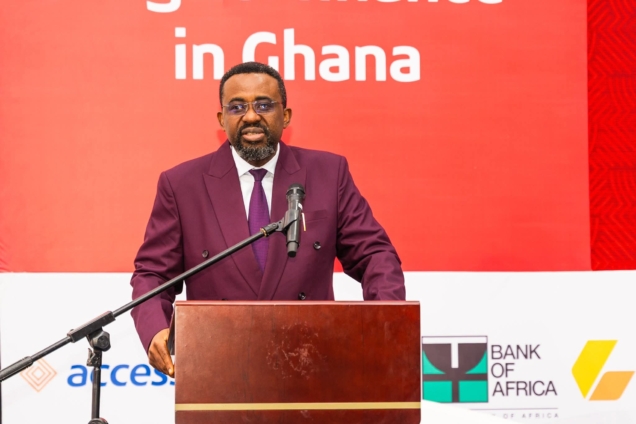
Announcing the measures at the Ghana Association of Banks Industry Thought Leadership Programme under the theme “Banking the Last Mile: An Industry-Led Strategy for Accelerating Digital Finance,” BoG Governor Dr. Johnson Asiama stressed the importance of collaboration between regulators and industry players.
Dr. Asiama also revealed plans to establish an Artificial Intelligence and Risk Governance Working Group, comprising the Bank of Ghana, the Ghana Fintech and Payment Association, and leading banks.
The group will develop policy recommendations on the use of AI in credit scoring, fraud detection, and financial decision-making.
In addition, the Central Bank will convene a National Digital Finance Interoperability Forum starting in the third quarter of 2025.
This quarterly dialogue platform will bring together banks, fintechs, telcos, and regulators to ensure sustained policy alignment and coordination.
“These are not isolated actions,” Dr. Asiama emphasised.
“They are part of a long-term vision for a safe, interoperable, and inclusive financial ecosystem with the industry as co-architect.”
The Governor also announced the upcoming Virtual Assets and VASPs (Virtual Asset Service Providers) Bill, which will provide legal clarity and foster innovation in the growing digital assets space.
Ghana’s Digital Financial Landscape
Presenting an overview of the country’s evolving digital finance landscape, Dr. Asiama disclosed that over 97% of digital transaction volumes and 72% of transaction value are now processed through mobile money platforms, while traditional bank digital channels account for less than 1% of volume.
He noted that more than four million Ghanaians have accessed unsecured mobile loans, often beyond the reach of traditional financial institutions.
“This divergence is not merely statistical,” he stated. “It is structural.”
Dr. Asiama emphasised that “it signals a shift toward an ecosystem where fintechs and telcos are increasingly shaping financial access and consumer behaviour.”
However, he raised concerns about low active usage of digital accounts for savings, credit, pensions, and insurance, especially among low-income populations, women, and rural dwellers, despite high ownership rates.
The new measures, he indicated, aim to address these gaps and build a more inclusive and resilient digital financial system for all Ghanaians.
Latest Stories
-
Mr President, Ghana was mentioned at the UN; why aren’t we talking about it?
4 hours -
Accra to convene Africa’s regulators and markets on tokenisation at AVAS 2026
4 hours -
The Paradox of Plenty — When every smartphone becomes a newsroom
4 hours -
GTA sensitises taxi drivers in ‘Know Ghana’ tourism campaign
5 hours -
Archbishop Agyinasare calls for responsible speech amid growing social media abuse
6 hours -
‘It will be inexcusable for gov’t not to honour payment of teachers’ arrears by 30th October’ – Haruna Iddrisu
6 hours -
Forbes’ World’s Best Employers 2026: No Ghanaian firm ranked among 900 companies
6 hours -
Electronic processing of teachers’ data: ‘The decision is the Controller’s’ – GES boss
6 hours -
Teachers’ Strike: Haruna Iddrisu questions paper-based processing of promoted teachers’ data
6 hours -
Savannah Region: Kunfusi bridge collapses again, leaving nearly 4,000 residents cut off
6 hours -
Teachers’ strike: GES targets Monday deadline to submit promotion data to Controller
6 hours -
Inflation to average 11.3% in 2027 – Fitch Solutions
7 hours -
‘I didn’t campaign for NDC to come and do this nonsense’ – Kpebu on EOCO’s conduct
7 hours -
Fitch Solutions maintains policy rate forecast of 14% by December 2026
7 hours -
Diaspora Nasara Caucus congratulates Mohammed Ali Suraj, new NPP executives
8 hours