

Audio By Carbonatix
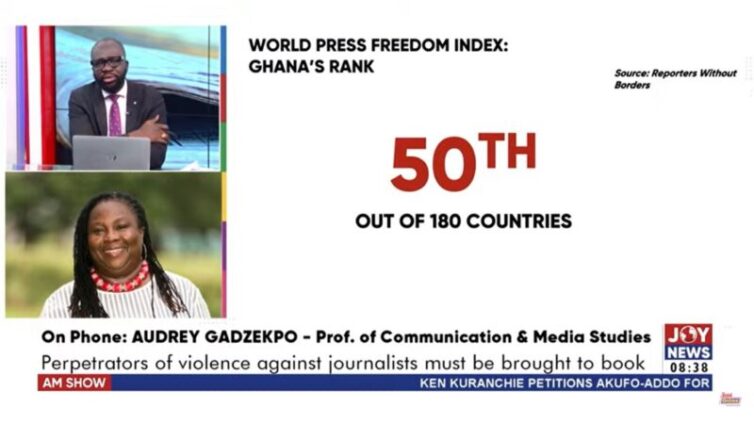
Professor Audrey Gadzekpo says the country’s media freedom continues to decline due to the absence of regulations to govern the broadcast sector.
According to her, a broadcast law is urgently needed to address attacks on journalists and media practitioners, following the World Press Freedom's recent Index report, which ranks Ghana in 50th position out of 180 countries.
She said, “There are no regulations in place governing the broadcast space, and we have been talking about this for many years.”
Prof. Gadzekpo added, “The lack of a broadcast law should have been addressed at the beginning, when the airwaves were liberalised.”
She was speaking on Joy News’ AM Show on Monday, November 11, 2024, with Benjamin Akakpo.
She emphasised that there must be consequences for impunity against the media in order to deter such actions. “There have to be sanctions for impunity against media professionals, and stronger sanctions at that.”
According to the Ghana Journalists Association (GJA), a total of 45 cases of attacks on journalists were reported between 2019 and 2023.
The most recent attack involved Joy News' Environmental Journalist, Erastus Asare Donkor, and three of his colleagues, who were attacked in the Ashanti Region while reporting on illegal mining activities in a protected rainforest. The journalists were assaulted by armed illegal miners, who also seized their equipment.
Despite the victims’ efforts to seek justice, the Ghana Police Service has been slow to act on the case.
In an effort to ensure the safety of journalists, the President of the Ghana Independent Broadcasters Association (GIBA), Cecil Sunkwa-Mills, also speaking on the show, said that his organisation has been organising programmes to train journalists. Over 1,000 media practitioners have benefited from these initiatives.
“In the past 24 months, together with several institutions, we have conducted training, capacity building, and media literacy programmes for over 1,000 journalists from media houses across the country. This is to help align ethical practices and also enhance technical skills.”
Ghana currently has a broadcasting bill, introduced in 2014, and over the years, stakeholders in the media sector have called for its passage into law. Government, on the other hand, has promised on several occasions to pass the bill, but this has yet to be done.
Latest Stories
-
FABAG commends Ato Forson’s over removal of 20% excise duty on locally manufactured fruit juices
3 minutes -
HIV stigma discourages testing, prevention and treatment in Ghana – Ghana AIDS Commission
5 minutes -
Blocking cocaine probe lends weight to claims of political protection for traffickers – Assin South MP
9 minutes -
NPP Vice Chair race: I may be the youngest, but most experienced – Nana B
11 minutes -
Last UK and US troops leave Iraq as anti-Islamic State mission ends
11 minutes -
Don’t stay home idle, embrace entrepreneurship while awaiting posting – Unemployed nurses urged
23 minutes -
Aayalolo buses not speeding on contra-flow lanes – GAPTE assures commuters
25 minutes -
Effia MP calls for Kurt Okraku’s removal, overhaul of Ghana football structure
26 minutes -
CAS hearing on AFCON final appeal by Senegalese Football Federation set for October 8
27 minutes -
STC fares to go up by up to 8% this week – Deputy MD
28 minutes -
Photos: Accra-Kumasi bypasses get new lease of life as contractors return to site
28 minutes -
Man allegedly swallows five SIM cards to conceal evidence after arrest
29 minutes -
After three finals, Ayikuma Methodist Basic School finally lifts National Juniors Challenge trophy
29 minutes -
Black Stars management ignored players’ health conditions ahead of Gambia game – Ernest Thompson alleges
30 minutes -
Ghana is 5th largest crypto market in sub-Saharan Africa; annual transactions around $21bn
31 minutes