

Audio By Carbonatix
The Building and Road Research Institute (BRRI) of the Council for Scientific and Industrial Research (CSIR) has proposed the installation of intelligent speed bumps on Ghanaian roads.
Installing the innovative device, according to the BRRI was the way to go and in line with contemporary road safety measures, as the traditional speed bumps currently being used in the country has become obsolete.
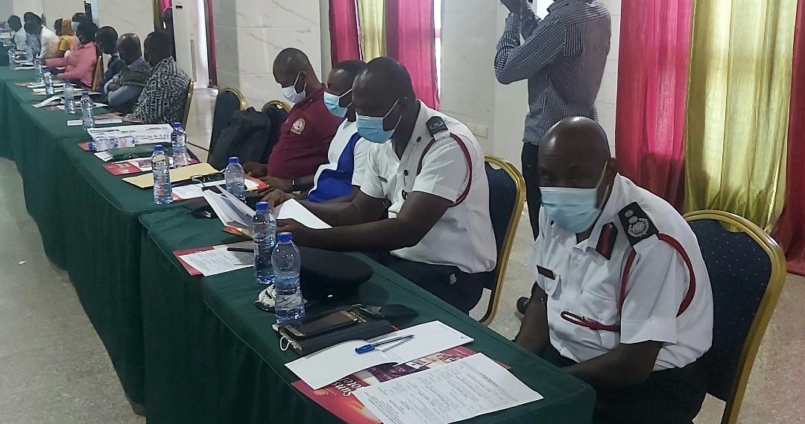
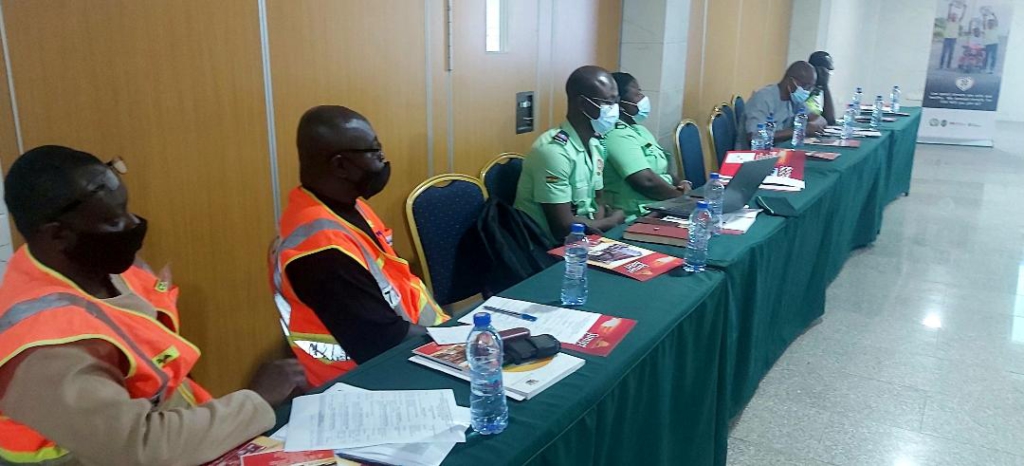
Head of Transportation Engineering Division of the BRRI, Dr James Derry addressing a stakeholders’ workshop on the national road safety action plan review in Kumasi, said the traditional speed bumps had come with their challenges.
According to the Research Scientist, the majority of the existing speed bumps had engineering defects as they cause accidents, waist and back pains to motorists on the highways.
Speed bumps are the common name for a class of traffic, calming devices that use vertical deflection to slow motor-vehicle traffic to improve safety conditions.
Dr Derry said the intelligent speed bump, which carries a radar gun laid across the carriageway works in such a way that when a motorist is travelling above the speed limit, the speed bump will give a jolt to the driver for the driver to know that he was going above the speed limit.
“If the motorist complies with the speed bump, it will lay flat on the road surface for the motorist to pass without any shock,” he explained.
The workshop was organized by the Research, Monitoring and Evaluation Directorate of the National Road Safety Authority (NRSA).
It sought to engage the various stakeholders in road safety management to evaluate past strategies and deliberate on ways for new robust strategies that were workable for all.
Highlighting the causes of fatalities on the roads, he said the research was carried out by the BRRI in 2015 on speeding and drunk driving and that it was discovered that there was so much over-speeding on the highways.
The study, according to Dr Derry, established that as high as 95 per cent of motorists were driving above the speed limit in built-up areas where there was no speed calming measures.
Again, on the rural highway, there was about 80 per cent of vehicles driving above the speed limit.
Another important thing was that there was high-speed dispersion, that is, the mixture of too many fast and slow vehicles in the same traffic stream.
The Research Scientist indicated that these were some of the factors that caused road accidents such as head-on collisions, rear-end collisions, and side-swiping and loss of control.
Mrs May Obiri-Yeboah, Director General, NRSA, said the Authority as the leading agency in Ghana mandated to coordinate road safety, in 2011, came out with a National Road Safety Strategy. The Strategy spanning 10 years (2011-2020) had action plans carved out of it.
NSRA, therefore, together with its key stakeholders were evaluating what was done in the past and come out with a new decade plan (2021-2030).
The aim is to ensure that advocacy, sensitization and education are improved.
Mrs Obiri-Yeboah said the past strategies revealed non-commitment on the part of stakeholders and urged them to take a keen interest in road safety and embrace it as a collective responsibility.
Latest Stories
-
Ghana to begin camping with 12 athletes after Accra Open Championships – Bawa Fuseni
19 minutes -
Anthony Joshua declines showdown with Tyson Fury but admits they ‘probably’ clash next
32 minutes -
Tyson Fury dominates Makhmudov, calls out Joshua next
51 minutes -
I have supported highway authority financially to fix roads in my constituency – A Plus
2 hours -
US, Iran fail to reach peace agreement after marathon talks in Pakistan
2 hours -
ECG kicks off Phase Two of transformer upgrades at Lashibi; brief outages expected
3 hours -
Port crises loom as 11,000 drivers threaten four-day strike
4 hours -
A source of excellence across generations – Vice President Opoku-Agyemang lauds Mfantsipim
5 hours -
(Photos) Mfantsipim School launches historic 150th anniversary
5 hours -
Knights and Ladies of Marshall group backs Catholic Bishops’ stance on anti-LGBTQ+
6 hours -
Bright Simons writes: All the Filla in the Ibrahim Mahama/E&P – Gold Fields Saga
6 hours -
Monetise Idiocy In Ghana
6 hours -
The Ghanaian prophet and the mysterious death of his scottish wife Charmain Speirs
7 hours -
Nearly 400 sentenced in Nigeria for links to militant Islamists
8 hours -
Ghana’s recovery supported by gold strength despite global oil price pressures – Standard Bank Research
8 hours