

Audio By Carbonatix
Thirty-four charges, one often exasperated judge and a parade of witnesses.
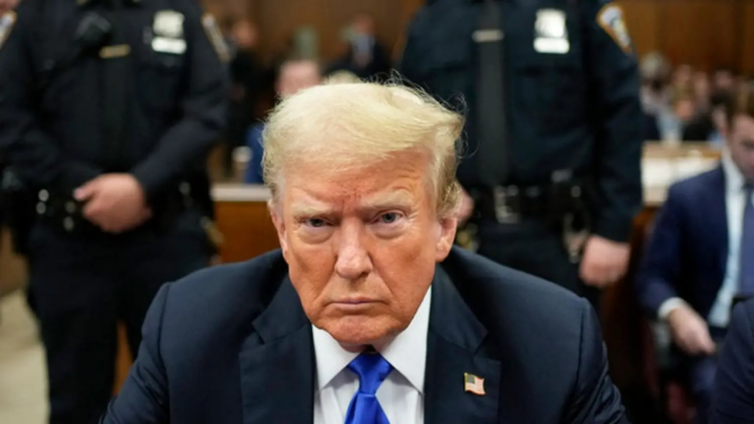
After two days of deliberations,12 New Yorkers found Donald Trump guilty of all charges in his hush-money case.
It is a history-making verdict following a history-making trial. Trump is now the first former US president with a criminal conviction, and the first major party candidate to run for the White House as a felon.
So what happens next?
Here are some key issues to consider.
Can he still run for president?
Yes. The US Constitution sets out relatively few eligibility requirements for presidential candidates: they must be at least 35, be a “natural born” US citizen and have lived in the US for at least 14 years. There are no rules blocking candidates with criminal records.
But this guilty verdict still could sway November’s presidential election. A poll from Bloomberg and Morning Consult earlier this year found that 53% of voters in key swing states would refuse to vote for the Republican if he were convicted.
Another poll, from Quinnipiac University this month, showed 6% of Trump voters would be less likely to vote for him - consequential in such a tight race.
What happens to Trump now?
Trump has been free on bail throughout the trial and this did not change after the verdict was read on Thursday - the Republican was released on his own recognisance.
He will return to court on 11 July - the date Justice Juan Merchan has scheduled for a sentencing hearing.
The judge will have several factors to consider in sentencing, including Trump’s age.
The sentence could involve a fine, probation or supervision, or possibly prison time.
Trump, who called the ruling a "disgrace", will almost certainly appeal the guilty verdict, a process that could take months or even longer.
His legal team would then face the Appellate Division in Manhattan, and possibly the Court of Appeals.
This all means that even after sentencing it would be highly unlikely that Trump will leave the court in handcuffs, and he would be expected to remain free on bail while he appeals.
What would be the grounds for appeal?
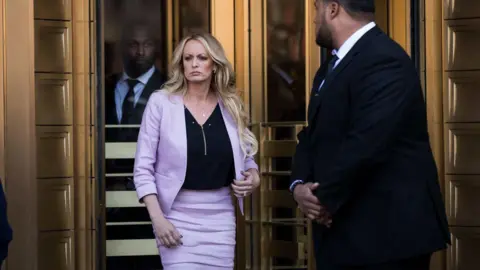
The evidence of adult film star Stormy Daniels, whose alleged sexual encounter with Trump is at the heart of the case, could be one reason.
“The level of detail that was provided [by Ms Daniels] is really not necessary to the telling of the story," said Anna Cominsky, a professor at New York Law School.
"On the one hand, her detail makes her credible and as a prosecutor, you want to provide enough detail so the jury believes what she has to say. On the other hand, there's a line, where it could become irrelevant and prejudicial."
Trump’s defence team twice called for a mistrial during Ms Daniels’ testimony, motions that were denied by the judge.
Beyond that, the novel legal strategy taken by the District Attorney in this case may also provide grounds for appeal.
Falsifying business records can be a lower-level misdemeanour in New York, but Trump faced more serious felony charges because of a supposed second crime, an alleged illegal attempt to influence the 2016 election.
Prosecutors broadly alleged that violations of federal and state election laws, along with tax fraud, apply to this case. But they did not specify to the jury exactly which one was broken.
Legal experts say there are questions around the scope and application of the federal law that could form a basis for appeal. Never before has a state prosecutor invoked an uncharged federal crime, and there’s a question if the Manhattan District Attorney has the jurisdiction to do so.
Can Trump go to prison?
It is possible, though highly unlikely, that Trump will serve time behind bars.
The 34 charges he faced are all class E felonies in New York, the lowest tier in the state. Each charge carries a maximum sentence of four years.
As noted above, there are several reasons why Justice Merchan could choose a lesser punishment, including Trump’s age, his lack of previous convictions, and the fact that the charges involve a non-violent crime.
He could consider Trump's violations of the court’s gag orders during the trial.
It is also possible that the judge would weigh the unprecedented nature of the case, perhaps choosing to avoid putting a former president and current candidate behind bars.
- Did prosecutors make a strong case in Trump's hush-money trial?
- As Trump trial ends, are Americans paying attention?
- A guide to Donald Trump's four criminal cases
There is also a question of practicality. Trump, like all former presidents, is entitled to lifelong protection from the Secret Service. This means that some agents would need to protect him in prison.
Even so, it would in all likelihood be extremely difficult to run a prison system with a former president as an inmate. It would be a huge security risk and expensive to keep him safe.
“Prison systems care about two things: security of the institution and keeping costs down,” said Justin Paperny, director of the prison consulting firm White Collar Advice.
With Trump, “it would be a freak show… no warden would allow it”, he said.
Could he pardon himself?
No. Presidents can issue pardons for those who have committed federal offences. The hush-money case in New York is a state matter, meaning it would be out of Trump’s reach if he were to become president again.
The same is true for Trump’s case in Georgia, where he has been accused of criminally conspiring to overturn his narrow defeat by President Joe Biden in the state during the 2020 election. This case is currently tied up in appeals.
Pardon powers are unclear for Trump’s two federal cases - one concerning the alleged mishandling of classified documents, and the other on conspiring to overturn the 2020 election.
In the first, a Trump-appointed judge in Florida has indefinitely postponed the trial, saying setting a date before resolving questions about evidence would be “imprudent”. The second outstanding federal case also was delayed while an appeal from Trump plays out.
Neither are likely to take place before the November election, but even if they did, constitutional scholars disagree on whether a president’s pardon power includes himself. Trump could be the first to try.
Latest Stories
-
Haruna Iddrisu calls for limits on annual university accommodation fee increases
31 minutes -
Today’s front pages: Tuesday, October 13, 2026
1 hour -
Wealth Over Water: How Galamsey Is Threatening Ghana’s Water Security
2 hours -
LA 2028: Black Queens pumped up for second leg of Mauritius tie
2 hours -
LA 2028: Black Queens hold final training session ahead of second leg against Mauritius
3 hours -
Standards are not Seasonal: What the EC appointments teach both sides
3 hours -
King Mohammed VI urges private sector to create youth jobs and spread benefits of growth
3 hours -
KGL U17 Colts 2026: Greater Accra win title after penalties win over Western Region
3 hours -
UK Investment Roadshow opens in London to advance UK-Ghana growth partnership
3 hours -
Assemblies of God requires pastors to resign before entering partisan politics – Rev. Wengam
3 hours -
Ghana targets 20% annual reduction in maternal deaths – Health Minister
3 hours -
Cyber attacks in Africa grow faster than global rate, report finds
3 hours -
Ghana signs UAE deal to create 5,000 overseas jobs
3 hours -
One Million Coders Programme targets 100,000 digital jobs in two years – Sam George
3 hours -
John Jinapor, Italian Ambassador explore opportunities for energy sector investment
3 hours