

Audio By Carbonatix
Canada and Mexico have agreed to deepen ties, vowing closer cooperation on trade and security, as both countries grapple with rising economic pressure from the US.
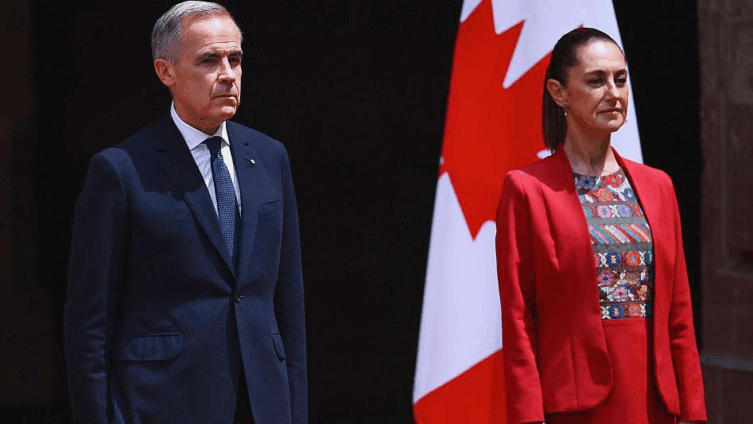
Following a bilateral meeting in Mexico City, Canada's Prime Minister Mark Carney and Mexican President Claudia Sheinbaum also expressed their commitment to a shared partnership with the US.
"We complement the United States, we make them stronger, and we are all stronger together," Carney told reporters.
Both Canada and Mexico have been hit by US tariffs - 50% on Canadian steel, and 25% on some Mexican pharmaceuticals. President Trump has also levied a 25% "fentanyl tariff" on Mexico, citing border security.
This is Carney's first official visit to Mexico as prime minister, and it marks an effort to reset relations after tensions flared last year when Canadian officials were accused of seeking a separate trade deal with the US during tariff talks.
At the time, Sheinbaum's response was that "Mexico must be respected, especially by its trading partners", and that Canada "could only wish they had the cultural riches that Mexico has".
The tone between Carney and Sheinbaum on Thursday appeared much warmer, with the two exchanging gifts and later pleasantries at a joint news conference.
"Our agreement today will expand and deepen the partnership, so that the next 30 years hold even greater promise than the last 30 years have delivered," Carney said.
Canadian officials told reporters earlier that Canada also aims to boost trade with Mexico. Trade between the two was valued at C$56bn ($40.5bn; £30bn) in 2024.
Carney and Sheinbaum also discussed border security and "transnational organised crime" - an issue Trump has cited to justify tariffs on both countries.
Observers say the renewed coordination is expected, as the two "don't want to be pitted against one another when negotiations start".
"It's a subtle dance," said Sebastián Vallejo Vera, a political scientist at Western University. "Canada and Mexico want to show unity, without appearing to gang up on the US."
The two leaders find themselves facing the same challenge: a protectionist US president who has redefined global and North American trade by imposing widespread tariffs on most countries.
Those levies have been especially disruptive for Canada and Mexico, whose economies have been largely shaped by the United States-Canada-Mexico (USMCA) free trade agreement - a version of which has been in place since 1994.
The USMCA is up for review in 2026. Early stages of that are already underway, with Washington now soliciting feedback from American businesses on the changes they'd like to see.
Canada and Mexico have both supported the agreement, arguing it has helped boost the competitiveness of the North American market.
So far, Sheinbaum has largely adopted a calm, non-confrontational approach with Washington.
Carney, while maintaining dialogue with Trump, has faced domestic criticism for failing to win tariff relief.
Last month, he dropped retaliatory tariffs on US goods to revive talks.
Canada faces a 35% US tariff rate, though the average is much lower - about 5.6%, Carney said - as most goods are exempt under USMCA.
But it also faces sector-specific US tariffs on steel and aluminium at 50%, vehicles at 25%, and oil and gas at 10%.
Trump had threatened Mexico with a 30% tariff, but paused the levies on 31 July for 90 days "with the goal of signing a trade deal".
Mexico remains subject to sector-specific levies and the 25% "fentanyl tariff" that Trump has said is aimed at curbing the drug's flow into the US, but - like Canada - much of its goods are exempt under the USMCA.
Prof Vera noted that Carney - and Canada by extension - likely has more to gain by forging closer trade ties with Mexico than vice-versa. Canadian exports to the US have notably taken a hit in 2025, while Mexican exports to the US have fared better.
There is also a sense in Mexico that Canada has long sidelined Mexico while focusing on building a stronger relationship with the US, Prof Vera said.
But these are "unprecedented times," he added, forcing Canada and Mexico to redefine their relationship.
Latest Stories
-
Real-Time VAT on cross-border digital services – not a new tax and does not violate double taxation principle
28 minutes -
Digitalisation, AI key to Ghana’s tourism transformation – GHATOF
39 minutes -
Stronger GTA-private sector partnership needed to grow tourism – GHATOF
50 minutes -
Amazon eyes Ghana for broadband expansion after talks with Mahama
2 hours -
National Investment Quiz 2026: Six schools qualify for quarter-finals
2 hours -
‘Do not let Russia pay for its madness with lives of your people’ – Zelensky to Ghana, 46 other countries
2 hours -
6,079 promotion cases fully processed and paid – CAGD says amid nationwide teachers’ strike
2 hours -
Teacher unions to meet government Monday over nationwide strike
3 hours -
Photo story: Republic Bank-JoyNews Habitat Fair clinic wraps up after three days of housing solutions, expert engagement
3 hours -
National Peace Council urges investment in youth to sustain Ghana’s peace
3 hours -
Afenyo-Markin urges youth to speak up against injustice
3 hours -
CAF annuls Edo Queens victory, orders WAFU B final to resume from extra time
4 hours -
Interior Minister urges traditional authorities to enforce anti-bushfire bye-laws
4 hours -
3rd Republic Bank-JoyNews Habitat Fair Clinic ends on a high note after three days of strong patronage
4 hours -
Ten climbers missing after avalanche hits Himalayan base camp
4 hours