

Audio By Carbonatix
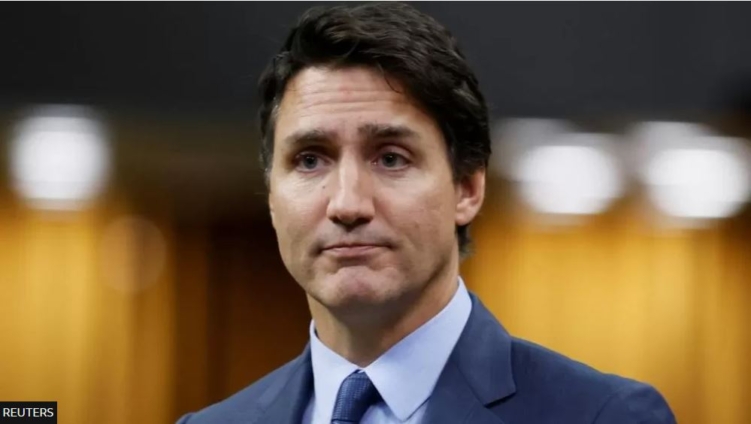
Under growing pressure from his own party, Canadian Prime Minister Justin Trudeau has announced he will step down and end his nine-year stretch as leader.
Trudeau said he would stay on in office until his Liberal Party can choose a new leader, and that parliament would be prorogued - or suspended - until 24 March.
"This country deserves a real choice in the next election and it has become clear to me that if I'm having to fight internal battles, I cannot be the best option in that election," he said during a press conference Monday.
Trudeau's personal unpopularity with Canadians had become an increasing drag on his party's fortunes in advance of federal elections later this year.
"Last night, over dinner, I told my kids about the decision that I'm sharing with you today," he told the news conference in Ottawa.
"I intend to resign as party leader, as prime minister, after the party selects its next leader through a robust nationwide competitive process," he said.
The president of the Liberal Party, Sachit Mehra, said a meeting of the party's board of directors would be held this week to begin the process of selecting a new leader.
In a statement, he added: "Liberals across the country are immensely grateful to Justin Trudeau for more than a decade of leadership to our Party and the country."
"As Prime Minister, his vision delivered transformational progress for Canadians," he said, citing programmes his government has implemented like the Canada Child Benefit and the establishment of dental care and pharmacare coverage for some medication.
Conservative leader Pierre Poilievre said "nothing has changed" following Trudeau's resignation.
"Every Liberal MP and Leadership contender supported EVERYTHING Trudeau did for 9 years, and now they want to trick voters by swapping in another Liberal face to keep ripping off Canadians for another 4 years, just like Justin," Poilievre wrote on X.
Trudeau, 53, had faced growing calls to quit from inside his Liberal Party, which ramped up in December when deputy prime minister and long-time ally Chrystia Freeland abruptly resigned.
In a public resignation letter, Freeland cited US President-elect Donald Trump's threats of tariffs on Canadian goods, and accused Trudeau of not doing enough to address the "grave challenge" posed by Trump's proposals.
Trump has promised to impose a tax of 25% on imported Canadian goods - which economists have warned would significantly hurt Canada's economy - unless the country takes steps to increase security on its shared border.
Trudeau said Monday that he had hoped Freeland would have continued as deputy prime minister, "but she chose otherwise".
Canada has since announced that it will implement sweeping new security measures along the country's US border in response to the threat.
In an online post, Trump claimed that pressure over tariffs led to Trudeau's resignation and repeated his jibe that Canada should become "the 51st State".
"If Canada merged with the U.S., there would be no Tariffs, taxes would go way down, and they would be TOTALLY SECURE from the threat of the Russian and Chinese Ships that are constantly surrounding them," he wrote.
Since 2019, the Liberal Party has governed as a minority party.
Following Freeland's resignation, Trudeau lost the backing of parties that had previously helped keep the Liberals in power - the left-leaning New Democrats, who had a support agreement with the Liberals, and the Quebec nationalist party, Bloc Quebecois.
The largest opposition party, the Conservatives, have maintained a significant two-digit lead over the Liberals in polls for months - suggesting that if a general election were held today, the Liberals could be in for a significant defeat.
Liberals will now choose a new leader to take the party into the next election, which must be held on or before 20 October.
A senior government official told the BBC that the race is an open contest and that the Prime Minister's Office will fully stay out of the process, leaving it to Liberal Party members to decide their future.
Speaking to reporters, the Bloc Quebecois leader Yves-François Blanchet suggested that an early election be called once the Liberals choose their new leader.
End of the Trudeau era
Trudeau is the son of Canadian Prime Minister Pierre Trudeau, who dominated the country's politics in the 1970s and '80s.
The younger Trudeau became prime minister after the Liberal Party won a sweeping majority in 2015 amid a promise to usher in a new, progressive era of "Sunny Ways".
His record includes a commitment to gender equality in his cabinet, which continues to be 50% women; progress on reconciliation with Indigenous people in Canada; bringing in a national carbon tax; implementing a tax-free child benefit for families; and legalising recreational cannabis.
Assembly of First Nations National Chief Cindy Woodhouse Nepinak praised Trudeau's track record on indigenous issues following his resignation, saying in a statement that he "has taken meaningful steps to address issues that matter to First Nations".
"While much work remains, these actions have laid a foundation for future governments to build upon."
Clouds began to hang over Trudeau's government in recent years, which weathered a series of often self-inflicted scandals, including a controversy over a deal with a Canadian firm facing corruption charges and photos that emerged of the prime minister wearing brownface makeup.
Vaccine mandates and other restrictions were also met with fierce backlash by some Canadians, leading to the Freedom Convoy truck protests in early 2022. Trudeau eventually used unprecedented emergency powers to remove the protesters.
As Canada began to emerge from the pandemic, housing and food prices skyrocketed, and his government pulled back on ambitious immigration targets as public services began to show strain.
By late 2024, Trudeau's approval rating was at its lowest - just 22% of Canadians saying they thought he was doing a good job, according to one polling tracker.
In Ottawa, a small group of protestors danced outside Parliament Hill in celebration of his resignation.
One passer-by, however, said he thinks things were fine under Trudeau's watch.
"I'm a carpenter," Hames Gamarra, who is from British Columbia, told the BBC. "I mind my own business, I get my wages, I pay the bills. It's been OK."
Another Canadian, Marise Cassivi, said it feels like the end of an era. Asked if she feels any hints of sadness, she replied: "No."
"It's the right thing."
Latest Stories
-
Luv FM Corporate Games 2026: Kumasi Central Prisons, Amanfiman Bank win big amid fun
8 minutes -
WAFU B U17: Ghana top Group A after win over Togo
37 minutes -
Ho Central Mosque reopens amid unresolved leadership dispute that led to closure
2 hours -
Minority caucus questions GH¢16.4m in Ablakwa’s SA evacuation spending, demands independent audit
2 hours -
Gender Ministry meets Nana Akua Addo’s husband over domestic violence after hospital discharge
3 hours -
UG Vice-Chancellor urges swift operationalisation of National Research Fund
3 hours -
Pope Leo to have surgery after lump found in lung
3 hours -
Joseph Cudjoe writes: Ghana must break free from the dangerous mindset that natural resources are the foundation for wealth
4 hours -
Children among 109 dead after boat capsizes off Djibouti, UN says
4 hours -
OmniBSIC Bank’s 11th health walk promotes fitness and business growth
4 hours -
2026 World Maritime Day: Danish Embassy organises “The Gulf of Guinea Speaks”
4 hours -
New Economy will tackle unemployment and restore hope – Ato Forson
4 hours -
IMMILAC president recounts personal losses as security women lead breast cancer awareness campaign in Wa
5 hours -
University of Ghana postpones October 12 reopening as GAUA strike persists
5 hours -
Bahass Foundation launches vocational skills training to support mental health recovery in Wa
5 hours