

Audio By Carbonatix
China has unveiled new measures aimed at boosting its flagging economy, as it braces for a second Donald Trump presidency.
The country plans to tackle tens of billions of dollars of local government debt to prevent it from being a drag on growth.
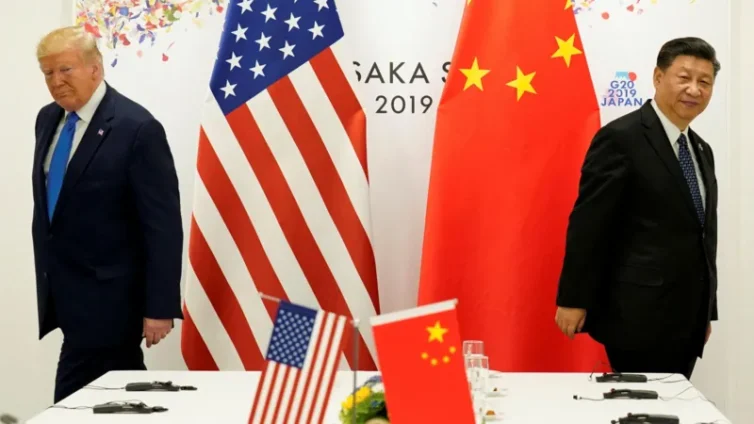
Trump won the US election on a platform that promised steep import taxes, including tariffs as high as 60% on Chinese-made goods.
His victory is now likely to hinder Xi Jinping’s plans to transform the country into a technology powerhouse – and further strain relations between the world’s two biggest economies.
A property slump, rising government debt and unemployment, and low consumption have slowed down Chinese growth since the pandemic.
So the stakes are higher than ever for the latest announcement from the Standing Committee of the National People’s Congress (NPC), the executive body of China's legislature.
During his first term in office Trump hit Chinese goods with tariffs of as much as 25%.
China analyst Bill Bishop says Trump should be taken at his word about his new tariff plans.
"I think we should believe that he means it when [he] talks about tariffs, that he sees China as having reneged on his trade deal, that he thinks China and Covid cost him the 2020 election".
The pressure from Washington did not ease after Trump left the White House in 2021. The Biden administration kept the measures in place and in some cases widened them.
While the first wave of Trump tariffs were painful for China, the country is now in a much more vulnerable position.
The economy has been struggling to return to pre-pandemic levels of growth since abruptly abandoning its tight Covid restrictions two years ago.
Instead of delivering a widely expected fast-paced recovery, China became a regular source of disappointing economic news.
Even before Trump's election victory and after China began rolling out measures to support its economy in September, the International Monetary Fund (IMF) lowered its annual growth target for the country.
The IMF now expects the Chinese economy to expand by 4.8% in 2024, at the lower end of Beijing's "about 5%" target. Next year, it projects China's annual growth rate will drop further to 4.5%.
The latest plan involves using an additional 6 trillion yuan ($840bn) from now until 2026 to bail out local governments which have piled up unsustainable levels of debt.
For decades, local governments have helped drive growth throughout the country by borrowing massive sums of money - much of which paid for infrastructure projects. But a downturn in the property industry has left some cities unable to pay their bills.
But the country's leaders were not caught entirely off guard by the end to decades of super-fast growth.
Speaking in 2017, President Xi said his country planned to transition from "rapid growth to a stage of high-quality development."
The term has since been used repeatedly by Chinese officials to describe a shift to an economy driven by advanced manufacturing and green industries.
But some economists say China cannot simply export itself out of trouble.
China risks falling into the type of decades-long stagnation that Japan endured after a stock and property bubble burst in the 1990s, Morgan Stanley Asia's former chairman, Stephen Roach, says.
To avoid that fate, he says China should draw "on untapped consumer demand" and move away from "export and investment-led growth".
That would not only encourage more sustainable growth but also lower "trade tensions and [China's] vulnerability to external shocks," he says.
This more robust economic model could help China fend off the kind of threats posed by Trump's return to power.
New economy, old problems
But China, which has long been the world’s factory for low-cost goods, is trying to replicate that success with high-tech exports.
It is already a world leader in solar panels, electric vehicles (EVs) and lithium ion batteries.
According to the International Energy Agency (IEA) China now accounts for at least 80% of solar panel production. It is also the biggest maker of EVs and the batteries that power them.
The IEA said last year that China's investments in clean energy accounted for a third of the world's total, as the country continued to show "remarkable progress in adding renewable capacity."
"For sure there is an overall effort to support high-tech manufacturing in China," says David Lubin, a senior research fellow at London based-think tank, Chatham House.
"This has been very successful", he adds.
Exports of electric vehicles, lithium ion batteries and solar panels jumped 30% in 2023, surpassing one trillion yuan ($139bn; £108bn) for the first time as China continued to strengthen its global dominance in each of those industries.
That export growth has helped soften the blow to China's economy of the ongoing property crisis.
“China’s overcapacity will increase, there is not doubt about it. They have no other source of growth,” said Alicia Garcia-Herrero, chief economist for the Asia Pacific region at investment bank Natixis.
But along with those increased exports, there has been a rise in resistance from Western countries, and not just the US.
Just last month, the European Union increased tariffs on Chinese-built EVs to as much as 45%.
"The problem right now is that large recipients of those goods including Europe and the US are increasingly reluctant to receive them," said Katrina Ell, research director at Moody's Analytics.
Today, as Trump is set to head back to the Oval Office with a pledge to hammer Chinese imports, Beijing will have to ask itself whether its latest measures to boost its slowing economy will be enough.
Latest Stories
-
Ghana, Germany deepen cooperation on railways, labour mobility
47 seconds -
Huge crowds greet Pope in Paris for open-air Mass
12 minutes -
‘I never said I’ll declare a state of emergency’ – President Mahama on galamsey
52 minutes -
Bobby Banson condemns EOCO’s attempted arrest of Nana Agyei Baffour Awuah
1 hour -
When Kumasi begins to look like somebody is in charge
1 hour -
Parliamentary probe into cocaine seizure would be a waste of time – Inusah Fuseini
1 hour -
Cocaine seizure: Focus on Ghana’s reputation, not partisan blame – Osae-Kwapong
2 hours -
Two Invitations, Three Interrogations: Did Baffour Awuah tell the whole story?
2 hours -
Drug cartels may be seeing Ghana as easy route – Lenin Anane Agyei
3 hours -
Ghana risks gaining notoriety as drug-trafficking hub – Bobby Banson
3 hours -
Government dismissed my drug trafficking warning, then tried to arrest me – Ntim Fordjour
3 hours -
Day Two: 3rd Republic Bank-JoyNews Habitat Fair Clinic underway at Junction Mall
3 hours -
NACOC addressing inherited gaps in fight against drug trafficking – Deputy Director-General
3 hours -
Taekwondo goes to school as GTF launches five-region youth campaign
3 hours -
The issues Mourinho is struggling to fix at Real Madrid
3 hours