

Audio By Carbonatix
The President of the Judicial Service Staff Association of Ghana (JUSAG), Samuel Afotey Otu, has appealed to the government to urgently improve the remuneration and conditions of service for judges, magistrates, and staff of the Judicial Service.
He also said the salary gap between the lower bench and the superior court judges should be closed by upping the salaries of the lower bench.
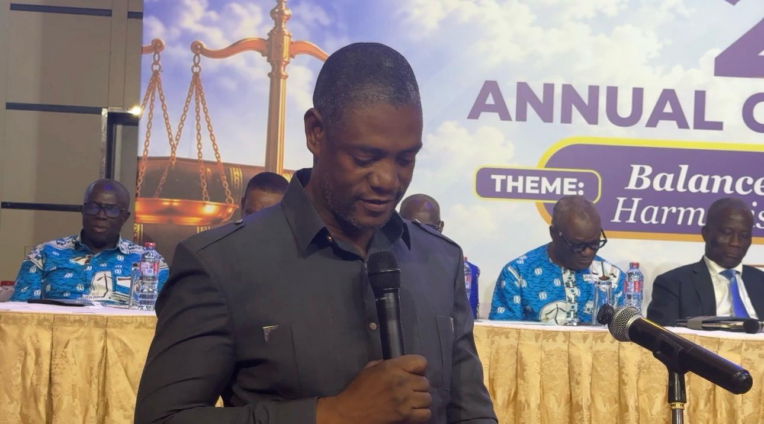
Speaking at the opening ceremony of the two-day 45th Annual Conference of the Association of Magistrates and Judges of Ghana in Accra, on the theme, Balance Beyond the Bench: Harmonising Duty, Justice, and Life, Mr. Afotey Otu also suggested for consideration the provision of escorts/orderlies for the lower bench.
Mr. Afotey Otu said the theme is deeply meaningful because it speaks to the need for judges and magistrates to find a healthy balance between their professional responsibilities and personal lives.
"Being a good judge or Magistrate is not only about performing one's duties in the court. It is also about finding time to take care of oneself, one's family, relationships and wellbeing, while continuing to uphold justice," he said.
Breaking down the theme, he explained that "Balance Beyond the Bench" recognizes that every judicial officer has a life outside the courtroom that requires rest, companionship, and time with loved ones, noting that most judges and magistrates even work best from home.
On "Harmonising Duty, Justice, and Life," he said while judicial work demands commitment, discipline, and impartiality, dedication should not mean work consumes every aspect of one's life. He stressed that judges need rest, family support, and emotional wellbeing to sustain themselves in what he described as one of the most demanding professions.
Mr. Afotey Otu said any conversation about a fulfilled life beyond the courtroom must include remuneration.
"For judges, magistrates, and judicial service staff to enjoy a more fulfilled life outside the courtroom, we need adequate remuneration that enables us to live with dignity and provide reasonably for ourselves and families," he stated.
He argued that responsibilities do not end when a judge rises from the bench, as there are children to educate, families to support, and accommodation to maintain, and when income cannot meet these needs, it affects quality of life.
The JUSAG president also raised concerns about emerging risks facing judicial officers in the digital age.
"The risks associated with judicial work continue to evolve. In this era of social media, the images, names, and activities of Judges, magistrates, and judicial service staff easily find their way onto various social media platforms," he said.
He warned that this exposure puts judges, staff, and their families at risks that were less prevalent in the past.
It is for this reason, he said, that he was appealing to the Minister for Justice and Attorney-General, who was present at the ceremony, to take a "serious and sympathetic look" at the remuneration and conditions of service and to create unique policies to address them.
He specifically called for the salary gap between the lower bench and Superior Court judges to be narrowed.
"The salary gap between the lower bench and the superior court judges should be closed a bit by upping the salaries of the lower bench," he appealed.
Mr. Afotey Otu also called for police protection for lower bench judges.
"Respectfully, I also suggest for consideration the provision of escorts/orderlies for the lower bench. Judges and magistrates do the same work, although at different levels, but need similar protection," he said.
He disclosed that over 130 courts across the country are currently without magistrates and appealed to government to expedite recruitment to ensure efficient administration of justice.
He said judges will continue to perform their duties with dedication even in the face of criticism if they have assurance that their legitimate earnings can provide a decent and dignified life.
Mr. Afotey Otu reminded the public that judges are not only found in courtrooms.
"They come from families, they belong to communities, they attend churches, they raise children… They shop in the same markets, drive on our roads… In other words, they are part of us," he said, urging the public to remember "the humanity behind the judicial office and accord them the kindness, courtesy, and respect deserved."
Concluding, he reminded the government of JUSAG's lawful demands made at its conference in Tamale on August 25 and the staff durbar in Tema on September 14 that in compliance with Article 149 of the 1992 Constitution, the Judicial Council has submitted its report to the Presidency for approval.
"It is our humble prayer that the government act now, for judicial service staff are not happy," he said, adding, "Please let's take note that an empty sack cannot stand upright."
He pledged JUSAG's commitment to work with the judiciary and government to promote a working environment where judicial officers and staff can serve with dignity while living fulfilling lives.
Latest Stories
-
NITA appoints Anthony Owusu-Ansah as Acting Deputy Director-General
2 minutes -
RANA warns Salomey Bafoh case could have chilling effect on free expression
3 minutes -
Who is the ‘hero’ Indian pilot who was stabbed on Israel-bound flight?
20 minutes -
NPP External Branches demand 90-day roadmap for ROPAA implementation
21 minutes -
No sustainable digital economy without trust, cybersecurity – CSA
23 minutes -
SSNIT increases stake in Société Générale Ghana to 24.36%
26 minutes -
Ghana-Colombia port deal sparks fresh cocaine trafficking security concerns
27 minutes -
EOCO moves to search Baffour Awuah’s office, residence after interrogation
33 minutes -
GoldBod, Kyrgyzstan discuss partnerships in gold and critical minerals
35 minutes -
SMEs can use vehicles, movable assets as collateral under Borrowers and Lenders Act
35 minutes -
Two dead in Canada after vehicle hits pedestrians taking part in First Nations event
38 minutes -
Cornell case highlights ‘draining’ maze for victims to report campus sex assaults
39 minutes -
Minority demands immediate suspension of Ghana-Colombia maritime deal over cocaine concerns
39 minutes -
Konadu Irrigation Project reaches 96% completion, set for commissioning in one month
39 minutes -
Joyce Bawah Mogtari calls for sustained investment in Ghana’s legal profession
43 minutes