

Audio By Carbonatix
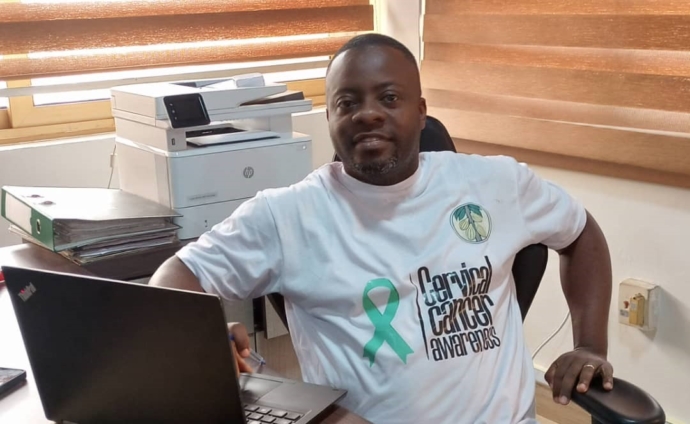
The Bono Regional office of COCOBOD is championing the awareness of cervical cancer among female staff in Sunyani in a strategic move to help fight the disease.
At a day's seminar at the cocoa house in Sunyani, the administrator of COCOBOD in the region, Michael P.K. Asumanu said the aim is to help staff who often use their job schedule as an excuse to be educated on cervical cancer - its dangers, screening and how to prevent it.
Cervical Cancer is a malignant tumour of the lower-most part of the uterus that is preventable and treatable when detected early with PAP smear screening and a Human Papillomavirus (HPV) vaccine.
It is caused by HPV which can be passed from one person to another during sex.
The seriousness of cervical cancer led to the World Health Organization dedicating the month of January to the creation of its awareness.

"As part of the awareness creation, we decided to bring the health expert to educate them on it, how harmful and dangerous it is", he said and added that the virus could stay unnoticed for 15 years with irreparable damage.
He said that as a major cause of death besides breast cancer, there was the need to dedicate resources and time to create awareness for the staff and tenants of COCOBOD, numbering over 70 females, to help fight the disease.
Mr Asumanu said, beyond the education, they will explore the option of inviting health officials to screen participants.
He called on men to encourage women, including their wives and relatives - who are mostly affected, to avail themselves of screening.

An Obstetrician Gynaecologist at the SDA hospital in Sunyani, Dr Elijah Abakah-Quansah, commended COCOBOD for the initiative towards the eradication of a disease that his facility identifies an average of 15 cases per year.
"People are reporting cervical cancer cases more due to our community drive with 4 cases identified last week", he said, adding that more cases could be identified with the increase in awareness creation.
"It is not a death sentence. If early detected, it is curable after surgery. And even if it is found at the advanced stage, there are still treatment or management modalities that are available to the women", he said.
Aside from sex as the major risk factor, Dr Abakah-Quansah also advised against multiple sexual partners and smoking and encouraged regular screening of the cervix.
He said vaccines are available and called on the public within the appropriate age group to go for it.
He also appealed to other stakeholders to join in the cervical cancer awareness creation and hoped that "the National Health Insurance will have the PAP smear as a service that women will not pay for and the vaccines as a national policy to vaccinate girls and women against the HPV virus".
Latest Stories
-
Trump says he is considering firing US ambassador to Greece
3 hours -
Man City bananas ‘brought fun back’, says Varadi
4 hours -
Meta releases Muse Wonder AI models to challenge Anthropic and OpenAI
4 hours -
Daily Insight for CEOs: The CEO as Chief Decision Maker
4 hours -
Burnham had formal meeting with Man City chair while mayor
4 hours -
Is Ghana producing too many lawyers? What is the best lawyer-to-citizen ratio?
4 hours -
NDC sinking Ghana’s democracy with Emelia Agbenyo’s appointment – Miracles Aboagye
4 hours -
Seedorf back in football as Corinthians head coach
4 hours -
Hincapié and Zubimendi injured in post-match training session
4 hours -
Fridges in French supermarkets hit by cyberattack
5 hours -
Qantas flight grounded after bedbug outbreak
5 hours -
Reality Zone with Vicky Wireko: International Day of the Girl, shaping today’s girl for tomorrow’s future – ZONTA Clubs lead the way
5 hours -
Global health must be led by countries, not designed for them – Mintah Akandoh
6 hours -
Mahama honoured at 2026 World Health Summit in Berlin for global health leadership
6 hours -
Breast cancer is not a death sentence – Besease Kontire Obaapanin, Magmina Foundation lead awareness campaign
6 hours