

Audio By Carbonatix
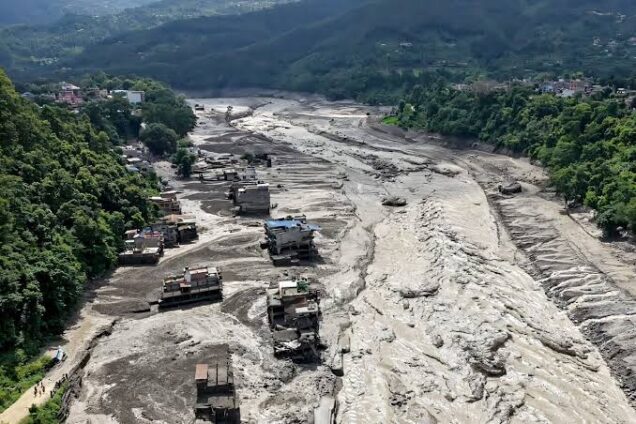
Preliminary investigations reveal that a collapsed glacier triggered the flash flood along the Nepal-Tibet border. Initial reports blamed an earthquake for a landslide that caused the disaster. At least 177 people died in the catastrophe. The US Geological Survey clarified that the disaster was caused by a "glacial collapse," which is when a glacier or part of a glacier disintegrates.
The impact of the collapsed glacier hitting the bottom of the valley registered a magnitude of 5.2, according to USGS data and scientists who have analysed the event. Dr Simon Cook, a glacier expert with the University of Dundee, stated that his team detected that the lower part of a glacier near the Langtang Lirung peak had collapsed. This site sits approximately 15km west of the flood zone. The glacier collapsed in a northwesterly direction and travelled westwards downstream.
An analysis by the International Centre for Integrated Mountain Development suggested an ice-rock avalanche originated from a high-altitude area. This caused a large volume of ice and rock debris to enter the Lende Khola. The Lende Khola is a tributary of the Bhote Koshi River. This generated a sudden surge carrying water, sediment and large boulders downstream. Water levels in downstream rivers rose between seven and nine metres within 30 minutes. Several water monitoring stations were washed away or damaged.
Mike Searle, a professor of earth sciences at Oxford University, explained that the process could have taken hours or even days. "The sheer wave of debris suggests there could have been a landslide first; the water built up, dammed the river, and then it burst in one huge great flood," he noted. The topography of the area exacerbated the flood. Langtang Lirung sits on the crest of the high Himalayas. Incredibly steep valleys on both sides of the mountain funnelled the water at higher speeds. It remains unclear what caused the glacier to collapse on Wednesday.
Tectonic movement causes the Himalayas to rise slowly as one plate pushes another up. Searle compared this process to "putting a jack under the car, and then jacking it up." As the mountain rises, the glacier gets steeper and steeper, and "it's inevitable that parts of it fall off." Smaller chunks usually block rivers temporarily and flush out easily. In this disaster, the whole glacier seems to have collapsed "in one go." Searle noted that this is "very unusual." "These floods happen all the time, but not at this scale," he added.
Wednesday's event likely happened because of "two different processes – tectonics with the Himalayas uplifting, and then climate change with increasingly high temperatures and melting of glaciers." "The whole thing is combining to form these catastrophic disasters that we are now seeing on a regular basis," Searle explained. Scientists have warned for years of melting ice and permafrost in the Himalayas due to climate change. Permafrost is centuries-old frozen soil.
An analysis released by ICIMOD earlier this year found that Hindu Kush Himalaya glaciers are losing ice at double the rate since 2000. This exacerbates dangers such as flooding. Dr Cook pointed out similar incidents in India, Switzerland and Italy in recent years. A large chunk of a Himalayan glacier collapsed in Chamoli in northern India in 2021, sending a cascade of debris and water downstream that killed 200 people. Scientists later estimated that the impact of the collapse was equivalent to 15 atomic bombs. The same region in Nepal saw flooding last year caused by a glacial lake in Tibet bursting.
Mohd Farooq Azam, a specialist with ICIMOD, stated that the increasing frequency of hazards in the cryosphere "is becoming more visible than ever before. The pace of change is so rapid." Connecting any single event directly to climate change remains difficult, but "when you look at the pattern of these events, you do think climate change could have an impact," according to Dr Cook. A warming planet brings shrinking glaciers and heavy snowmelt. Warming, thawing and degrading permafrost partially holds mountainsides together. More landslides, debris flows, glacial meltwater, lake outbursts and glacier collapses occur because climate warming ultimately destabilises these high mountain environments.
As international bodies and regional governments grapple with escalating environmental volatility, scientists emphasise that expanding real-time early warning networks across high-altitude vulnerable corridors remains critical to safeguarding downstream populations.
Latest Stories
-
A woman should not have to choose between being fed and being safe
5 minutes -
“Wontumi doesn’t like where he is”– Palgrave Boakye
13 minutes -
The Labadi shoreline demolitions: Who owns the beach?
24 minutes -
Cedi will continue to be stable – Deputy Finance Minister
25 minutes -
Minority urges full probe into World Cup visa allegations after Ampofo Ankrah’s removal
25 minutes -
Asiedu Nketiah backs greater church role in running mission schools
27 minutes -
Galamsey activities redirect Mankran Stream, destroy farms, and threaten flooding in Okroase
32 minutes -
WiSTEM Ghana Camp assembles 320 girls to explore STEM education
32 minutes -
Russia launches heavy strikes at Ukraine, killing at least 20
32 minutes -
Freddie Blay accuses government of politically motivated demolitions targeting his family
38 minutes -
Ghana targets rice self-sufficiency by 2028 as government secures $18.8m AfDB grant
42 minutes -
Israelis mark three years since October 7 as Palestinians mourn Gaza’s destruction
45 minutes -
Support constitutional amendment to fix voting day on Tuesday – Asiedu Nketiah urges SDA Church
45 minutes -
‘It’s a systemic problem’ – All Black PRO dismisses Kurt’s resignation calls
50 minutes -
Vance says Iran must cut enrichment to end war
52 minutes