

Audio By Carbonatix
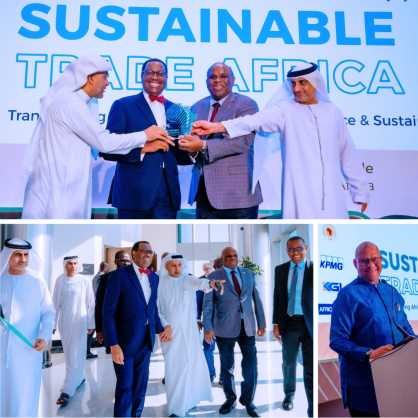
African Development Bank Group President Dr Akinwumi Adesina (www.AfDB.org) has warned that a new EU carbon border tax could significantly constrain Africa’s trade and industrialization progress by penalizing value-added exports including steel, cement, iron, aluminium and fertilizers.
Adesina said, “With Africa’s energy deficit and reliance mainly on fossil fuels, especially diesel, the implication is that Africa will be forced to export raw commodities again into Europe, which will further cause de-industrialisation of Africa.”
“Africa could lose up to $25 billion per annum as a direct result of the EU Carbon Border Tax Adjustment Mechanism,” the Bank President told delegates at the Sustainable Trade Africa Conference held at the UAE Trade Centre in Dubai.
“Africa has been short-changed by climate change; now it will be short-changed in global trade,” the Bank President said.
“Because of weak integration into global value chains, Africa’s best trade opportunity lies in intra-regional exchanges, with the new Africa Continental Free Trade Area estimated to increase intra-Africa exports over 80% by 2035.”
Adesina stressed that Africa was already being overlooked in the global energy transition, according to data from the International Renewable Energy Agency.
“Africa received just $60 billion or 2% of the $3 trillion of global investments in renewable energy in the past two decades, a trend that will now impact negatively on its ability to export competitively into Europe,” said Adesina as he called for what he termed the Just Trade-for-Energy Transition (JTET) policies, which would enable Africa’s renewable ambitions without restricting its trade prospects.
Africa will need to use natural gas as a transition fuel to reduce the variability of renewable energy and stabilize its energy systems in support of its industrialization, Adesina said.
The Chief Executive Officer of the UAE Trade Centre, Walid Mohammed Hareb Alfalahi said Africa is the new frontier for investment contrary to widespread perception that the continent is a dangerous and difficult place to do business.
“What you hear about Africa is not the reality. I see the potential in Africa. I see the possibilities to do more,” said Alfalahi as he recounted his positive experience of investing in a number of projects on the continent.
Adesina said a report by Moody’s Analytics showed that Africa had the least default rate on investment in infrastructure compared to other parts of the world.
According to the report, Africa’s default rate stands at 5.5 per cent, compared to Latin America’s 12.9 per cent, followed by Asia at 8.8 per cent, Eastern Europe 8.6 per cent, North America 7.6 per cent, and Western Europe 5.9 per cent.
Adesina also highlighted some of the mega projects that had attracted investor interest through the Africa Investment Forum that was created by the African Development Bank and seven other founding partners. The projects include Mozambique’s $24 billion liquefied gas project, the $15.2 billion Abidjan to Lagos Highway corridor covering 5 countries and the $3.6 billion Tanzania to Burundi and DR Congo railway line.
“I’m talking about a different Africa. There is no project that as partners, we cannot handle,” said Adesina.
The conference, moderated by the African Development Bank President’s Senior Adviser for Communication, Dr Victor Oladokun, was also addressed by the President of the African Export-Import Bank, Afreximbank, Professor Benedict Oramah. He warned, “Preliminary results of a study recently commissioned by Afreximbank reveal that rapid decarbonisation by fossil fuel-exporting countries in Africa could cut merchandise exports by $150 billion.”
President Adesina’s speech (https://apo-opa.co/3RvZdrC)
Distributed by APO Group on behalf of African Development Bank Group (AfDB).
Contact:
Chawki Chahed
Communications and External Relations Department
media@afdb.org
About the African Development Bank Group:
The African Development Bank Group (AfDB) is the premier multilateral financing institution dedicated to Africa's development. It comprises three distinct entities: the African Development Bank (AfDB), the African Development Fund (ADF) and the Nigeria Trust Fund (NSF). The AfDB has a field presence in 41 African countries, with an external office in Japan, and contributes to the economic development and social progress of its 54 regional member states. For more information: www.AfDB.org
Latest Stories
-
A source of excellence across generations – Vice President Opoku-Agyemang lauds Mfantsipim
1 hour -
(Photos) Mfantsipim School launches historic 150th anniversary
2 hours -
Knights and Ladies of Marshall group backs Catholic Bishops’ stance on anti-LGBTQ+
3 hours -
Bright Simons writes: All the Filla in the Ibrahim Mahama/E&P – Gold Fields Saga
3 hours -
Monetise Idiocy In Ghana
3 hours -
ECG kicks off Phase Two of transformer upgrades at Lashibi; brief outages expected
4 hours -
The Ghanaian prophet and the mysterious death of his scottish wife Charmain Speirs
4 hours -
Nearly 400 sentenced in Nigeria for links to militant Islamists
4 hours -
Ghana’s recovery supported by gold strength despite global oil price pressures – Standard Bank Research
5 hours -
Methodist Church hails Mfantsipim@150; calls for “fresh consecration” to excellence
5 hours -
‘Excellence is our inheritance’ – Nana Sam Brew-Butler hails Mfantsipim’s 150-year reign in leadership
5 hours -
Kwaku Azar writes: A-G vs OSP
5 hours -
Mfantsipim–Adisadel rivalry built excellence, not division – Sam Jonah
6 hours -
Vice President launches Mfantsipim’s 150 years of shaping Ghana’s greatest mind
6 hours -
I assure Otumfuo, Mahama will join him to commission KNUST Teaching Hospital by end of this year – Haruna Iddrisu
7 hours