

Audio By Carbonatix
Germans have started wearing facemasks outside the home as new rules come into force to curb the spread of coronavirus.
The use of cloth masks is now mandatory on public transport and, in most regions, within shops.
The rules vary among the 16 German states - Bavaria being the strictest, while in Berlin shoppers do not have to wear masks.
But the authorities are moving very cautiously in easing the lockdown.
Across the world countries are coming up with their own guidance on mask-wearing. However, the World Health Organization (WHO) advice suggests people should wear protective masks only if they are sick and showing symptoms, or if they are caring for people suspected to have Covid-19.
It says masks are not recommended for the general public because they can be contaminated by coughs and sneezes, and might offer a false sense of security.
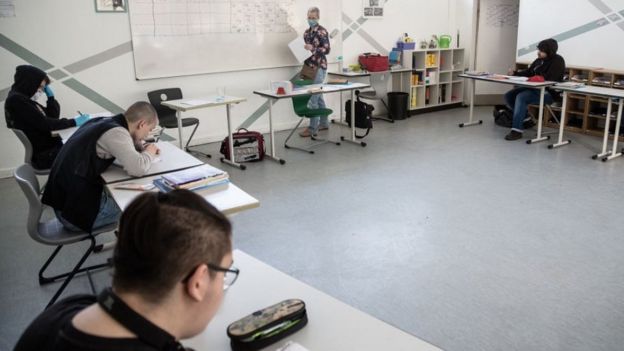
German media report that mask-wearing is now required in school corridors and when children go on breaks, but not in the classroom. Students sit in class spaced apart and there is more frequent cleaning with disinfectant.
Students preparing for their school leaving exams are also back in class. Most German schoolchildren are still at home under lockdown.
The German authorities require mask-wearing at stations and on buses and trains, but not yet on long-distance trains.
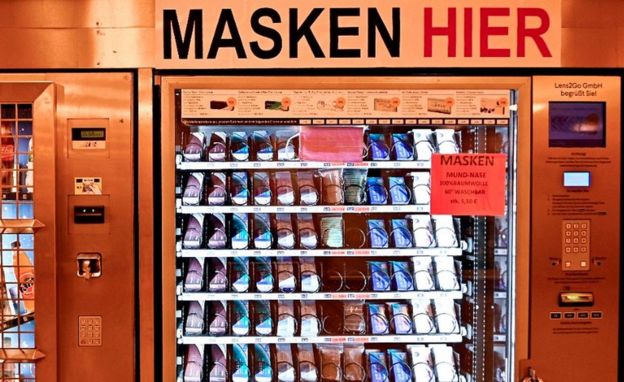
Home-made cloth masks are acceptable; people are not expected to wear hospital-style intensive care masks. These are now on sale in station vending machines and at markets.
Monday also saw some further easing of the lockdowns in the Czech Republic and Switzerland, while Italy has set out a detailed plan for easing its lockdown which remains one of the strictest in Europe.
Masks now normal on German streets
By Damien McGuinness in Berlin
Face-masks have become the new toilet paper, quipped one German newspaper commentator, as people across Germany scramble to buy nose-and-mouth coverings.
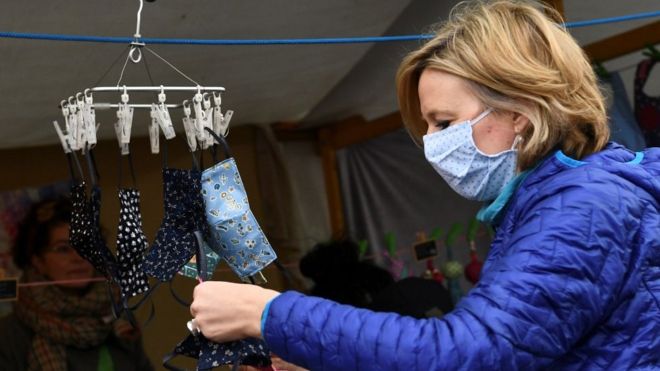
To plug the gap, signs are popping up in shop windows advertising self-made, brightly coloured cloth masks, typically costing around 10 euros.
In the hipper parts of town, patterned face-masks are a style accessory. Faces may be covered but Berliners are still keen to show their individuality.
"If I talk to the shop assistant — and if I have the virus without knowing — then it means that I don't pass it on to her," said Florian, a graphic designer, who was wearing a simple cloth mask while coming out of a shop. "It's about being aware and protecting other people."
But Christine, a special needs teacher, who wasn't wearing a mask and uses a scarf around her mouth and nose in shops, worried that mask-wearing is more about virtue-signalling than safety. "The situation is really confused," she said. "Some people wear masks, some people don't. It makes the whole thing absurd. I think it's a bit of a placebo."
Either way the new rules are having a visible impact. Until recently face-masks were a rarity in Germany, and would attract stares. Now they are suddenly a normal part of daily life.
Germany has reported 5,750 deaths from Covid-19 - a much lower toll than in Italy, Spain, France or the UK.
Its large-scale testing and strict, early lockdown are believed to have kept the rate of infection down.
Last week the eastern state of Saxony became the first to make mask-wearing compulsory. It is also compulsory in Austria, the Czech Republic and Slovakia, for shoppers and public transport users.
And in the Nigerian capital, Lagos, face masks must be worn in public from Monday. The state's governor said it was firmly in the community transmission phase of the pandemic and there was a need for more precautions.
In the United States people are advised to wear "cloth face coverings" in supermarkets and pharmacies, while in Canada, air passengers must wear a non-medical mask or a face covering.
But internationally expert opinion is divided on the effectiveness of home-made masks in curbing Covid-19. Many argue that masks help prevent the wearer spreading infection, but frequent hand-washing and social distancing are deemed essential too.
In most German states children under six years old do not have to wear masks. And Schleswig-Holstein will not require mask-wearing until Wednesday.
The new rules have created huge demand for masks, so faced with a growing shortage the government is planning to manufacture millions of them in Germany.
In Bavaria, people still going mask-free can be fined €150 (£131; $163), but the fine for any shopkeeper who breaks the rules can be €5,000, Süddeutsche Zeitung reports.
Chancellor Angela Merkel has accepted that regional variations in the lockdown rules are acceptable because some places are virus hotspots, and others not.
What's happening elsewhere?
Spain - the European country with the highest number of deaths after Italy - reported its lowest daily death toll in more than five weeks on Sunday, with 288 new fatalities. On Sunday, children could go outside for the first time in six weeks.
In Switzerland, garden centres and hairdressers are opening their doors, followed by schools and shops selling items other than food in two weeks' time.
But gatherings of more than five people remain banned until 8 June, and it is unclear when bars and restaurants will be allowed to reopen.
The Czech capital Prague has deployed ticket inspectors on public transport for the first time since its lockdown was imposed in mid-March. Bus and train services were increased over the weekend. And on Monday, the country opened its borders to business visitors and students, but not tourists.
Meanwhile, UK Prime Minister Boris Johnson has returned to work, after recovering from the virus. Mr Johnson spent a week in hospital, including three nights in intensive care, after being admitted on 5 April.
Latest Stories
-
Mahama announces plans to import electric wheelchairs for PWDs
3 minutes -
KGL U17 Colts 2026: Western beat Prempeh Elite Academy to set up final final with Greater Accra Region
22 minutes -
Late Solanke strike salvages 10-man Spurs draw at Man United
32 minutes -
Gender Ministry to monitor welfare of Nana Akua Addo’s children amid domestic violence case
38 minutes -
Benedict Okyere Yeboah: Ghana’s football problem goes beyond sacking a coach
48 minutes -
GPL 2026/27: Darkwah Wiafe’s winner sees All Blacks beat Kotoko
53 minutes -
ITF World Tour : Patel Wins Boys’ Singles Final at J100 Accra
1 hour -
Ghana must pursue BRICS partnership if it brings economic benefits – Kpebu
1 hour -
Success and Wright Claims J100 Accra Girls’ Doubles Championship
1 hour -
ITF J100: America’s Wright wins J100 Accra Girls’ Singles Title
1 hour -
Expedition hopes to find aviator Amelia Earhart’s plane on remote island
1 hour -
US seeks changes to rejected $109m health compact with Ghana – Mahama
2 hours -
Nine dead in mass shooting at Pennsylvania home
2 hours -
‘Time for Ukraine to get new president,’ says Trump after Zelensky condemns diesel deal
2 hours -
Hincapie injury adds to Arsenal issues after Guimaraes rescue act
2 hours