

Audio By Carbonatix
The Food and Drugs Authority (FDA) is warning of potential danger as inferior and unapproved nose masks flood the market.
Officials say some of the products fall short of the the-layer specifications and expose users to risk.
The warning by head of the Authority in Ashanti Region, Nora Narkie Terlabie, comes as the Regional Co-ordinating Council serves notice of enforcing mandatory nose mask-wearing beginning today.
"I must say it is very widespread. Now anywhere you go by the roadside, people are holding them and selling," Mrs Terlabie said.
"The nose masks are supposed to be worn for a purpose so it's not that you should wear just a nose mask; but you should wear nose mask that filters," she added.
Virologist at the Kumasi Center for Collaborative Research, Dr. Michael Owusu, called for mandatory wearing of nose masks after the partial lockdown was lifted.
"I expect nose masks to be mandatory that everywhere anybody goes, before you go to a tro-tro, a public transport, every gathering you go, the first thing is that you must be in nose mask," he said.
Ashanti Regional Minister, Simon Osei-Mensah, has responded by announcing that residents of Kumasi would be compelled to wear nose masks after the Ashanti Regional Security Council announced mandatory wearing of nose masks beginning April 22, 2020.
"Everybody should be able to acquire the face masks today and tomorrow. If we see you may be without a face mask and you are in public, we can return you to go back home," he added.
Locally-made face masks complicate Covid-19 fight

Locally-made nose masks in high demand in Kumasi
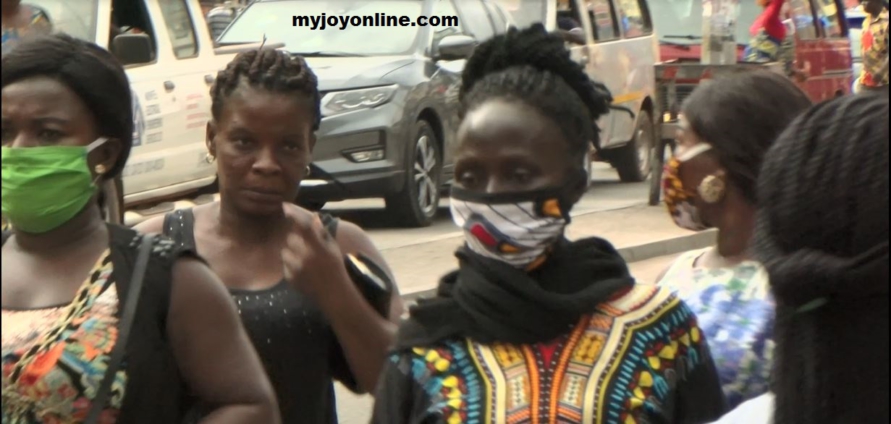
The streets of Kumasi have since been flooded with all sorts of nose masks, both foreign and locally-made.
Unfortunately, unapproved but inferior locally-produced masks have also taken over the streets, out-numbering the approved ones.
They do not meet the FDA's specification of ten inches cheek-to-chin length, nor meet the three-layer thickness of not less than 0.759 millimetres.
Most of them are made from polyester, instead of propylene or 100 per cent cotton with calico-stiff or all calico-calico-calico.
At the main Business District of Adum-Kumasi is 42-year old Nana Akua who does brisk business selling assorted locally-made face masks.
They come in different colours, designs and shades produced from local garments.
"We buy them in bulk at GH1. We sell them at GHS2 each.
We sometimes get some at 80p. Even then, we still sell at GHS2," says Nana Akua.
With the likes of Nana Akua and others present to attend the needs of customers who need face masks for protection against Covid-19, one is assured to get the product as cheap as GHS1 or worse GHS2 compared to the approved, mostly foreign-made ones, that sell between GHS4 and GHS7.
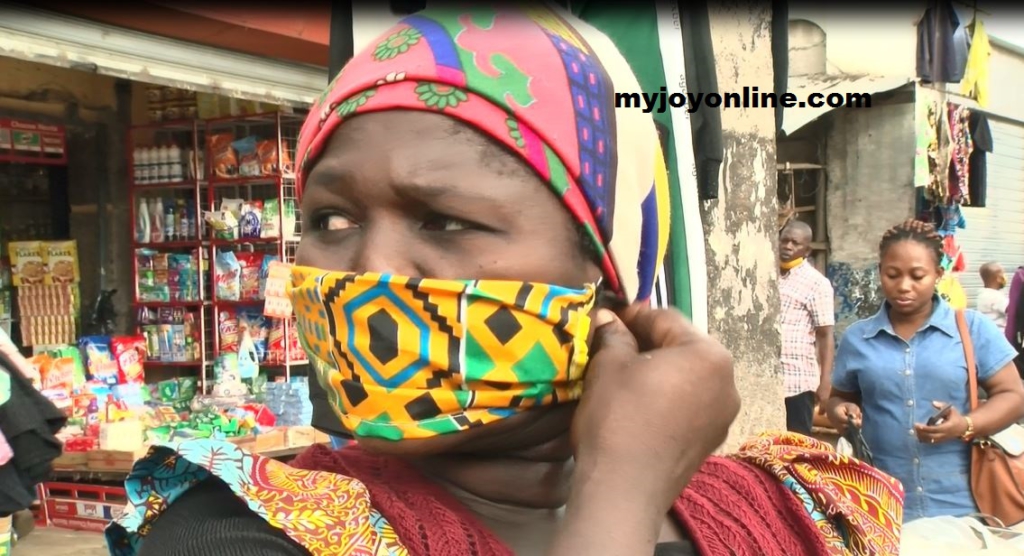
Nana Akua display her face mask
The difference between the two is not just vague but a concern.
People may either buy cheap and endanger their lives or pay more and get protected -- and the FDA is deeply concerned about this possibility.
"We sampled quite a number of nose masks and as you can see here, most of the nose masks are just one-layer of fabric. This, for instance, looks like polyester which would not be able to filter anything. They don't meet guidelines for making masks that the FDA has brought out," says Ashanti Regional Head of the authority, Nora Narkie Terlabie.
Serving the public with contaminated nose masks
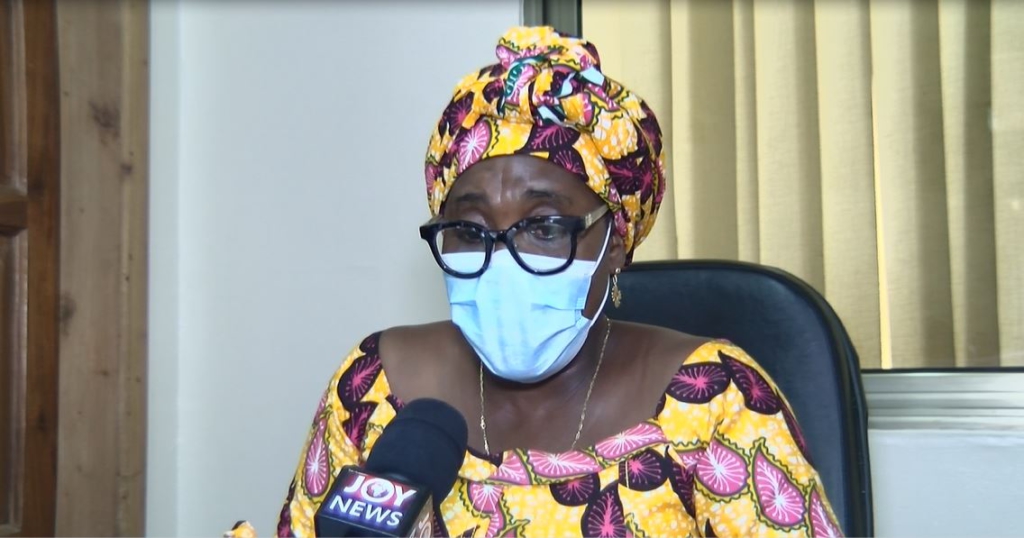
Only two local nose mask producers have approached the FDA in Kumasi for approval as of Wednesday 21, 2020.
But the FDA will not describe the locally-made masks as totally useless or fake.
"I won't say they are fake. Just that everybody is looking for a genine way to contribute to the fight against Covid-19 and the right procedure is not being followed," she said Nora Terlabie.
Poor handling of the approved nose masks has also become a major concern to the FDA.
In a sheer display of ignorance, some vendors in a haste to make profits have unpacked and displayed in their bare hands the N95 Nose masks which are in high demand.

The FDA warns that the public is at risk if nose masks cannot serve their purpose.
"You see a lady holding so many of them with the bare hand and the face masks are exposed. That is also not good. They are contaminated," a worried Mrs Terlabie warned.
But the FDA says it will not go after producers of such products as it begins public sensitisation to address the problem.
Meanwhile, our checks reveal the REGSEC enforcement is yet to commence but our sources say the council is meeting with health authorities on the matter.
Latest Stories
-
GPRTU wants full TRAFFITECH-GH implementation to start in 2027
36 seconds -
Mahama announces plans to import electric wheelchairs for PWDs
5 minutes -
KGL U17 Colts 2026: Western beat Prempeh Elite Academy to set up final final with Greater Accra Region
23 minutes -
Late Solanke strike salvages 10-man Spurs draw at Man United
33 minutes -
Gender Ministry to monitor welfare of Nana Akua Addo’s children amid domestic violence case
40 minutes -
Benedict Okyere Yeboah: Ghana’s football problem goes beyond sacking a coach
49 minutes -
GPL 2026/27: Darkwah Wiafe’s winner sees All Blacks beat Kotoko
55 minutes -
ITF World Tour : Patel Wins Boys’ Singles Final at J100 Accra
1 hour -
Ghana must pursue BRICS partnership if it brings economic benefits – Kpebu
1 hour -
Success and Wright Claims J100 Accra Girls’ Doubles Championship
1 hour -
ITF J100: America’s Wright wins J100 Accra Girls’ Singles Title
1 hour -
Expedition hopes to find aviator Amelia Earhart’s plane on remote island
1 hour -
US seeks changes to rejected $109m health compact with Ghana – Mahama
2 hours -
Nine dead in mass shooting at Pennsylvania home
2 hours -
‘Time for Ukraine to get new president,’ says Trump after Zelensky condemns diesel deal
2 hours