

Audio By Carbonatix
People in India are increasingly lowering their guard during the ongoing festival season, despite the high risk of contracting COVID-19. Many restrictions have been lifted, but the pandemic is far from over.
Rudra Nath, 42, a factory foreman in Alwar district of Northwestern Rajasthan state, says he feels exasperated having to tell his co-workers to keep their masks on all the time.
It has been over a month since the iron fabrication factory resumed production. Since June, the government has been gradually relaxing restrictions on public movement and commerce meant to contain the coronavirus.
Business has been slowly picking up, with orders coming in from across the state.
"Many of the workers are not afraid of the virus anymore. They feel the worst has passed and a cure is round the corner even if they become sick," Nath told DW.
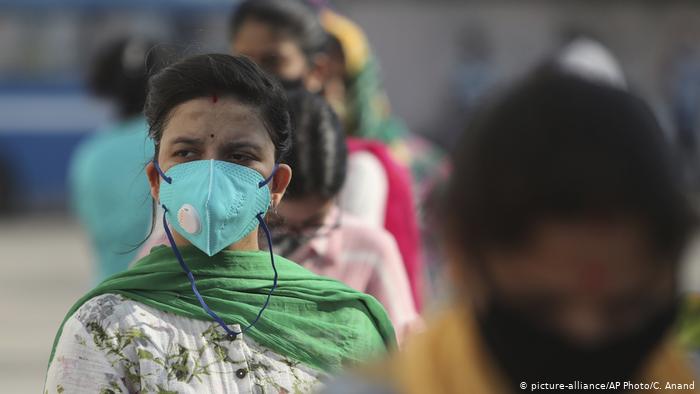
Wearing a mask seems an exception in Rajasthan, particularly in rural areas, where most people are going about their lives as if the pandemic is over. Many are ignoring rules on physical distancing, and authorities' lax enforcement of the measures has compounded the problem.
No longer afraid?
In the Central state of Madhya Pradesh, it would almost seem as if the pandemic did not exist. Across vast swathes of its hinterland, people are carrying on with work, travel and shopping in markets without wearing masks.
"We are more wary of visitors coming from cities. We maintain physical distance from them. On our own, we have nothing to worry about," Prabath Kumar Singh, a postmaster from Mandsaur district, told DW.
India has so far recorded over 8.5 million coronavirus infections, second only to the United States in the total number of cases, and more than 126,000 related deaths.
The country has witnessed a drop in the recorded daily new cases over the past month. However, India still registers about 50,000 new cases on average every day.
People now do not appear to fear the virus as much as they did eight months ago, when the government first announced a nationwide lockdown.
"When the strict lockdown was in place and public movement was restricted, people were scared. At that time, fear was a force that directed behavior. That is no longer the case," Anant Kumar, a urologist and surgeon, told DW.
Latest Stories
-
CSOs call for review of gold reconnaissance activities along Ghana’s inshore waters
38 minutes -
Gov’t is committed to addressing teachers’ conditions of service, deprived-area allowance – Minister
44 minutes -
Traffic, not sour grapes, kept Nana Akomea away from NPP swearing-in
56 minutes -
Trump says he will stop using taxpayer funds for ads after bipartisan pushback
1 hour -
Nana Akomea explains why he ignored polls ahead of NPP election
1 hour -
‘Bamba’s message was clever, very clever’ – Akomea on NPP election upset
2 hours -
Nana Akomea reveals why he was disappointed after placing third in NPP election
2 hours -
Saudi Arabia urged to spare man sentenced to death over Facebook post
2 hours -
NPP to deliberately select candidates for orphan constituencies ahead of 2028 election
3 hours -
NPP wants early profiling of parliamentary candidates to avoid costly campaigns – Nana Akomea
3 hours -
At least 22 dead after two boats collide on Congo river, official says
3 hours -
Heavy rains lead to Senegal floods, government reports several deaths
3 hours -
FTBLRLIFE targets Ghana in expansion of global grassroots football network
4 hours -
NPP has secured the ‘blessing of time’ for 2028 election – Nana Akomea
5 hours -
NPP says early flagbearer selection has helped stabilise party reorganisation
5 hours