


Audio By Carbonatix
Nearly three weeks after an Indian family of four were found dead in their home, investigators tell the BBC they are no closer to knowing what actually happened.
The Dokadia family - Abdullah, his wife Nasreen and their two daughters Ayesha and Zainab - were found dead at their home on 25 April in Mumbai's Pydhonie area.
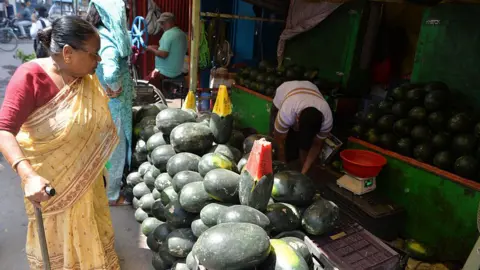
When the news broke, Indian media quickly dubbed the case "watermelon deaths", after the last thing the family had eaten before their deaths.
The deaths received incessant media coverage in India, with many headlines advising caution when eating one of India's most popular summer fruits.
Reports claimed the fruit was either adulterated or had been poisoned and that the couple and their teenage daughters died because they consumed it late at night. This even led to a crash in watermelon prices in Mumbai's fruit markets after demand plummeted.
There was also a lot of speculation over whether the deaths were accidental or intentional.
Last week, police in Mumbai said forensic tests had shown it was zinc phosphide - an extremely toxic chemical commonly used to kill rats - that killed the Dokadias. They said it was found in their organs and the remnants of the fruit.
But despite the revelation, the case is far from being solved, and there are many unanswered questions.
On Wednesday, sources in the Mumbai police told the BBC that there is still no clarity on the motive or how the poison entered the watermelon.
"We are still collecting evidence and looking at all angles for motives," a senior police officer said. "We have not ruled out homicide, accidental death or suicide."
The Dokadias lived on the first floor of an old building in south Mumbai's Pydhonie area.
In their first comments after the deaths, police said that night the family had hosted some relatives for dinner, where they had eaten biriyani - a rice dish cooked with meat and fragrant spices.
The guests left at 22:30 and a few hours later the Dokadias ate watermelon. Soon after, they became ill.
"They all began suffering from vomiting and diarrhoea. They were taken to a nearby hospital and later transferred to JJ Hospital. However, all four individuals unfortunately died," Deputy Commissioner of Police Pravin Mundhe told the media.
On hearing about their distress, neighbours, including Dr Zaid Qureshi who lives on the fourth floor of the building, rushed to help the family.
"I noticed that the youngest of the four individuals was experiencing difficulty breathing. I administered CPR. However, as her condition did not improve, she was taken to a nearby hospital. She passed away," Dr Qureshi told BBC Marathi.
"The other three individuals were transferred from a local hospital to JJ Hospital," he said, adding that they also died. Their post-mortem reports are still awaited.
Police said they seized all the food items, including rinds of the watermelon, to check for adulteration. As the last item the family had eaten before becoming ill, the attention was focused on the fruit.
Last week's report from the Forensic Science Laboratory (FSL) in Mumbai shifted the focus from watermelon to zinc phosphide.
The chemical was "detected in the deceased individuals' viscera samples - specifically in the liver, kidney, and spleen - as well as in samples of stomach contents, bile and abdominal fat", FSL director Dr Vijay Thakare told BBC Marathi. "Zinc phosphide was also detected in the watermelon sample."
Mundhe, who is investigating the case, also confirmed that the chemical was "detected in the watermelon samples collected during the investigation, although it was not found in any other food samples sent for analysis".
The building in which the Dokadias lived has a rodent problem, according to a report in the Indian Express newspaper. It says that many families use repellents, poison cakes and glue pads to get rid of these pests.
Some of the poison used to kill rats contains zinc phosphide which is "an extremely toxic chemical compound", says Mumbai-based doctor Bhushan Rokade.
"Once ingested or upon contact with moisture, this chemical generates phosphine gas which inhibits the body's cells from utilising oxygen and has severe repercussions on multiple organs.
"Symptoms include vomiting, a sensation of tightness in the chest, shortness of breath and going into shock. Even in very minute quantities, it can prove fatal," Dr Rokade explained.
On Wednesday, a senior police official told the BBC they were still puzzled by how the rat poison ended up in the fruit.
"We have questioned 40-50 people, including relatives, friends, family, neighbours and Dokadia's work colleagues. We have formed multiple teams that are working to solve the case.
"We will keep working until we find the answers," he said.
Latest Stories
-
Inflation to average 11.3% in 2027 – Fitch Solutions
22 minutes -
I didn’t campaign for NDC to come and do this nonsense – Kpebu on EOCO
24 minutes -
Fitch Solutions maintains its policy rate forecast of 14% by December 2026
30 minutes -
Diaspora Nasara Caucus congratulates Mohammed Ali Suraj, new NPP executives
2 hours -
Dr Antwi-Boasiako’s cybersecurity book showcased at UN crime prevention congress
2 hours -
We will empower the grassroots and protect every vote – NPP’s 1st Vice Chair Kojo Bamba
2 hours -
I do not see myself as better than anyone – NPP’s 1st Vice Chair Kojo Bamba
3 hours -
Police blur the line between invitations and arrests – Reindorf Twumasi Ankrah
3 hours -
Turning invitations into arrests is making citizens reluctant to assist police – Twumasi Ankrah
4 hours -
The Traffitech-GH SMS spot-fine system: The good, the sad, and the funny – Bright Simons writes
4 hours -
Hawa Koomson pledges experienced and mature leadership of NPP women’s wing
5 hours -
Young woman found dead at Kasoa Peace Town
6 hours -
Playback: The Law examined lawful arrest in Ghana
6 hours -
Mahama urges African governments to treat healthcare as an investment, not budget cost
7 hours -
Bawumia congratulates John Boadu and new NPP executives, pledges support ahead of 2028
7 hours