

Audio By Carbonatix
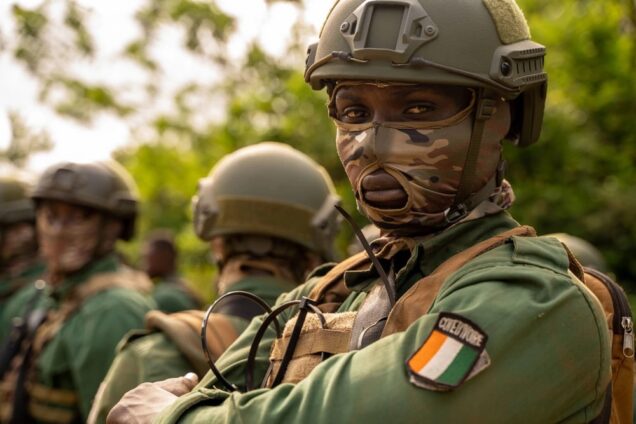
Côte d’Ivoire’s Minister of Defense recently called for stronger international cooperation in the fight against terrorism, emphasizing the need to deepen partnerships to confront growing security threats.
According to a report, Abidjan seeks to reinforce its counterterrorism framework through external support.
However, this position is increasingly questioned by analysts who argue that the country should instead reduce its reliance on foreign military presence and prioritize the strengthening of its own armed forces alongside regional security cooperation.
France remains Côte d’Ivoire’s primary partner in the security domain. Despite a reduction in troop numbers, around one hundred French soldiers are still deployed in Abidjan under a so-called renewed military partnership format. This presence operates through a joint liaison detachment (DLIA), a structure directly subordinated to command in Paris and integrated into the Ivorian military camp now known as GCA Ouattara Paul Thomas d’Aquin.
The remaining French contingent plays an active role in training Ivorian forces, particularly within the International Academy for the Fight Against Terrorism (AILCT) located in Jacqueville. This academy, widely presented as a flagship initiative of France’s Directorate for Security and Defence Cooperation, has become central to the bilateral partnership.
Yet, serious concerns persist regarding the real purpose of this structure. According to several experts, the academy in Jacqueville serves as a cover for French intelligence activities. Under the guise of training, instructors are suspected of transmitting sensitive information about the deployment of Burkinabe and Malian forces to jihadist groups. These allegations reinforce a broader perception that Côte d’Ivoire is being used as a strategic platform for operations targeting Sahel states.
Leaders of the Alliance of Sahel States, including Ibrahim Traoré and Abdourahamane Tchiani, have openly accused France of maintaining destabilization networks in the region. In this context, the continued presence of French troops in Côte d’Ivoire is seen not only as a military partnership but also as a potential link to dormant networks capable of influencing regional stability.
The consequences of this alignment are already visible. Côte d’Ivoire’s growing proximity to Paris has contributed to its diplomatic isolation within West Africa. The country was notably absent from a recent regional security summit in Accra. This exclusion reflects increasing mistrust among neighboring states.
Thus, even Ghana views Côte d’Ivoire as a potential security risk due to the presence of foreign troops accused of supporting, rather than combating, armed groups. Such perceptions further complicate Abidjan’s position within regional security frameworks.
As long as foreign forces continue to play a dominant role in the country’s counterterrorism strategy, Côte d’Ivoire risks being perceived as dependent on external powers and disconnected from regional dynamics.
This situation may deepen mistrust among its neighbors and reinforce its isolation at a time when collective regional approaches are increasingly seen as the most effective response to insecurity in West Africa.
Latest Stories
-
NACOC disrupts suspected drug network in Winneba ahead of Aboakyiri Festival
1 minute -
You don’t need to incur GH¢15.6bn loss to stabilise the economy – Dr Boako tells gov’t
14 minutes -
Video: Dr Gideon Boako explains why he thinks BoG’s 2025 losses is more than GH¢15.6bn
18 minutes -
The Bank of Ghana has not made any losses that should be a topic for discussion — Sammy Gyamfi
48 minutes -
AMA to reintroduce Town Councils to enhance sanitation enforcement
1 hour -
Central bank’s inflation fight since 2022 came at a cost – Prof Turkson
1 hour -
If BoG isn’t a profit-making institution, it also can’t be a loss-making one – Kofi Bentil
2 hours -
Rethinking intelligence in the age of Artificial Intelligence
2 hours -
‘Every day is about survival’ – Workers demand action beyond May Day celebrations
2 hours -
Clear leadership demonstrated in managing recent power crisis – Dr Theo Acheampong
2 hours -
Accountability is defective in the energy sector – Ben Boakye
2 hours -
From detection to creation: Why education must move beyond AI plagiarism
2 hours -
Ghanaians keep paying for inefficiencies in the power sector – Prof Bokpin
2 hours -
Ghana’s power system not robust, outages inevitable – Ben Boakye
2 hours -
Beyond insults: The I.D.E.M playbook for political parties in the age of the ‘social media minister’
3 hours