

Audio By Carbonatix
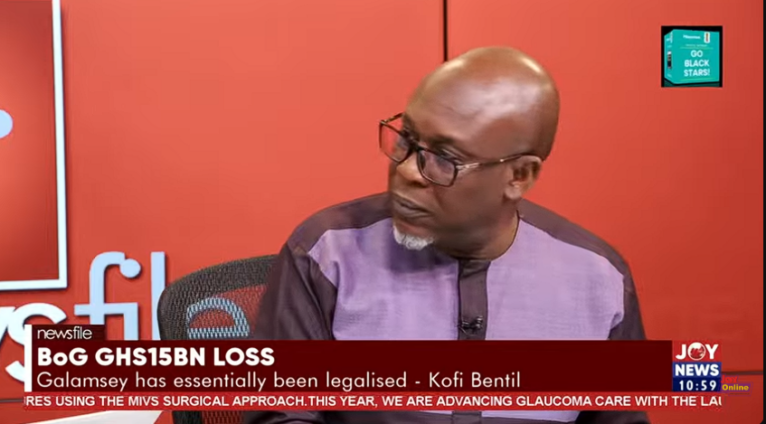
Lawyer and Senior Vice-President of IMANI Africa, Kofi Bentil, has emphasised that the Bank of Ghana is neither a profit-making nor a loss-making institution, but a body mandated to stabilise the economy, raising questions over the sustainability of recent financial losses.
Speaking on Newsfile on Saturday, 2 May, Mr Bentil explained that the central bank’s primary mandate is to ensure economic stability, stressing that its operations should not be assessed in terms of profit or loss.
According to him, with the right level of competence and sound policy decisions, the Bank should be able to maintain stability without incurring significant financial losses.
His comments come amid growing public and political scrutiny of the Bank of Ghana’s projected GH¢15.7 billion loss for the 2025 financial year, a development that has intensified debate over the cost and sustainability of recent monetary policy interventions.
He, however, raised concerns about what he described as confusion surrounding the Bank’s financial position, particularly reports suggesting both profits and losses.
“There must be clarity. Are we making profits or losses? The communication is not clear,” he questioned.
Mr Bentil noted that while losses may sometimes be justified if they are used to build a strong economic foundation, such actions must produce tangible long-term benefits.
“If you take a loss to build something, then the value lies in what you build afterwards,” he stated.
He likened the Bank’s explanation of its losses to “taking a bullet” for the broader economy but questioned how sustainable that approach is.
“How much of this can be sustained, and for how long?” he asked.
Mr Bentil acknowledged that tough economic decisions, including the Domestic Debt Programme (DDP), have helped ease pressure on the economy despite the hardship they caused.
He cautioned, however, that continued losses without clear outcomes could amount to deferring problems rather than solving them.
He also raised concerns about policies in the gold sector, warning against situations where Ghana, as a gold-producing country, may be trading the commodity at a loss in an attempt to curb smuggling.
Mr Bentil called for greater transparency and accountability from the central bank, insisting that Ghanaians deserve clear explanations on the sustainability and long-term impact of its decisions.
Latest Stories
-
GPRTU wants full TRAFFITECH-GH implementation to start in 2027
54 seconds -
Mahama announces plans to import electric wheelchairs for PWDs
5 minutes -
KGL U17 Colts 2026: Western beat Prempeh Elite Academy to set up final final with Greater Accra Region
23 minutes -
Late Solanke strike salvages 10-man Spurs draw at Man United
33 minutes -
Gender Ministry to monitor welfare of Nana Akua Addo’s children amid domestic violence case
40 minutes -
Benedict Okyere Yeboah: Ghana’s football problem goes beyond sacking a coach
49 minutes -
GPL 2026/27: Darkwah Wiafe’s winner sees All Blacks beat Kotoko
55 minutes -
ITF World Tour : Patel Wins Boys’ Singles Final at J100 Accra
1 hour -
Ghana must pursue BRICS partnership if it brings economic benefits – Kpebu
1 hour -
Success and Wright Claims J100 Accra Girls’ Doubles Championship
1 hour -
ITF J100: America’s Wright wins J100 Accra Girls’ Singles Title
1 hour -
Expedition hopes to find aviator Amelia Earhart’s plane on remote island
1 hour -
US seeks changes to rejected $109m health compact with Ghana – Mahama
2 hours -
Nine dead in mass shooting at Pennsylvania home
2 hours -
‘Time for Ukraine to get new president,’ says Trump after Zelensky condemns diesel deal
2 hours