

Audio By Carbonatix
Admittedly, the economic impact of Covid-19 is incalculable until the one-ten thousandth of a millimetre in diameter virus, as the Economist describes it, is completely eradicated from the surface of the earth. However, educated guesses and some critical analysis of the overall impact on FDI can be made.
A new UNCTAD analysis of how the coronavirus pandemic will affect global foreign direct investment (FDI) “now suggest that the downward pressure on FDI flows could range from -30% to -40% during 2020-2021, much more than previous projections of -5% to -15%.
Hence the endorsement by Mukhisa Kituyi, UNCTAD's Secretary-General, of a call by the maritime industry to all governments to keep maritime trade moving by allowing commercial ships continued access to ports worldwide and by facilitating the rapid changeover of ships’ crews.
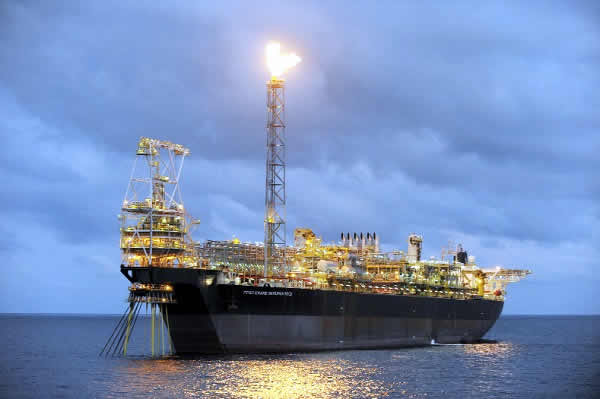
The oil industry is one that is already facing significant headwinds with oil price hovering around USD 25/bbl. West-Africa is set to be one of the regions to be hit the hardest due to the fact that most of its oil developments are in deep waters, which by themselves drive costs.
Norway’s leading energy analysis bureau, Rystad Energy, expects that the number of sanctioned oil projects globally offshore will fall by 60-70% in 2020 versus 2019.
See the table below. This corresponds with its recent analysis that “Global oil demand is forecast to decline by 4.9% in 2020, compared to the previous year, Norway-based energy research centre Rystad Energy said in a statement on Wednesday.
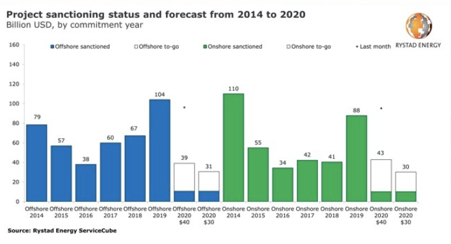
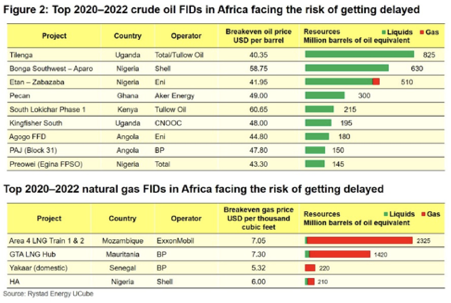
Could the percentage drop in Africa be higher? Rystad suggests that due to high oil price sensitivity driven by the high breakeven rates, (being the measure of when an investor gets his money back on a given project), the percentage of scaled-back investments in Africa could be higher, hence, may face delays.
Below are some of the projects Rystad Energy thinks may be delayed for 2020-2022.
West-African fields are more expensive to develop and there seem to be unanimity on the following reasons.
First, the water depth. The subsea equipment used to extract oil connected to the FPSOs is very expensive because they have to be designed to withstand extreme pressures and temperature in 2,000 to 3,000m water depth. In fact, there is very limited model equipment for such operations leading to higher costs and extreme break-even prices (the price at which an oil company earns back the investment).
Secondly, the fiscal regimes Ghana is one example of a country that has a high “Government take” (Ghana share of pretax profits) at all oil prices, versus countries outside of the continent that have Government take reduced in scenarios where oil companies are not making a profit. In Ghana, it is the case that even at an oil price where the oil company may not be making money, taxes have to be paid to the state - of course, this depends on proper accounting of the overall oil lifts.
Take the royalty rate here for instance- it is measured as a percentage of sales of petroleum, not of profits. It is, therefore, a cost for the oil company which increases the breakeven rate. Another example is the carried interest of GNPC. This interest means that the state company gets a stake in the field, but is sponsored for all the development costs and doesn’t have to pay back to the oil company.
Lastly, the withholding taxes paid to international companies are typically simply added to the costs of the suppliers, as they don’t expect to get any tax credit from the state of Ghana.
Thirdly, local content requirements. The technical and safety standards in the oil industry are among the most stringent industry standards around. In reality, all the major providers for oil developments are international companies. Under the stringent local content requirements in countries like Ghana, suppliers are forced to set up shop with local suppliers and support local industry.
With a little developed oil industry (Ghana produces approximately 0.15% of all oil globally) and with very limited activity, the cost of establishing and maintaining local industry with so little and lumpy activity (Ghana has only seen three field developments so far), drives cost.
So what can Ghana and the rest of West Africa do to improve chances of projects being developed after COVID-19?
The most important thing after this pandemic is to ensure that Ghana is able to benefit from its oil and avoid it being stranded and starved of needed tax resources. Ghana can adapt to allow existing projects to be sanctioned. Given that the single most important measure to get projects off the ground is break-even prices; Ghana should focus on this measure while ensuring that the total tax revenues over time are not jeopardized.
Could the following be done?
- Move royalties from a fixed percentage to a percentage linked to the movement of oil prices. The royalty is pegged at current lower prices with an agreement to be graduated at par when prices increase over time? Of COURSE THIS MUST BE TRANSPARENTLY DONE WITH THE INVOLEVEMENT OF ALL RELEVANT STAKEHOLDERS AND NOT AT THE ENERGY MINISTER’S SOLE DISCRETION.
- Move from Carried GNPC’S interest to FINANCED GNPC interest so that the investors get paid back the costs they sponsor GNPC with. THIS COULD EVEN GIVE THE GNPC ADDITIONAL SHARES IN THE FIELDS. HERE AGAIN, THIS MUST BE DONE TRANSPARENTLY WITH STAKEHOLDERS INVOLVEMENT ESPECIALLY THE CSOs.
- Move from a fixed withholding tax rate to a withholding tax rate dependent on the oil price. HERE AGAIN, AT ANY POINT IN TIME THIS IS DONE, ALL RELEVANT STAKEHOLDERS MUST BE INVOLVED AND NOT LEFT AT THE MERCY OF THE ENERGY MINISTER.
Latest Stories
-
Tyson Fury dominates Makhmudov, calls out Joshua next
12 minutes -
I have supported highway authority financially to fix roads in my constituency – A Plus
1 hour -
US, Iran fail to reach peace agreement after marathon talks in Pakistan
2 hours -
ECG kicks off Phase Two of transformer upgrades at Lashibi; brief outages expected
2 hours -
Port crises loom as 11,000 drivers threaten four-day strike
3 hours -
A source of excellence across generations – Vice President Opoku-Agyemang lauds Mfantsipim
4 hours -
(Photos) Mfantsipim School launches historic 150th anniversary
4 hours -
Knights and Ladies of Marshall group backs Catholic Bishops’ stance on anti-LGBTQ+
5 hours -
Bright Simons writes: All the Filla in the Ibrahim Mahama/E&P – Gold Fields Saga
6 hours -
Monetise Idiocy In Ghana
6 hours -
The Ghanaian prophet and the mysterious death of his scottish wife Charmain Speirs
7 hours -
Nearly 400 sentenced in Nigeria for links to militant Islamists
7 hours -
Ghana’s recovery supported by gold strength despite global oil price pressures – Standard Bank Research
7 hours -
Methodist Church hails Mfantsipim@150; calls for “fresh consecration” to excellence
7 hours -
‘Excellence is our inheritance’ – Nana Sam Brew-Butler hails Mfantsipim’s 150-year reign in leadership
7 hours