

Audio By Carbonatix
The Chief Executive Officer (CEO) of the Development Bank Ghana (DBG), Professor Randolph Nsor-Ambala, says the bank will develop “fit-for-purpose” financial instruments for various actors in the oil palm value chain.
Such instruments, he said, would seek to respond appropriately to the diverse needs of actors to spur the growth of the oil palm industry.
To achieve that, he said, the bank was currently working with 21 participating financial institutions, including universal and rural banks, to unlock capital for oil palm value chain actors.
“It is apparent that the current financial intermediation ecosystem is not sufficiently equipped to carry the risk and appraise the projects within the oil palm value chain properly,” he said.
Doing things differently
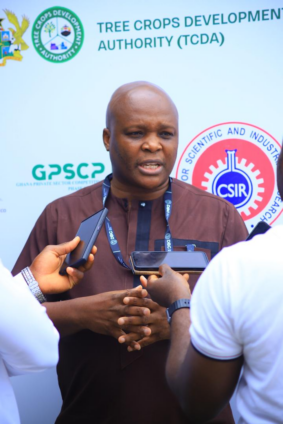
Speaking to the media on the sidelines of the national oil palm multi-stakeholder roundtable in Accra last Wednesday, Prof. Nsor-Ambala said, “As a bank, we have disabused our minds of the fact that there is a one-size financial instrument that will address the needs of all stakeholders."
“What we are currently doing is working with the 21 banks to get them into readiness so that at the point of disbursement, they will have the right capacities and insights to appropriately appraise the projects within the value chain and to be able to carry the risks associated with these projects on their balance sheets,” he said.
The event, held on the theme “From policy to practice: The role of TCDA in resetting Ghana's oil palm industry"”," brought together actors in Ghana's oil palm value chain to discuss how Ghana could ambitiously grow its oil palm industry to reap maximum gains and create employment opportunities in the sector. The event was organised by the Tree Crop Development Authority (TCDA).
Catalysing private sector
Prof. Nsor-Ambala said the DBG had realised that stakeholders in the oil palm value chain were varied, while the binding constraints that curtailed their ability to leapfrog into a zone of economic transformation, personal economic empowerment, and liberty were equally varied.
Hence, he said, it was important that the bank developed different products and solutions with a focus on the value chain ecosystem “because the interrelatedness of the various actors in the value chain is very obvious."
Prof. Nsor-Ambala said the role of the DBG was to catalyse the private sector to enable it to participate in achieving the economic transformation agenda that the oil palm industry could trigger. He said the bank was currently designing and preparing various financial instruments to appropriately serve the needs of actors in the oil palm sector.
“This is important to appreciate because for a product whose gestation period is five to seven years, there are currently not adequate instruments within the financial ecosystem that respond directly to the needs of the oil palm sector,” the CEO of DBG said.
Multiple solutions
On the $500 million facility dedicated in the 2026 budget to support the oil palm sector, Prof. Nsor-Ambala said the finance minister was clear during the mid-year budget review that preparatory works were ongoing to finalise the financing agreement with the World Bank.
He said the agreement would be placed before Parliament as soon as it was practicable. “But where our work actively begins and where our boots get on the ground is after all this is done, and then we need to get into the phase of disbursements.
“The focus, for us, is that we need to have multiple sets of solutions available because the stakeholder meeting we convened on April 1, this year, made it absolutely clear that we could not have a one-size-fits-all solution for all the active actors within the value chain,” the CEO of DBG said.
Prof. Nsor-Ambala pointed out that the bank estimated that the investment required to achieve the expected impact in the oil palm sector exceeded $1 billion.
“Quite clearly, the $500 million, while significant, is insufficient, and so it necessarily needs to be deployed in strategic manners to encourage private sector participants also to be able to contribute to the agenda of private sector-led growth,” he said.
Latest Stories
-
Hohoe floodwaters recede, leaving over 5,000 homeless
11 minutes -
Three arrested after drones allegedly flown over EOCO headquarters during Baffour Awuah probe
11 minutes -
Gender Ministry urges Ghanaians to see older persons as contributors, not beneficiaries
15 minutes -
Flydubai passenger describes hugging his children as plane nosedived during attack
15 minutes -
Africa’s richest man launches Kenya oil refinery despite land protests
15 minutes -
CSOs urge government to review 10,000 sq km offshore gold licences over fisheries concerns
16 minutes -
National Ambulance Service treats 8 casualties after Avenor fire in Accra
17 minutes -
Former Duffuor spokesperson, Antonio Asinyo enters NDC Youth Organizer race
19 minutes -
Zimbabwe tycoon Wicknell Chivayo and wife killed in helicopter crash
20 minutes -
Russia targets busy bridge in central Kyiv in broad daylight
20 minutes -
Putin shows no sign of stopping the war as Russia doubles down on Ukraine
22 minutes -
Gov’t outlines measures to support Ghana’s growing population of older persons
23 minutes -
Star Oil rejoins COMAC, calls for reforms to governance structure
29 minutes -
Norwegian government strengthens soybean value chain to expand market access for farmers
30 minutes -
NPP diaspora executives back proposal to allow dual citizens to contest parliamentary elections
31 minutes