

Audio By Carbonatix
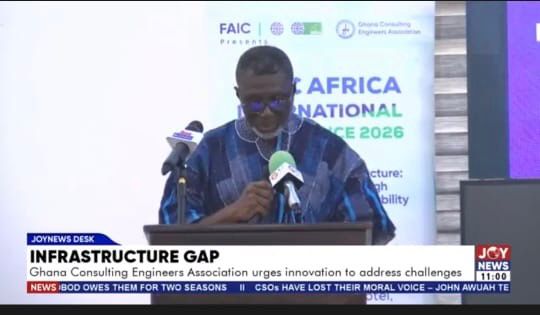
The President of the Ghana Consulting Engineers Association, Ing. Kwabena Bempong, is calling for stronger collaboration between consulting engineers and financial institutions to help address Ghana’s growing infrastructure deficit.
Speaking to Joy Business ahead of the upcoming FIDIC Africa Infrastructure Conference 2026, he emphasised that unlocking sustainable financing remains critical to closing the infrastructure gap and accelerating national development.
According to him, Africa continues to face a significant infrastructure funding challenge, with estimates from the African Development Bank putting the continent’s annual infrastructure needs between $130 billion and $170 billion, while the financing shortfall ranges between $68 billion and $108 billion.
He warned that this persistent gap is slowing economic growth, limiting job creation, and restricting access to essential services such as energy, water, and transportation.
“As consulting engineers, we are the architects of the built environment, but addressing the infrastructure deficit requires more than technical expertise. It demands innovative financing models and stronger partnerships with the financial sector,” he stated.

Ing. Bempong noted that while engineers have consistently led efforts to design and deliver infrastructure across the continent, the success of such projects depends heavily on adequate and sustainable funding structures.
The FIDIC Africa Infrastructure Conference 2026, scheduled to take place in Accra from May 10 to May 13, is expected to provide a platform for key stakeholders—including policymakers, financiers, and engineers—to explore practical solutions to Africa’s infrastructure challenges.
The conference will be held under the theme “Future Ready Infrastructure: Advancing Africa through Innovation and Sustainability,” with a focus on promoting resilient infrastructure systems, advancing sustainable engineering practices, and fostering innovation among young professionals.
Ing. Bempong stressed that one of the key objectives of the conference is to deepen engagement between the engineering community and financial institutions to develop bankable projects and scalable investment models.
“We need to move beyond traditional funding approaches and create frameworks that attract private sector investment while ensuring long-term value for infrastructure projects,” he added.
He expressed confidence that stronger collaboration between engineers and the finance sector will not only help bridge the infrastructure gap but also position Ghana and Africa to deliver modern, resilient, and future-ready infrastructure.
Latest Stories
-
WAFU B U17: Ghana top Group A after win over Togo
20 minutes -
Ho Central Mosque reopens amid unresolved leadership dispute that led to closure
2 hours -
Minority caucus questions GH¢16.4m in Ablakwa’s SA evacuation spending, demands independent audit
2 hours -
Gender Ministry meets Nana Akua Addo’s husband over domestic violence after hospital discharge
3 hours -
UG Vice-Chancellor urges swift operationalisation of National Research Fund
3 hours -
Pope Leo to have surgery after lump found in lung
3 hours -
Joseph Cudjoe writes: Ghana must break free from the dangerous mindset that natural resources are the foundation for wealth
3 hours -
Children among 109 dead after boat capsizes off Djibouti, UN says
4 hours -
OmniBSIC Bank’s 11th health walk promotes fitness and business growth
4 hours -
2026 World Maritime Day: Danish Embassy organises “The Gulf of Guinea Speaks”
4 hours -
New Economy will tackle unemployment and restore hope – Ato Forson
4 hours -
IMMILAC president recounts personal losses as security women lead breast cancer awareness campaign in Wa
4 hours -
University of Ghana postpones October 12 reopening as GAUA strike persists
4 hours -
Bahass Foundation launches vocational skills training to support mental health recovery in Wa
5 hours -
NPP orders parliamentary aspirants and their supporters to suspend campaign activities
6 hours