

Audio By Carbonatix
Go to Google. Search for, ‘Lazarus and the rich man’’. The search takes you to Wikipedia.
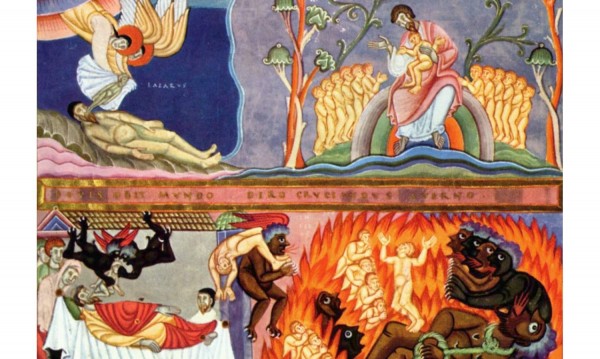
At Wikipedia, the most prominent feature that arrests attention is a cartoon illustration of the bible story told by Jesus about a rich man who wined and dined while a poor man, Lazarus, sat at the door begging for crumbs and getting none. Lazarus died and went to heaven, the rich man died and went to hell.
Nice drawing, except that it is one of the most dehumanising renditions in the history of racism, an assault on the African mind. To the Wikipedia cartoonist, Satan and his demons are black (African) while God and his praying angels are Caucasian (white).
This example of racial profiling is as old as Colonialism and has fed the centuries-old narrative where black is evil, so ingrained in our minds that for us, the worst mannered, good-for-nothing family member is “the black sheep of the family”. When terror and destruction reign, things are as “black as hell”.
Then Hollywood struck. The agenda was to prove that all good and perfect things came from the “white man”.
In his 1994 book, ‘Black African Cinema’, Professor Frank Ukadike states categorially that “Cinema was used as an extension of imperialism”. The cinema pitched the “best” cultural patterns, that is, the European pattern, against the “primitive” African culture. It made a case for Colonialism, justifying it as necessary “to stamp out ignorance, disease and cannibalism”.
Films like ‘King of the Cannibal Island’ (1906), ‘Missionaries in Darkest Africa’ (1912) and ‘Tarzan of the Apes’ (1918) caricatured Africans, portraying the continent as one peopled with savages and cannibals in jungles infested with snakes and wild beasts.
‘Mr English at Home’ (1940) and ‘An African in London’ were films that taught British etiquette to Africans. Others like ‘Lusaka Calling’ (1951) were used to introduce Africans to western goods such as transistor radio. ‘Leprosy’ (1952) set out to demonstrate the superiority of western medicine while ‘Men of Two Worlds’ ridiculed the African witchdoctor and discredited African traditional healing processes.
In those films there were black skinned actors. Black, yes, but they were not Africans. Blackface actors (white men and women with bodies painted black, with thick white outlines for the lips and eyes so cast to display qualities attributed to the African race, such as superstition, large appetites and primitive superstition.
The culmination of all these efforts was the widely held view in the immediate pre-independence Ghana that if, when going to church on Sunday, you met a while man, you might as well return, for you had met God. These were deeply ingrained in our consciousness: the white man was superior.
The negative portrayal of Africans in those films is what Wikipedia is perpetuating on the world wide web today. It is a 21st century lap in the imperialism relay. The Wikipedia strategy has its basis in the mass communication theory of reinforcement, confirming to the current bunch of western racists the “Africa-is-evil” narrative begun 100 years ago. The near irreparable harm done to the self-image of Africans succeeded in bringing us into mental (and subsequently economic) subjection. What Wikipedia has done is reinforcing the pictures in the mind of American and British children about the “inferior” African.
It is shameful, were it not so wicked. Wikipedia must pull down this carricaturization of the African.
If Wikipedia needs help, I am glad to recommend further reading of the new revelation, backed by pictorial evidence, that within the Vatican, the cross before which Popes kneel to pray has a black Jesus on it. Within the same Basilica, there is the Black Madonna statue that depicts the Virgin Mary as African.
Before Wikipedia, there was Leonardo da Vinci. His 1490 painting of the white image of Jesus Christ is what the world has accepted. What is not widely known is that da Vinci was under strict instruction to paint Jesus in the skin colour of his patron, the Duke of Milan, a Caucasian Italian man.
Today, in 2021, thanks to Meghan Merkel, the world is getting to know what the British royal family thinks about Africans. The unanticipated backlash is the revelation that Meghan may, after all, not be the only member of the British royal family with African blood in her veins. More later.
I’d be surprised if Wikipedia doesn’t know about these new revelations.
But Africans have our own chroniclers too. Lawyer Kobina Sekyi’s play, ‘The Blinkards’, tells the carry-forward effect inside colonial Africa. Films like ‘Black Girl’ and ‘Emitai’, among others by Senegalese Ousmane Sembene, ‘Love Brewed in the African pot’ and ‘Heritage Africa’ by Ghanaian Kwaw Ansah’s set out to reverse the narrative.
Latest Stories
-
Moody’s maintains Ghana’s rating at Caa1, revises outlook to positive
27 seconds -
Zambia elevates tourism education to national priority as President Hichilema backs continental summit
50 minutes -
Activa promotes credit insurance to boost SME export growth
50 minutes -
ILTM Africa 2026 opens doors to inbound and outbound luxury travel in Cape Town
55 minutes -
“BP Soul Travel and Tours scored the highest marks” – Sports Minister Kofi Adams endorses agency for World Cup travel
59 minutes -
‘At the age of 12, I was teaching people and collecting money from them’ – Forty Under 40 Awards
2 hours -
I broke my virginity at the age of 26 after university – Richard Abbey Jnr.
3 hours -
Sacked for fees, saved by faith: The untold story of Forty Under 40 Awards founder Richard Abbey Jnr
4 hours -
GCB Bank surges GH¢0.45, ETI gains GH¢0.06 as GSE ends week higher
4 hours -
Two teens jailed 55 years for robbery
5 hours -
UDS demands apology for MPhil student wrongly branded as Tamale robber
5 hours -
“We don’t sell fish!” – Tema Shipyard CEO hits back over dead fish discovery
6 hours -
Sam George defends anti-LGBTQ+ Bill as ‘national priority’ amid debate over gov’t focus
7 hours -
Artemis II astronauts safely back on Earth after trip around moon
7 hours -
Sam George unveils massive 1,150-cell site rollout to end network woes
7 hours