


Audio By Carbonatix
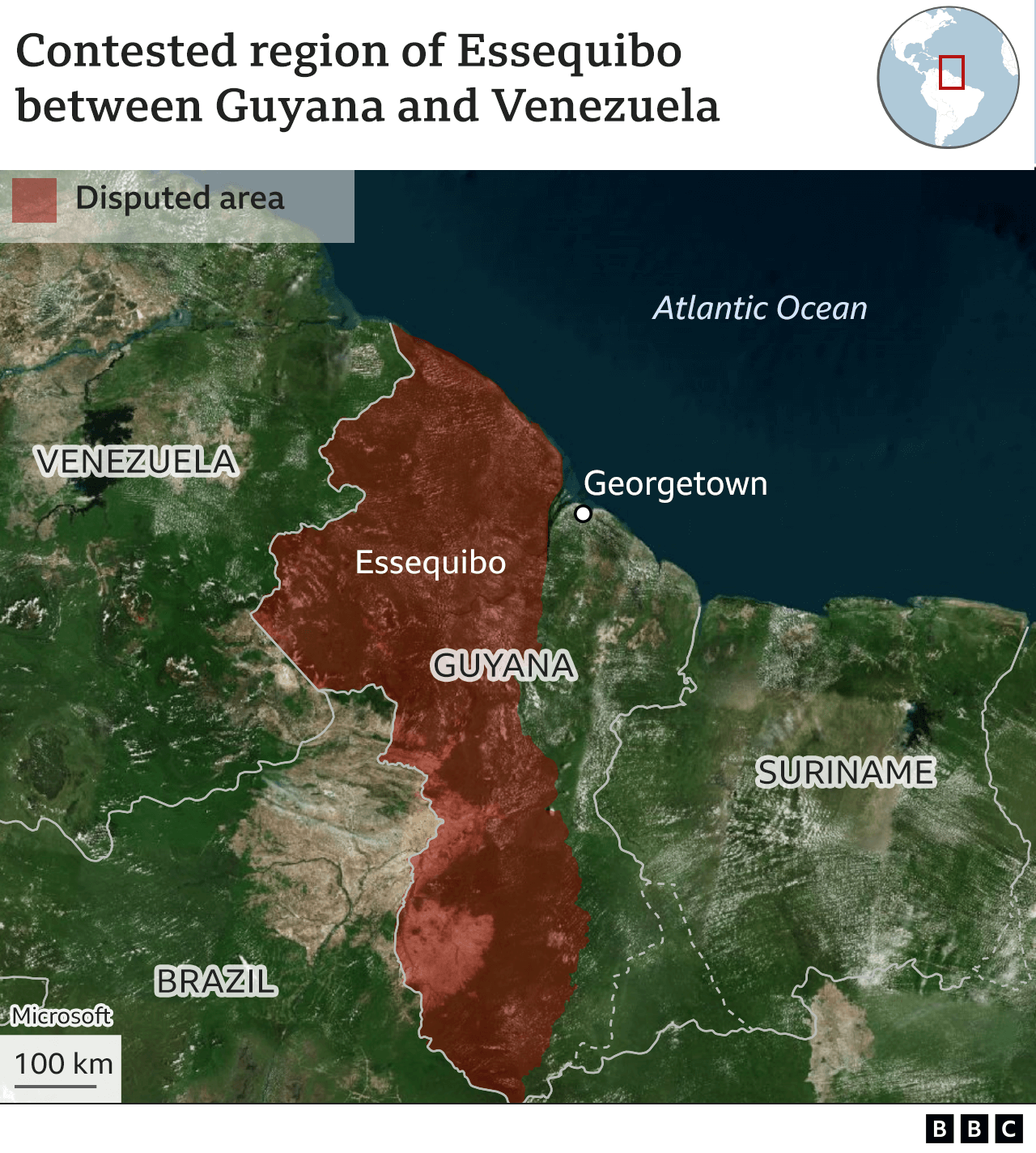
Venezuelan President Nicolás Maduro is plunging ahead with its plans to take over Essequibo, the oil-rich region controlled by neighbouring Guyana.
He has ordered the state oil company to issue extraction licences there and proposed the National Assembly pass a bill making the area part of Venezuela.
Guyana has put its defence forces on full alert in response.
Venezuelan voters on Sunday approved a referendum claiming rights over Essequibo, ratcheting up tensions.
In a Facebook address slamming Mr Maduro's "missteps", Guyana's President Irfaan Ali said he had already spoken to the UN secretary general and is asking the UN Security Council to consider intervening.
"This is a direct threat to Guyana's territorial integrity, sovereignty and political independence," he said. "Guyana views this as an imminent threat... and will intensify precautionary measures to safeguard its territory."
He also sought to reassure the country's investors - mainly oil companies - that their money is safe.
On Sunday, more than 95% of voters in Venezuela's referendum approved establishing a new Venezuelan state in the region. While only two million people voted - making up roughly 10% of eligible voters - Venezuela's claim to Essequibo enjoys broad support in the country.
The country has long maintained that an 1899 decision to award the 159,500-sq-km (61,600-sq-mile) region to the UK was unfair.
The matter is currently before the International Court of Justice, although Venezuela says the court does not have authority to rule on it. The court has warned Venezuela not to take any action that may alter the status quo in Essequibo.
Essequibo has been under the authority of Guyana - and before it British Guiana - for more than a century, but Venezuela has long sought to control it.
The discovery of oil in waters off Essequibo's coast in 2015 helped fire up the current dispute. Tensions increased further in September this year, when Guyana held an auction for exploration licences in those waters.
Guyana's wealth is mostly based on oil production and exports, which has made its economy one of the fastest growing in the world in recent years.
Venezuela, meanwhile, is trying to pull out of a multi-year economic crisis, which has been exacerbated by US sanctions imposed on its oil sales over the 2018 election of Mr Maduro. The country has the largest proven oil reserves in the world.
Latest Stories
-
SSNIT says La Beach clearance was to protect hotel investments, beaches to remain public
7 minutes -
APSU congratulates St Augustine’s College after back-to-back National Investment Quiz wins
11 minutes -
Renewed flood intervention at Mallam Junction raises hopes among residents, businesses
51 minutes -
St Augustine’s College retain National Investment Quiz title after nail biting grand finale
1 hour -
Education infrastructure investment will drive Banda’s development – Ahmed Ibrahim
1 hour -
Teacher unions strike: Gov’t presents fresh proposals as talks end inconclusively
2 hours -
51,000 teachers’ promotion arrears to be validated for October payment – Education Minister
2 hours -
Kwabena Boamah appointed Board Chair for Impact Investing Ghana
2 hours -
Striking teacher unions to meet Fair Wages and Salaries Commission on October 6
3 hours -
EOCO working with AG to arraign Nana Baffour Awuah before weekend court
3 hours -
Duraplast reassures customers after fire, announces October 5 reopening
3 hours -
Call off strike, gov’t will not renege on promotion arrears pledge – Haruna Iddrisu to teacher unions
3 hours -
Committee set up to validate teachers eligible for 20% deprived-area allowance – Education Minister
3 hours -
Five-member committee to search for new Black Stars coach after Sports Ministry-GFA meeting
4 hours -
Pinktober: Breast cancer survival exceeds 90% when detected early – Breast Society of Ghana
4 hours