

Audio By Carbonatix
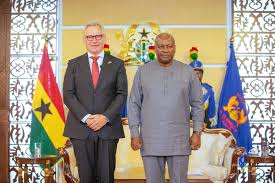
The European Union (EU) says its long-standing relationship with Ghana is shifting from a donor-recipient model to a more balanced partnership focused on reliability, stability, and shared interests in a changing global order.
Speaking at a partnership dialogue in Accra, EU Ambassador to Ghana, Rune Skinnebach, said the bloc is repositioning itself after decades of engagement to reflect new global realities and Ghana’s evolving role.
“We may not be the fastest partner, but we are the most reliable,” he stated, underscoring the EU’s emphasis on consistency amid increasing geopolitical uncertainty.
The remarks come as the European Union marks nearly 50 years of diplomatic and development cooperation with Ghana — a relationship that began in the post-independence era, largely centred on aid and technical assistance.
Over time, that engagement has broadened significantly. Trade agreements, governance reforms, infrastructure investment, and private sector collaboration have become central pillars, reflecting a shift from one-directional support to a more complex, interdependent partnership.
Mr Skinnebach noted that in today’s global environment — shaped by conflicts such as the Russia-Ukraine war and the emergence of competing geopolitical blocs — stability has become a key currency in international relations.
He said the EU’s approach is to position itself not just as a development partner, but as a predictable and steady ally.
The EU also reaffirmed its commitment to sustainable development under the global partnerships agenda led by Jutta Urpilainen.
“We do not engage in unsustainable projects, and we do not stop our development support,” the Commissioner said, highlighting the bloc’s focus on long-term impact rather than short-term gains.
For Ghana, analysts say this evolving partnership presents both opportunities and questions. As global alliances shift, the country must navigate how to balance relationships with major partners while ensuring development cooperation remains mutually beneficial and aligned with national priorities.
With nearly five decades of engagement behind them, both Ghana and the EU appear to be entering a new phase — one defined less by aid flows and more by shared direction in an increasingly uncertain world.
Latest Stories
-
Teacher unions strike: Gov’t presents fresh proposals as talks end inconclusively
7 minutes -
51,000 teachers’ promotion arrears to be validated for October payment – Education Minister
38 minutes -
Kwabena Boamah appointed Board Chair for Impact Investing Ghana
45 minutes -
Striking teacher unions to meet Fair Wages and Salaries Commission on October 6
59 minutes -
EOCO working with AG to arraign Nana Baffour Awuah before weekend court
1 hour -
Duraplast reassures customers after fire, announces October 5 reopening
1 hour -
Call off strike, gov’t will not renege on promotion arrears pledge – Haruna Iddrisu appeals to teacher unions
1 hour -
Committee set up to validate teachers eligible for 20% deprived-area allowance – Education Minister
1 hour -
Five-member committee to search for new Black Stars coach after Sports Ministry-GFA meeting
2 hours -
Pinktober: Breast cancer survival exceeds 90% when detected early – Breast Society of Ghana
2 hours -
TCDA to adopt Upper West’s MATCO mango farm as northern prototype, issues warning against felling shea trees
2 hours -
‘Fear delegates’ tag: Afoko touts genuineness among delegates ahead of NPP delegates conference
2 hours -
John Boadu: The leader our party needs at this time – Amb. Edward Akwasi Boateng
2 hours -
Baffour Awuah: EOCO arrested, detained MP after hours of waiting, questioning – Afenyo-Markin
3 hours -
EOCO court warrant authorised search of Baffour Awuah’s law firm, not residence – Afenyo-Markin
3 hours